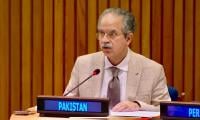
Aurangzeb sees deal on $1.2bn IMF payout this week
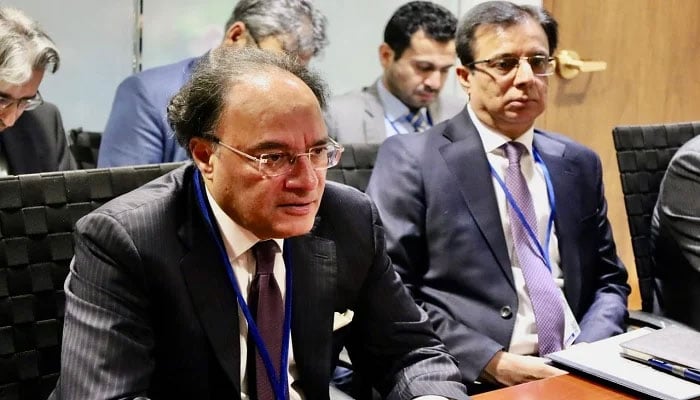
ISLAMABAD: Minister for Finance and Revenue Muhammad Aurangzeb Tuesday said Pakistan was poised to sign a preliminary deal on a review of its loan programme with the International Monetary Fund (IMF) this week, a key step required to pave the way for another $1.24 billion payout from the lender.
Aurangzeb, who is currently visiting Washington to attend the annual meetings of the Bretton Woods Institutions (BWIs) — the IMF and World Bank — stated in his interview with Reuters that Pakistan is expected to sign an SLA with the IMF this week.
Pakistan and the IMF held parleys from September 25 to October 8, 2025, under a $7 billion Extended Fund Facility (EFF) and a $1.4 billion Resilience Sustainability Facility (RSF), but could not strike a staff-level agreement. After signing the SLA, the IMF’s Executive Board is expected to consider the request for approval of the next tranche in a four to six-week period.
“The [IMF] mission was on the ground for a couple of weeks, we had very constructive dialogue with them around the quantitative benchmarks, the structural benchmarks, and we’ve been having some follow-up discussions,” the minister told Reuters during an interview on the sidelines of the IMF and World Bank annual meetings.
Aurangzeb said: “During the course of this week, we’re hoping that we can get the SLA done.”
He expected the government would launch a Green Panda bond — the first one denominated in Chinese yuan for Pakistan — before year-end and return to international markets next year with a bond sale of at least $1 billion, though details were still to be decided.
“Euro, dollar, Sukuk, Islam Sukuk — we’re keeping our options open,” he said.
Meanwhile, the privatisation push -- part of a long-delayed sale of state assets under an economic reform and fiscal stabilisation agenda -- was expected to gain traction in the fiscal year ending June after disappointing results last year. “This is very important as part of our economic roadmap,” he said.
Pakistan was also making progress on the sale of three power distribution companies (Discos) and the national carrier, Pakistan International Airlines (PIA).
“We are quite hopeful,” Aurangzeb said, citing prospects for qualified bidders for PIA after lucrative routes to Europe and Britain were opened, which made it “a very good proposition for the investors.”
The transaction would mark the country’s first major privatisation in about two decades. A previous attempt collapsed last year after a single lowball offer was received; however, the government has since drawn interest from five domestic business groups, including Airblue, Lucky Cement, investment firm Arif Habib and Fauji Fertilizer. Final bids are expected later this year.
Meanwhile, the finance minister and his delegation had a key meeting with Jihad Azour, Director of the IMF’s Middle East and Central Asia Department, and his team. Both sides exchanged views on Pakistan’s reform agenda and reaffirmed their shared commitment to sustaining the current momentum of reforms. The meeting reviewed progress under the Second Review of the EFF and acknowledged the importance of maintaining macroeconomic discipline. The sources stated that this meeting raised hopes for striking the SLA this week.
The minister for finance and revenue, meanwhile, participated in a high-level discussion titled “AgriConnect: Farms, Firms, and Finance for Jobs” organised by the World Bank Group on the sidelines of the 2025 World Bank Group–IMF Annual Meetings in Washington.
The session brought together global policymakers and experts including Ajay Banga, President of the World Bank Group, Sergii Marchenko, Minister of Finance of Ukraine, and Mariama Cire Sylla, Minister of Agriculture of Guinea, among others, to deliberate on strengthening family farms which represent nearly half a billion smallholders producing about 80 percent of the world’s food.
During the discussion, Aurangzeb underscored the pivotal role of agriculture in Pakistan’s economy, noting that it accounts for nearly one-fourth of the national GDP and provides livelihoods to millions of small-scale farmers owning less than five hectares of land. He highlighted that the government’s policy focus is on enabling and facilitating rather than controlling the sector, with the aim of allowing the private sector to take the lead in areas where it can perform more effectively.
The minister elaborated on Pakistan’s ongoing efforts to enhance agricultural productivity, improve access to finance, and strengthen the value chain from production and storage to exports. He noted that pilot initiatives have demonstrated positive results through the provision of seeds, fertilizers, agronomy services and satellite-based crop monitoring for small farmers. These interventions have led to improved yields, higher incomes, and reduced dependence on middlemen through the introduction of formal credit mechanisms.
Senator Aurangzeb emphasised the importance of scaling up such initiatives by involving the financial sector and providing institutional support.
Addressing the growing challenges posed by climate change, the finance minister stressed that agriculture and climate are deeply interconnected and that Pakistan is taking proactive measures to build climate resilience in the sector. He pointed out that the recent floods, which caused significant damage to the rice crop, underscore the urgency of adaptation.
In response to questions about private sector participation, Senator Aurangzeb reaffirmed Pakistan’s commitment to continued deregulation and to creating an enabling environment for private investment in cold chain infrastructure, warehousing, and value-added agriculture. He pointed to the strong export potential of Pakistan’s key crops, noting that rice exports alone are expected to reach about 3.5 billion dollars this year.
Earlier, Aurangzeb participated in the G-24 Ministers & Governors’ Meeting convened on Tuesday in Washington. In his address to the meeting, the minister highlighted macroeconomic stability achieved by the country underpinned by structural reforms in taxation with a focus on people, process and technology, energy, SOEs and privatisation.
Meanwhile, the IMF has projected the country’s GDP growth rate at 3.6 percent for the current financial year.
This projection in the World Economic Outlook released from Washington DC by the IMF does not yet reflect the impact of flooding in summer 2025, whose impact is still being assessed. The IMF shows the last fiscal year’s GDP growth at 2.7 percent, despite an upward revision made by the Pakistan Bureau of Statistics (PBS) elevating the growth rate to 3.04 percent in accordance with the finalized numbers.
However, according to the Rapid Need Assessment (RNA) shared virtually with the IMF, the accumulated losses caused by the recent floods stood at Rs744 billion, but it has not yet been validated by the consortium of international creditors, including the World Bank, Asian Development Bank, European Union, and United Nations Development Programme.
Pakistan intends to present the RNA losses before international donors with a request to validate the exact losses caused by the recent floods. This assessment will help Islamabad present its case before the IMF and for the launch of Panda or any other international bonds in Chinese and other Western markets. The IMF might place a validated assessment of floods from international donors as a prior action for presenting Pakistan’s request before its Executive Board in six weeks.
The IMF has projected the GDP growth rate unchanged at 3.6 percent; however, the CPI-based inflation has been lowered to 6 percent in FY26. By the end of FY26, the IMF has estimated that inflation is projected to touch 8 percent, but overall on average it will hover at 6 percent on a year-on-year basis. On unemployment, the IMF has projected that it would stand at 7.5 percent. The current account deficit has been projected at -0.4 percent of GDP in FY26 against a positive 0.5 percent of GDP in FY25.


-
 Aurangzeb confirms Saudi Arabia $10bn interest, says B2B shift ongoing
 -
 Pakistan to build artificial island to boost oil exploration
 -
 Special pink bus service launched for women on Green Line route
 -
 Same number plates from other provinces lead to wrong e-challans for Karachiites
 -
 State institutions ‘fail’ to perform constitutional duties: KP CM
 -
 CTD orders psychological testing of police on VVIP security duty
 -
 Navy busts drug consignment valued at $130m
 -
 Three ex-secretaries in race for ETPB chief post