What Muttaqi’s India visit means for Pakistan
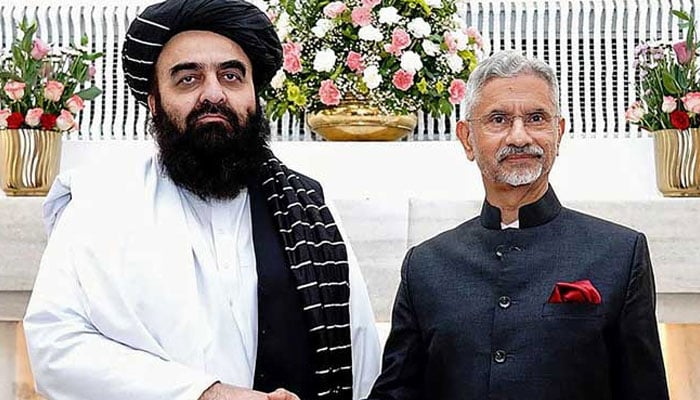
It appears that everything was thoughtfully choreographed. The Afghan Interim Government (AIG) ‘s Foreign Minister Amir Khan Muttaqi would visit New Delhi straight from the Moscow Format Meeting, to be followed by Afghanistan’s security forces’ attack on Pakistan’s border posts in both Khyber Pakhtunkhwa and Balochistan. Both sides suffered human losses, forcing Saudi Arabia, Qatar and Iran to intervene.
Muttaqi’s warning to Pakistan during the press conference in the Afghan embassy in New Delhi – that Pakistan should read Afghan history when it defeated the British, Soviets and the Americans – was quite instructive. Muttaqi’s refusal to admit to the TTP and its leadership’s presence on Afghan soil were equally belligerent, especially when the UN and international human rights organisations have come out with periodic reports on the TTP and other terrorist organisations’ presence in Afghanistan.
It may not be a coincidence that during the Moscow Format meeting, Muttaqi took strong exception to the statement of the quadrilateral meeting – comprising China, Iran, Pakistan and Russia – which expressed concern over the use of Afghan territory by various terrorist organisations, notably the TTP, BLA, ETIM, Al Qaeda and ISKP. However, while in New Delhi, the joint statement alluded to Afghanistan’s stability and the Taliban regime’s ability to control the terrorist threat emanating from Afghan soil.
Muttaqi’s six-day visit to India has already generated numerous speculations about the shifting dynamics in the region. Apparently, the visit, aimed at strengthening relations with India, was overshadowed by tensions between India and Pakistan, as well as between Pakistan and Afghanistan. India tried to portray the visit as an emergence of a new romance with the Taliban, otherwise loathed by the Hindutva dispensation, manifested in anti-Muslim rhetoric and suppression of Muslims in the country.
For India, the success of Muttaqi’s visit would mean more access to Afghanistan and the use of Afghan soil as a launching ground against Pakistan; at least this is the past history of Afghanistan. Whether the Afghan Taliban will be different from their predecessors is yet to be seen.
Second, the visit has been taking place at a time when Pakistan-India relations have plunged to a new low after the four-day war in May this year. Therefore, the visit has been portrayed as India’s ‘success’ in luring the Taliban to align with India in return for economic and humanitarian assistance, including a few ambulances.
Third, on the ideological plane, Muttaqi’s visit to Darul Uloom Deoband was a message to Pakistan’s clergy (Mufti Naeemi and Akora Khattak ulema) that the Afghan Taliban have other options to pursue religious education. In approaching Deoband, the Taliban may be looking towards this institution as an alternative to Pakistani madrassas.
The Afghan Taliban must be aware of the fact that not a single Taliban religious scholar is recognised in the Islamic world. The Afghan Taliban do not see eye-to-eye with their Pakistani mentors on their anti-women policies. In the future, the Afghan Taliban may try to enrol Afghans in Deoband to avoid the influence of Pakistani religious scholars.
On the bilateral plane, the two countries agreed to upgrade diplomatic ties. The existing Indian ‘technical staff’, commonly known in Kabul as Indian intelligence operatives belonging to the Research and Analysis Wing (RAW), will be replaced by the Indian foreign office officials, raising the diplomatic status to the Charge d’Affaires level. The recognition of the Afghan Taliban regime is not on the cards, at least for now.
As was expected, India’s External Affairs Minister S Jaishankar highlighted alleged “Pakistan-sponsored cross-border terrorism as a shared threat” during talks with Afghan counterpart, stressing “coordinated efforts against terrorism”. Muttaqi affirmed Afghanistan’s commitment to combating elements that threaten others and praised India’s humanitarian aid.
The fly in the ointment was revealed when women journalists were barred from Muttaqi’s press conference, held at the Afghan embassy. Opposition leaders, including Rahul Gandhi, Priyanka Gandhi and Mahua Moitra, as well as Indian journalists, took on the Modi government for not taking action against the discriminatory attitude of the Taliban officials on Indian soil.
Significantly, Muttaqi suggested activation of the Wahga border for trade between India, Pakistan and Afghanistan. Although the Indian side did not respond to Muttaqi’s proposal, the Afghan side promoted its agenda of greater trade within the region. In the past, India used Afghan shoulders to pressure Pakistan to open the Wagah border for the transit of Indian merchandise to Afghanistan.
Interestingly, bilaterally, India never requested Pakistan to allow a land route for trade with Afghanistan. India knew full well that Pakistan would reciprocally demand land access to Nepal, Bhutan and Bangladesh. Therefore, India used the Afghan side to plead to Pakistan to allow land access to India. Obviously, the purpose was to show Pakistan in a bad light.
Notably, Muttaqi was careful while responding to the Indian media persons’ query on India and Afghanistan carrying out joint operations to rid Afghanistan of “terror” groups, saying: “There is no question of international terrorists surviving inside Afghanistan over the past four years. During this period, no threat has emanated from the territory of Afghanistan targeting any country”.
He also ruled out any possibility of the Taliban’s willingness to initiate joint action with India, targeting terrorists in its territory. Muttaqi also rejected handing over of Bagram air base to the US as demanded by President Trump. The Moscow Format joint statement also echoed opposition to the establishment of military bases in the region.
Regarding Pakistan-Afghanistan border skirmishes, policymakers in Pakistan have failed to appraise the Afghan mindset developed over the decades about Pakistan. Pakistan’s expectations that its assistance since the Soviet intervention in Afghanistan would be reciprocated by the Afghans turned out to be a mirage. Instead, the post-Soviet withdrawal caused a ‘Pakistan syndrome’ in Afghanistan, rooted in a dogmatic maxim: “If you are a friend of Pakistan, you are a puppet of Pakistan”.
Therefore, instead of being swayed by emotions, policymakers in Pakistan would be well advised that, while improving relations with the Taliban regime, they should keep a respectable distance and treat Afghanistan as a sovereign state.
The writer is a former ambassador of Pakistan toIran and the UAE. He is also aformer special representative of Pakistan for Afghanistan and currently serves as a senior research fellow at the Islamabad Policy ResearchInstitute (IPRI).