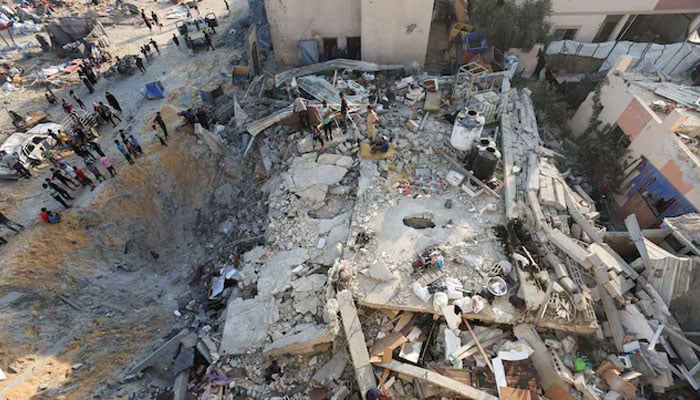
Regardless of how the long-delayed, welcome ceasefire in Gaza plays out, there are historic parallels that shed a warning on the future for Palestinians devastated by a two-year genocidal war following decades of ruinous occupation.
Early media reports raise red flags. It is uncertain whether the agreement will lead to a permanent end to Israel’s war on Palestinians, especially given the long-term far-right Israeli goal of full ethnic cleansing of both Gaza and the West Bank.
Further, Netanyahu’s extremist government has made no commitment to fully withdraw from Gaza, and there is no commitment to any real plan to rebuild the massive devastation Israel has created in Gaza with any role for any Palestinian leadership. And even with the announced ceasefire “food, water and medicine remained scarce,” the New York Times noted.
One horrific fact is clear. As of October 5, at least 67,139 Palestinians have been confirmed killed with tens of thousands more unaccounted for and likely still buried under rubble. Of those dead, more than 20,000 were children. At least 459, including 154 children, have died from starvation due to the famine imposed by Israel as a weapon of war.
Famines, especially those driven by political or military policy, have often produced persistent calamitous consequences for the survivors. Signs are already evident for Palestinians in Gaza. A study led by the UN Relief and Works Agency (UNRWA) for Palestine Refugees, published by the medical journal The Lancet this week, disclosed that nearly 55,000 children under the age of six in Gaza are estimated to be acutely malnourished.
UNRWA researchers found that 5 percent of children screened in January 2024 showed evidence of wasting. By May 2025, “levels of wasting among screened children rose to nearly 16 percent, with almost a quarter of these suffering severe acute malnutrition, the most dangerous form of the condition,” the Guardian described.
Even before the war, after years of an Israeli blockade of Gaza, children in Palestinian refugee families in Gaza were already “food insecure,” said UNRWA nutrition epidemiologist Dr Masako Horino, and now, due to the famine “face an increased risk of mortality.”
What does the future hold? A forewarning could be found in perhaps the world’s most chronicled famine in Ireland from 1845 to the early 1850s, following a devastating potato blight, a crop that dominated the food source in Ireland. An 1841 census recorded a population of 8.4 million people in Ireland. Ten years later, following years of famine and a mass emigration by desperately sick people, many forced off their land by British landlords, the population had plummeted to just 6.5 million, and it continued to decline for decades.
In 2025, the combined population of the Irish Republic, even after the economic gains of the so-called Celtic Tiger since the 1990s, and ongoing British controlled Northern Ireland, is still just 6.8 million people, less than before the famine. By comparison, the United Kingdom’s population in 1840, including all of Ireland, was 26.7 million. Today, the UK population, including Northern Ireland, has climbed to nearly 70 million.
In what may well be the definitive history of Ireland’s suffering, “Rot. An Imperial History of the Irish Famine,” Padraic Scanlan, explains that the Irish famine does not fit the international law definition of starvation crime. That requires deliberate action “by government or military committing the crime must act either to destroy the means of producing or obtaining food, or to forcibly displace people to cause starvation.” These are terms that directly apply to Israel’s forced famine in Gaza.
Though Scanlan does not directly address Gaza, there are multiple parallels. “The hyper dependence of so many of the Irish poor on the (potato) crop was an adaptation to English and British conquest, and to the subsequent growth of the British empire and imperial capitalism”.
Excerpted: ‘Gaza and Ireland: Shared Experiences and a Warning Going Forward’.
Courtesy: Commondreams.org