
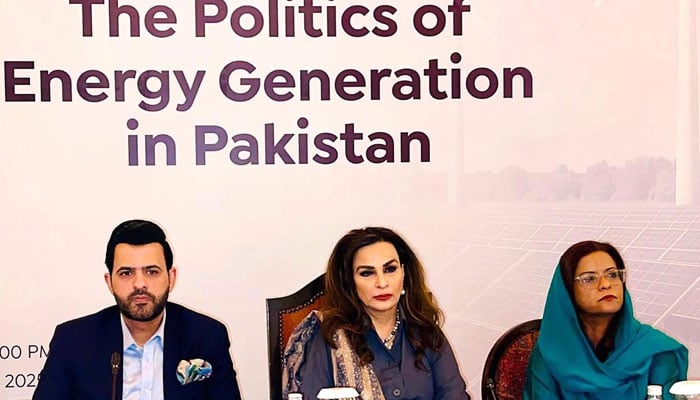
ISLAMABAD: Senate Committee on Climate Change and Environmental Coordination Chairperson Senator Sherry Rehman has underscored that “energy represents wealth for a country it is the foundation of energy democracy, security, and sovereignty”.
“Every industry, every household, every school, and every farm depends on low cost, sustainable, durable and affordable energy to power growth and human development. Electricity is not a privilege, it is a human right,” she emphasized while speaking as chief guest at the Parliamentary Forum on Energy and Economy “Implications of IGCEP 2025, Politics of Energy Generation in Pakistan” on Thursday. She commended the conveners of the forum for addressing issues of great national importance and fostering dialogue that involves matters central to Pakistan’s energy and economic future.
Referring to global energy trends, she noted that renewable energy has overtaken coal as the world’s leading source of electricity in the first half of 2025. “Growth in solar and wind energy met 100% of the rise in global electricity demand, driving down reliance on coal and gas,” she said.
She underscored that in 2024, 47% of Pakistan’s electricity came from low-carbon sources (Ember 2025), while according to Pakistan’s Ministry of Energy, the figure was even higher at 55% both well above the global average of 41%.
Pakistan ranked as the 26th largest country in the world by electricity demand, a clear sign of its growing energy footprint.
Sherry reaffirmed Pakistan’s climate commitments under its Nationally Determined Contributions (NDCs) to achieve 60% of power generation from renewable sources by 2030, net-zero emissions by 2050, a 30% transition to electric vehicles by 2030, and a complete ban on imported coal. “Renewables are the path to energy sovereignty and energy democracy,” she said.
Citing Pakistan’s remarkable rise in the global solar landscape, she said Pakistan is now the 6th largest solar market in the world (World Economic Forum, 2025).
She lauded the Sindh government’s pioneering role in renewable energy, recalling how it launched solar initiatives as early as 2013 solarizing 600 schools in Nagarparkar and electrifying border villages in Sanghar despite federal restrictions at the time.
Shedding light on the Sindh Solar Energy Project (SSEP) led by Chairman Bilawal Bhutto Zardari and supported by the World Bank, she said the initiative aims to provide affordable solar systems to 500,000 low-consumption households, with priority given to beneficiaries of the Benazir Income Support Program (BISP). She cautioned that Pakistan’s current energy planning remains “rooted in a 20th-century grid system - archaic, aging, and unoptimized”. She called for a “low-cost, best-cost” energy system that is inclusive, efficient, and sustainable.


-
 State institutions ‘fail’ to perform constitutional duties: KP CM
 -
 CTD orders psychological testing of police on VVIP security duty
 -
 Navy busts drug consignment valued at $130m
 -
 Three ex-secretaries in race for ETPB chief post
 -
 Punjab govt forms 71 JITs to probe cases against banned TLP
 -
 Some UNSC members ignoring broader reforms, seeking privilege: Pakistan
 -
 PAC body discusses non-recovery of Rs15bn gas cess
 -
 Pakistan received $2.29bn foreign loans in first 4 months of 2025