
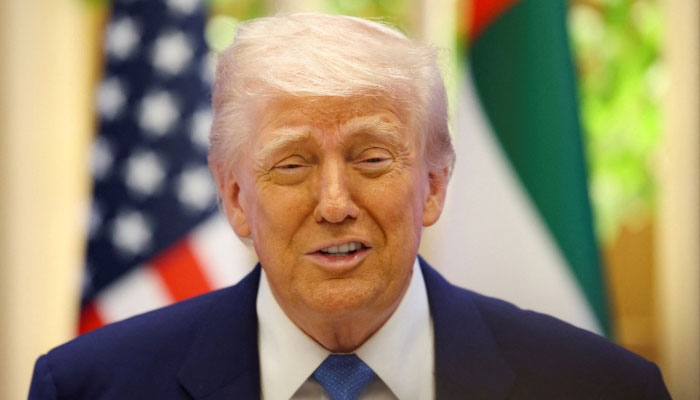
WASHINGTON: Few prizes attract as much intrigue as the Nobel Peace Prize. This year is no exception. US President Donald Trump has presented himself as a global peacemaker-in-chief, citing his role brokering several peace agreements and suggesting he belongs among the laureates. It remains unlikely that the Norwegian Nobel Committee will award him the prize on Friday, Time reported.
The reason is not political bias. The Committee is an independent body bound by Alfred Nobel’s will, which requires it to honor those who advance peace, disarmament, and international cooperation. By those standards, President Trump’s record presents a complex picture.
On international cooperation, the Trump Administration has taken a markedly isolationist approach. Early this year, President Trump signed executive orders withdrawing the U.S. from the World Health Organization, the Paris climate accord, and international tax agreements. These decisions reflect a shift away from multilateral engagement and stand in contrast to Alfred Nobel’s vision.
The Trump Administration has also dramatically cut U.S. foreign assistance efforts, dismantling the U.S. Agency for International Development. Billions of dollars in programs—from famine relief in Sudan to vaccination campaigns in sub-Saharan Africa—have been thrown into uncertainty.
Research published in The Lancet warns that this could result in up to 14 million additional deaths by 2030, including 4 million children under the age of five. Such actions again run counter to the spirit of Alfred Nobel’s will to promote fraternity and cooperation between nations.
On disarmament, President Trump’s approach has diverged from traditional arms control efforts. For instance, during his first term, his administration withdrew from a nuclear arms control treaty with Russia dating to the Cold War.
On peace, President Trump has taken visible steps to support peace initiatives. Israel and Hamas have agreed to the first phase of his Gaza peace plan, which is a promising achievement. The 20-point plan includes a ceasefire, the entry of humanitarian aid, and the release of Israeli hostages and Palestinian prisoners. But it faces criticism for excluding Palestinians from the negotiations and not properly addressing the root causes of the conflict.
Domestically, several of President Trump’s policies have emphasized order and security, sometimes at the expense of dialogue and inclusion of local state governments. In the District of Colombia, California, Tennessee, and elsewhere, he deployed the National Guard to quell unrest and cracked down on pro-Palestinian demonstrations at American universities.
Naturally, there have been lobbying efforts to highlight President Trump’s candidacy, openly supported by several international leaders including Israel, Pakistan, Armenia, and Azerbaijan. But the Norwegian Nobel Committee has strong institutional safeguards: its deliberations remain secret for 50 years, its mandate fixed by Alfred Nobel’s will, and its members chosen to uphold the Prize’s integrity. External pressure is unlikely to shape their decision, including this year’s outcome.
The Nobel Peace Prize is one among five prizes handed out every year “to those who, during the preceding year, have conferred the greatest benefit to humankind,” according to Alfred Nobel’s will. The Peace Prize is not a measure of popularity or promise or power, but of lasting contributions to peace, disarmament, and cooperation.
While President Trump has made notable efforts in several areas, the overall record at this stage does not fully align with the standards outlined by Alfred Nobel. Should his initiatives—such as efforts to end the war in Gaza—achieve lasting success, the situation could look quite different this time next year.



-
 State institutions ‘fail’ to perform constitutional duties: KP CM
 -
 CTD orders psychological testing of police on VVIP security duty
 -
 Navy busts drug consignment valued at $130m
 -
 Three ex-secretaries in race for ETPB chief post
 -
 Punjab govt forms 71 JITs to probe cases against banned TLP
 -
 Some UNSC members ignoring broader reforms, seeking privilege: Pakistan
 -
 PAC body discusses non-recovery of Rs15bn gas cess
 -
 Pakistan received $2.29bn foreign loans in first 4 months of 2025