
Following truce between PMLN, PPP: PM, Bilawal discuss political, national issues on phone
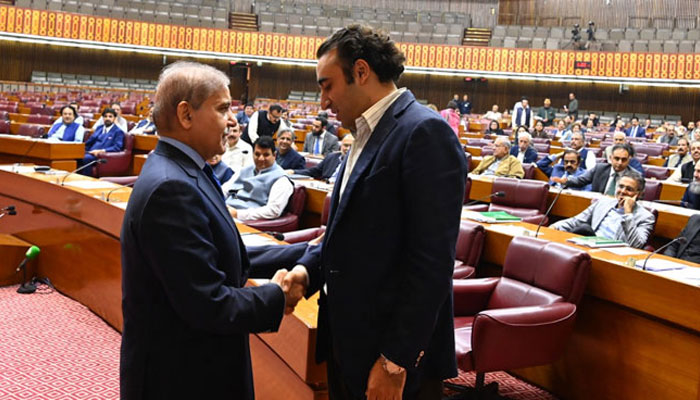
ISLAMABAD: Prime Minister Shehbaz Sharif and Pakistan Peoples Party (PPP) Chairman Bilawal Bhutto-Zardari spoke by telephone on Thursday, following a truce brokered between the two coalition partners.
This high-level political contact came after a pivotal meeting in Nawabshah on Wednesday night between top Pakistan Muslim League-Nawaz (PMLN) leaders—Deputy Prime Minister and Foreign Minister Ishaq Dar and National Assembly Speaker Sardar Ayaz Sadiq—and President Asif Ali Zardari, with Interior Minister Mohsin Naqvi also present at the gathering. During their call, the prime minister and PPP chairman engaged in substantive discussions covering the prevailing political situation and key national issues, including flood rehabilitation efforts and foreign policy matters.
According to sources, Prime Minister Shehbaz proactively initiated the contact as part of concerted efforts to defuse political tensions that had escalated following several days of sharp public exchanges between coalition partners. The earlier Nawabshah meeting proved crucial in establishing common ground, resulting in both sides agreeing to immediately end their public war of words and instead resolve their differences through structured dialogue and private consultations. Participants in the Nawabshah meeting thoroughly discussed the recent friction points and strongly emphasised the critical need for “mutual understanding” to maintain coalition harmony, formally agreeing to refrain from issuing any hostile statements against one another moving forward.
Meanwhile, addressing a federal cabinet meeting, the prime minister paid tribute to the nation’s martyrs, stating that they had “drawn a line with their blood” for the country’s defence, a line that “nobody could be allowed to breach.” “All efforts of the federal and provincial governments will go to waste if the menace of terrorism is not rooted out,” he said, noting that precious lives were being sacrificed in anti-terrorist operations. He described the current period as a critical time where “the game of fire and water could not go along any longer,” and confirmed he had held meetings with Chief of Army Staff Field Marshal Asim Munir, whose morale he described as “very high.” He stated the whole nation was focused on the elimination of the Khawarij (militants). “The whole nation is asking that on the one hand we are achieving successes at the diplomatic level, struggling for economic stability, and humiliated the enemy in Marka-e-Haq, and on the other hand efforts are being made to disintegrate the country,” he said. Paying tribute to Lt Col Junaid Tariq, Major Tayyab, Major Sibtain, and other soldiers, he said the martyrs were “the crown jewels of Pakistan’s honour and dignity.”
“Their sacrifices must always be remembered. Forgetting them would be the greatest injustice to the region, the country, and their families,” he said, adding that those who facilitate terrorists are “equally guilty.”
On foreign policy, the prime minister said Pakistan had shown “no flexibility” in its stance on Palestine, reiterating the position of “240 million people and the country’s Parliament” at the United Nations. He congratulated his team and praised the role of Field Marshal Asim Munir for Pakistan’s part in facilitating the Gaza ceasefire, noting it was an honour for Pakistan to be among eight out of 57 Muslim countries that prepared a joint statement on Palestine.
The federal cabinet ratified the Strategic Mutual Defence Agreement between Pakistan and Saudi Arabia, with members paying tribute to the leadership of the two brotherly countries. The cabinet also approved the draft of the Wapda Security Force Bill, 2025. Once passed by Parliament, the bill will provide for the establishment of a special security force to protect dams and hydroelectric power projects. Other decisions included the ratification of measures taken by the Economic Coordination Committee (ECC) in its October 2 meeting.
In a separate high-level review meeting on privatisation, Prime Minister Shehbaz directed authorities to accelerate the process for loss-making and inactive state-owned enterprises (SOEs), warning that administrative delays would not be tolerated. “The best possible deals should be secured for the entities included in the privatisation programme,” Shehbaz said, adding that he would personally monitor the process.


-
 State institutions ‘fail’ to perform constitutional duties: KP CM
 -
 CTD orders psychological testing of police on VVIP security duty
 -
 Navy busts drug consignment valued at $130m
 -
 Three ex-secretaries in race for ETPB chief post
 -
 Punjab govt forms 71 JITs to probe cases against banned TLP
 -
 Some UNSC members ignoring broader reforms, seeking privilege: Pakistan
 -
 PAC body discusses non-recovery of Rs15bn gas cess
 -
 Pakistan received $2.29bn foreign loans in first 4 months of 2025