
Pakistan, Malaysia sign six accords, raise halal meat quota to $200m
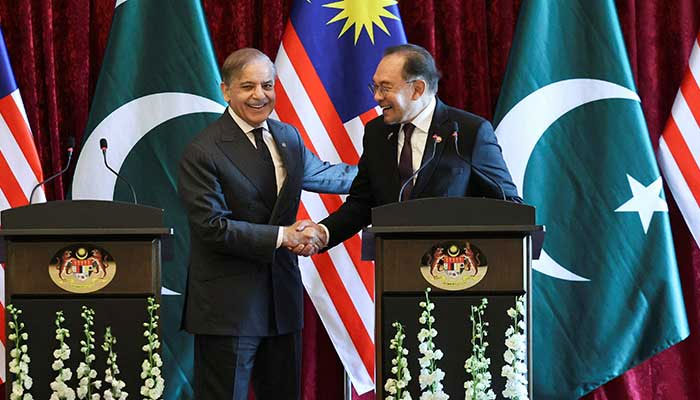
PUTRAJAYA, Malaysia: Pakistan and Malaysia on Monday signed six accords to strengthen bilateral cooperation covering different areas, including education, halal certification, tourism and combating corruption.
The pre-signed documents were exchanged at a ceremony held at Perdana Putra Complex, Office of the Malaysian Prime Minister. Both Prime Minister Shehbaz Sharif and his Malaysian counterpart Anwar Ibrahim witnessed the ceremony held after their meeting as well as the delegation-level talks.
Pakistan and Malaysia signed an MoU on Exchange of Notes between the Institute of Diplomacy and Foreign Relations (IDFR) and the Foreign Service Academy of Pakistan on cooperation in the field of training for diplomats.
The documents were exchanged by Deputy Prime Minister and Foreign Minister Ishaq Dar and Malaysian Foreign Minister Haji Mohamad Bin Haji Hasan. Minister of Tourism of Malaysia Tiong King Sing and Minister of Information and Broadcasting Attaullah Tarar exchanged the documents of an MoU between the two governments for cooperation in the field of tourism.
The two sides signed an MoU on Halal Certification and the relevant documents were exchanged by Malaysian minister Dr Haji Mohd Na’im Bin Haji Mokhtar and Minister for Commerce Jam Kamal Khan.
Both countries also inked an MoU to expand cooperation in combating and preventing corruption. The sixth accord was meant to enhance cooperation between Small and Medium Enterprises Development Authority (Smeda) of Pakistan and Small and Medium Enterprises Corporation of Malaysia.
Chief Executive Officer SME Corporation Malaysia Rizal bin Dato’ Nainy and Special Assistant to PM Syed Tariq Fatemi exchanged the documents. Earlier, bilateral ties and cooperation were discussed in a meeting between PM Shehbaz and his Malaysian counterpart Anwar Ibrahim at Perdana Putra.
Expressing satisfaction on the steady progress in bilateral cooperation, they agreed to continue working together to explore new avenues for collaboration, including investment and joint ventures in multiple sectors.
It was agreed that both sides would continue exploring new avenues for cooperation in information technology and telecommunications, the halal industry, automotive, connectivity, green energy, electrical and electronic manufacturing, tourism, higher education, climate change and agriculture.
Upon arrival, the prime minister was greeted by an official welcome ceremony followed by a smaller group meeting between the two leaders before the delegation-level talks between the two countries, under the leadership of the two prime ministers.
Shehbaz, who is on a three-day official visit to Malaysia, thanked Ibrahim for the exceptionally warm welcome and hospitality accorded to him and members of his delegation. During their “highly constructive and fruitful” meeting, the two leaders expressed their satisfaction on the steady progress in bilateral cooperation, following the Malaysian prime minister’s visit to Pakistan in October 2024.
Both sides also agreed to enhance the quota of halal meat exports from Pakistan to Malaysia to $200 million (Rs56.64 billion). They also expressed their satisfaction on the exports of rice from Pakistan to Malaysia, which had exceeded its quota.
Both leaders also held detailed discussions on major regional and international developments, including the situation in the Middle East. The Malaysian PM praised Pakistan’s efforts in a constructive role in the ongoing peace efforts in Palestine, including under the recent initiative of President Donald Trump.
Prime Minister Shehbaz also emphasised the importance of enhanced cooperation between Pakistan and Malaysia at multilateral forums including the United Nations and Organisation of Islamic Cooperation, particularly in the context of the complex challenges facing the Islamic world.
He reiterated Pakistan’s stance on Kashmir and thanked Malaysia for its steadfast support for a peaceful settlement of the Jammu and Kashmir dispute in accordance with UN resolutions. The two leaders further deliberated on strengthening Pakistan-Asean engagement.
While congratulating Ibrahim on Malaysia’s assumption of the Chair of Asean, Shehbaz thanked Malaysian PM for reaffirmation of Malaysia’s support for Pakistan’s bid to become a Full Dialogue Partner of Asean.
Both leaders agreed to remain in close consultation to follow up on the important decisions taken to enhance bilateral cooperation between both sides as well as to keep each other informed of their perspectives on major international affairs.
On this occasion, the two prime ministers launched the Urdu translation of Prime Minister Anwar Ibrahim’s seminal work, SCRIPT, that presents his vision and values on leadership. Ibrahim also hosted a special luncheon in honour of Shehbaz and his delegation.
Meanwhile, addressing the Pakistan-Malaysia Business and Investment Conference, Prime Minister Shehbaz stressed the vital role of the private sector in driving economic growth, urging business leaders from Pakistan and Malaysia to seize new opportunities for bilateral trade and investment.
He emphasised that governments could only create enabling environments, but real progress depended on private enterprise. “It is the private sector that must drive the engine of growth,” he said adding: “Governments can only lay the foundation and provide a framework, business should be run by business houses, enterprises, and experts, not government.”
The conference, attended by PM Anwar Ibrahim and a host of entrepreneurs from both countries , was aimed to explore joint ventures and deepen trade relations. Shehbaz expressed confidence that enhanced cooperation between Pakistani and Malaysian businesses could reduce Islamabad’s reliance on external financial assistance.
He also lauded Malaysia’s remarkable economic transformation under the leadership of Ibrahim, calling it “nothing less than a miracle”. He expressed confidence that with similar commitment and cooperation, Pakistan too could achieve sustained economic growth and independence from international financial support.
“We are currently under an IMF programme that is helping stabilise our economy. This programme will end in two years. But if entrepreneurs from both Pakistan and Malaysia step forward, commit to joint ventures, and build lasting business relationships, I believe we can say goodbye to the IMF forever,” he added.
PM Ibrahim on the occasion stressed fostering collaboration under Asean, noting that expanding the grouping’s economic footprint would benefit the entire region. He assured Pakistani entrepreneurs of his government’s support in facilitating smoother business processes and regulatory cooperation. He also uttered a few words in Urdu language that was warmly applauded by the audience, further highlighting the warmth between the two nations.
PM Shehbaz said as the fifth-largest producer of cotton and milk, and the fourth-largest mango producer globally, Pakistan offered immense potential for value-added agricultural exports.
“Our mangoes are among the best in taste worldwide. With Malaysian expertise, we can build SME-based processing units for off-season packaging, value addition, and export.” Highlighting the vast mineral potential of Pakistan, he pointed to the Reko Diq copper and gold mine in Balochistan as a major opportunity for joint investment, especially in the context of the global energy transition.
The prime minister said Pakistan had also vast potential of tourism as the country’s northern and many other areas offered world-class destinations. “With Malaysian tourism expertise, we can transform these regions into major international tourist attractions,” he said.
He also proposed leveraging the country’s young and skilled labour force to support Malaysian industries, where rising labour costs had become a concern. Shehbaz pointed out that Pakistan also offered cost-effective skilled labour, and by combining investment portfolios, both sides could establish joint production units that export to Gulf countries, Central Asia, and beyond.
As regards the government’s performance on the economic front, he noted that Pakistan’s macroeconomic indicators were showing encouraging results. Inflation has dropped from 36 percent to single digits, and policy rates have decreased from 22.5 percent to 11 percent, he said.
The prime minister emphasised that combined efforts could unlock new horizons in trade, investment, and industrial collaboration. Earlier, PM Shehbaz was given a guard of honour as he arrived at the Perdana Putra Complex to meet PM Ibrahim and hold the delegation-level talks.
As Shehbaz, who is on a three-day official visit to Malaysia, arrived at the venue of the official welcome reception, he was warmly received by PM Anwar Ibrahim. The national anthems of Pakistan and Malaysia were played as both the leaders stood at the salute dais.
Shehbaz inspected the guard of honour given by the smartly turned-out contingents of Malaysian armed forces. Later, both the leaders introduced their respective delegations to each other before proceeding for the one-on-one meeting and the delegation-level talks.
Accompanied by Deputy Prime Minister and Foreign Minister Ishaq Dar, Federal Minister for Information and Broadcasting Attaullah Tarar and Special Assistant to the Prime Minister Tariq Fatemi, the prime minister is visiting Malaysia at the invitation of his Malaysian counterpart.
As he landed at the Bunga Raya International Airport on Sunday night, he was received by the Malaysian Minister of Communications Fahmi Fadzil, Pakistan’s High Commissioner to Malaysia Syed Ahsan Raza Shah and diplomatic staff.
Meanwhile, Prime Minister Shehbaz, welcoming Bloomberg’s recent positive report on Pakistan’s economy said that the notable decrease in the price of Pakistan’s Credit Default Swap (CDS) reflected a consistent increase in global investors’ confidence in the country’s economy.
According to the report, there has been a significant reduction of 2,200 basis points in the default risk implied in Pakistan’s CDS, a press statement issued by the PM Office said. Pakistan is now the second country among emerging economies, following Turkiye, in the global rankings, which is great news for our economy, the prime minister said, adding that at the end of the previous government’s tenure, the country was on the brink of default.
He said the Bloomberg’s report was a crucial milestone and a reflection of the government’s journey towards progress. “With the relentless efforts of the Government of Pakistan and the cooperation of both the Pakistani and global business communities, the promise of Pakistan’s development is now on track,” the prime minister said. He stressed that this journey of progress will never halt.


-
 State institutions ‘fail’ to perform constitutional duties: KP CM
 -
 CTD orders psychological testing of police on VVIP security duty
 -
 Navy busts drug consignment valued at $130m
 -
 Three ex-secretaries in race for ETPB chief post
 -
 Punjab govt forms 71 JITs to probe cases against banned TLP
 -
 Some UNSC members ignoring broader reforms, seeking privilege: Pakistan
 -
 PAC body discusses non-recovery of Rs15bn gas cess
 -
 Pakistan received $2.29bn foreign loans in first 4 months of 2025