
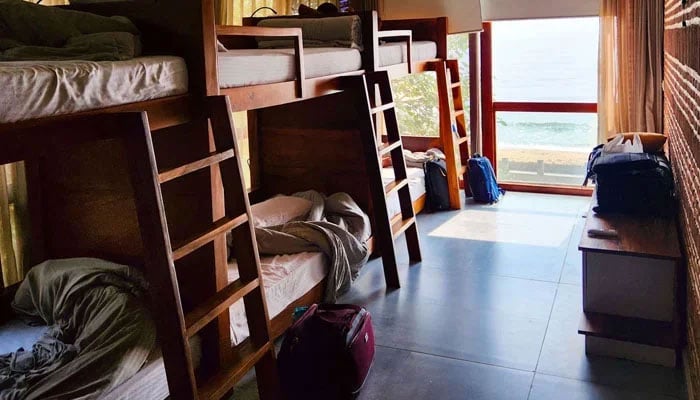
Islamabad: The protest demonstration staged by the students in front of the National Press Club on Monday reignited the serious issue of hostel shortages in the federal capital.
Youth enrolled in Islamabad’s public colleges from Balochistan, Khyber Pakhtunkhwa, Gilgit-Baltistan and Azad Jammu and Kashmir have long been demanding the restoration of hostels in educational institutions regulated by the Federal Directorate of Education.
Sangeen Khan, a student residing in a private hostel, lamented that despite Islamabad being regarded as the academic hub of the country, “thousands of students continue to suffer due to the absence of affordable on-campus accommodation.”
The problem worsened after the Capital Development Authority began sealing private hostels operating in residential sectors, citing violations of building bylaws. For many students, these private hostels were the only available option for accommodation.
“It is ridiculous that we are not provided hostels in our colleges and universities, and when we rent a room in a private hostel in the residential area, CDA seals it, saying it violates regulations. Where are we supposed to go?” asked Salman, a student from Khyber Pakhtunkhwa.
The protest also brought to light a deeper issue, the FDE’s neglect and misuse of existing public resources. Many hostel buildings that were originally constructed for students have been handed over to external organizations and projects, leaving students deprived of their rightful facilities.
One such case is the hostel of Islamabad Model College for Boys (IMCB) H-9, which was handed over to Pakistan Sweet Home (PSH) in 2012 under a controversial memorandum. Teachers and students have long questioned why an organization already receiving massive charitable funding was allowed to occupy a college hostel building.
They allege that PSH, while claiming to work for orphans, has effectively turned into a multi-billion-rupee enterprise enjoying state patronage at the expense of public education infrastructure.
Similarly, the hostel building of Islamabad Model Postgraduate College (IMPC) H-8 was handed over to the Pakistan Institute of Fashion and Design instead of being restored for student use. Such decisions, according to educationists, reveal a consistent pattern of indifference among FDE authorities toward students’ basic needs.
“Authorities have failed to realize that hostel facilities are not a luxury but an essential part of higher education,” said a senior professor. “In a city like Islamabad, where accommodation costs are already beyond the reach of most families, denying student hostels is equivalent to denying them education.”
He said the lack of hostels has hit students from financially weaker backgrounds the hardest. Many are forced to live in cramped, unsafe private lodgings or abandon their studies altogether. Rising rents, transportation challenges, and safety concerns have further compounded their hardships.”
Another student Ismail said that while Islamabad hosts some of Pakistan’s leading educational institutions, “its infrastructure has not kept pace with the growing needs of students.” He added that despite repeated assurances, successive governments have failed to prioritise the provision of student housing.
Students demanded that the hostels of H-8 and H-9 colleges, currently occupied by outside organisations, be immediately vacated and restored for student use. They also called for the construction of new hostels in major colleges and universities to meet the increasing demand. “We are not asking for charity but our right to education,” the students added.


-
 State institutions ‘fail’ to perform constitutional duties: KP CM
 -
 CTD orders psychological testing of police on VVIP security duty
 -
 Navy busts drug consignment valued at $130m
 -
 Three ex-secretaries in race for ETPB chief post
 -
 Punjab govt forms 71 JITs to probe cases against banned TLP
 -
 Some UNSC members ignoring broader reforms, seeking privilege: Pakistan
 -
 PAC body discusses non-recovery of Rs15bn gas cess
 -
 Pakistan received $2.29bn foreign loans in first 4 months of 2025