Prevention was possible
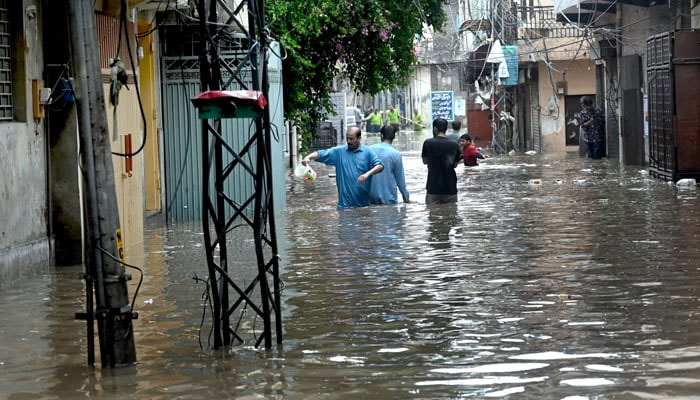
Twenty-years ago in Athara Hazari (Jhang district), a few months after the birth of her daughter, Khadija Bibi began saving for her daughter’s wedding. Rupee by rupee, she filled steel trunks with hand-embroidered quilts, china tea sets, gold bangles and silk suits, like rural mothers do.
This year Chenab’s flood’s muddy floodwater swept through her house and carried it all away. “The jahez is gone”, she told relief workers. “Everything I gathered for my daughter’s new home is floating in the street.”
Saleem, an office manager at a textile mill in Lahore had used his lifelong savings and took a loan from the employer and the bank to build his house in a housing society on the banks of Ravi, his house is inundated and all household items submerged chest high water. “How will I pay off the loans” he asks, with a look of wilderness.
In Dulla Akoka (Bahawalnagar) along the path of the Sutlej, Ghulam Hussain saw his thirty-five acres buried under six feet of sand and silt, a comfortable middle class livelihood source erased. These are not statistics. They are broken lives – and unfortunately much of the devastation was preventable.
Punjab is not short of laws. The Punjab Flood Plain Regulation Act 2016 empowers the government to declare floodplains off-limits for construction, override municipal permissions and even restrain federal agencies from unsafe development.
The Punjab Irrigation, Drainage and Rivers Act 2023 goes further, mandating River Ledgers of vulnerabilities, annual flood protection plans and strict technical standards for embankments. Section 88 explicitly forbids river training works without impact simulations – the very analyses missing in many recent failures. On paper, this framework is as advanced as any in the world. In practice, it is a dead letter. Rules have not been finalized, committees rarely meet, surveys mandated every October are skipped and floodplain maps remain incomplete. The laws exist, but enforcement does not.
None of this negligence is new. After the catastrophic 2010 floods, Justice Syed Mansoor Ali Shah’s Lahore High Court commission, ‘A Rude Awakening’, identified the same failures: encroachments in pond areas, unmaintained embankments, highways obstructing natural water channels. His recommendations were clear: remove obstructions, enforce zoning, strengthen early warnings. Thirteen years later, the same vulnerabilities drowned Khadija’s daughter’s dowry, Ghulam Hussain’s land, Saleem’s dream home and thousands of other families’ futures.
To their credit, Punjab’s rescue services, cabinet members, NGOs and volunteers mobilised with speed and courage. Boats, helicopters, rations and evacuation centres saved many lives. But this very efficiency exposes the paradox: the state is capable of organisation, yet uses it after, not before, disaster. While relief is heroic, prevention is absent. Rescue packages may rebuild walls, but they cannot restore years of Khadija’s daughter’s dowry or Saleem’s house or Ghulam Hussain’s land. Prevention would have spared them.
The irony is that colonial engineers understood rivers better than many planners today. To quote one example, the hundred-arch ‘100 moriya pull’ near Shahdara was designed a century ago to let Ravi floodwater pass freely. Roads and Railway bridges included extra spans and tracks followed ridge lines to avoid inundation. By contrast, today’s modern motorway M5 near Jalalpur Pirwala collapsed because it blocked natural flood channels with inadequate culverts. Housing societies rise in river basins and roads act as dams. Vulnerability is being built into the landscape.
The costs of this neglect go far beyond damaged homes and lands. Each cycle of flooding and reconstruction drains billions from the exchequer, money that could have built schools, hospitals and roads. Agriculture, the backbone of Punjab’s economy, loses not only standing crops but also fertile soil buried under sand and silt. Entire communities are displaced, living for months in makeshift shelters. Families fall into debt as they borrow to rebuild homes and start afresh. Breadwinners abandon work to deal with displacement. This is not a natural calamity; it is a man-made governance disaster repeated every few years at staggering economic and social cost.
Punjab’s legal framework, if enforced, already embodies many of the best practice principles from around the world. What it lacks is the political will to enforce them. The tragedy is that every stakeholder knows, after the repeated cycle what needs to be done. District and irrigation officials know where encroachments choke natural flood channels. Rescue agencies know which villages need early warnings. Engineers know where embankments require reinforcement. Satellite imagery can map floodplains with precision. Yet these tools are shelved while development authorities continue to approve housing schemes in natural basins and influential landowners block rivers with impunity. The knowledge exists, the capacity exists, and the laws exist, but none of it translates into prevention.
Punjab does not need new legislation or foreign consultants. It needs to implement what is already in its statute books, but implementation must be made concrete. Canal officers should be formally trained in floodplain management, not just irrigation duties. GIS technology should be deployed to map and notify floodplain boundaries with legal force, making them enforceable against encroachers. River ledgers must be completed annually using hydrological and satellite data. Encroachments must be removed through joint surveys by irrigation, revenue and district administrations, with penalties applied under existing provisions.
Construction approval committees should include hydrologists and environmental engineers, not just bureaucrats, so that flood risk is factored into every decision. Annual flood protection plans should be tied to performance evaluations of deputy commissioners and irrigation officials, ensuring accountability. Early warning systems should be expanded through automated river gauges feeding into PDMA and NDMA centres. Evacuation drills must be conducted in at-risk districts before every monsoon. None of these actions requires new laws, only the enforcement of those already passed.
This requires courage, because every encroachment has a patron and every illegal construction has a benefactor. But the cost of inaction is written in the grief of families like Khadija’s, Saleem’s and Ghulam Hussain’s. Punjab now stands at a crossroads. It can continue the cycle of neglect, disaster, rescue and reconstruction, or it can break it by enforcing the protections already written into law. Families should not depend on boats and relief trucks when prevention could have saved them. Their resilience should not excuse the failures of the state.
The tools exist, the knowledge exists, the judicial guidance exists. What is missing is political will. Until that gap is closed, every monsoon will bring not just water, but preventable tragedy.
The writer is a former Punjab minister for irrigation and finance, with extensive experience in Pakistan’s provincial and federal legislatures.