
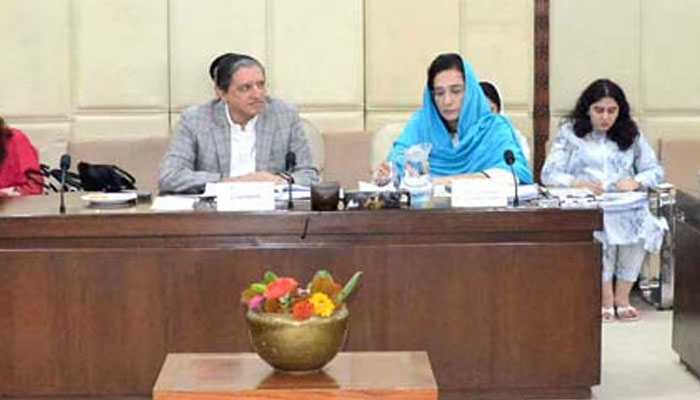
ISLAMABAD: Members of the sub-committee of the Senate Standing Committee on Cabinet Secretariat stressed on Thursday that Pakistan’s civil service recruitment system must be modernised to reflect contemporary realities, including the integration of new technologies such as artificial intelligence.
The meeting of the sub-committee, convened by Senator Saleem Mandviwala, was also attended by Anusha Rehman.
The agenda focused on a comprehensive review of the civil service examination system, with particular emphasis on structural reforms, inclusivity, and alignment with international standards.
The session featured detailed discussions between committee members, representatives of the Federal Public Service Commission (FPSC), civil servants, and student associations. The primary focus was on revamping the civil service examination to meet the evolving needs of the 21st century.Senator Saleem Mandviwala remarked: “We understand the need to restructure the civil services exams according to international standards and modern requirements.
The purpose of this sub-committee is to build consensus among students from all regions and backgrounds, and to introduce fairness and ease into the process. However, the competitive standard of the civil service exam must remain at the highest level.”A central point of debate was the proposal to extend the upper age limit for the CSS exam from 30 to 35 years. Students, particularly from underprivileged and rural areas, advocated for this change, citing systemic educational delays, lack of access, and socio-economic challenges. Female aspirants also supported the proposal, highlighting delayed education and familial responsibilities such as marriage during academic years.Student representatives said: “Age relaxation is not just a number—it is a matter of equity and fairness for thousands who are left behind due to systemic challenges.”
In response, officials expressed concern that increasing the age limit might undermine the goal of inducting young and fresh talent into the civil service. Striking a balance between experience and youthful potential remained a key point of deliberation. Students, however, maintained that extending the upper age limit to 35 would help attract professionals with valuable practical expertise.Another major concern raised by students was the transition from two-year to four-year bachelor’s degrees post-2016. They argued that this reduced their eligibility window, further strengthening the case for age relaxation.The committee also reviewed the conventional nature of the current testing system and exam content. Members stressed the need to update the syllabus in line with modern realities, including artificial intelligence, digital governance, and global policy frameworks. It was further suggested that the academic curriculum from primary to matriculation be revised to align with the expectations of civil service examinations.
Additional points included revising eligibility timelines to address systemic delays in education and recruitment processes, filling long-standing vacant posts—particularly minority seats—and expanding the talent pool to overcome recurring shortages in the civil service.
The committee deferred final decisions to its next meeting and asked all student associations to submit their recommendations and demands in writing for formal consideration. It was also observed that an inter-ministerial committee, chaired by Federal Minister Ahsan Iqbal, is already working on a parallel national-level agenda to modernize the civil services examination.Senator Mandviwala assured participants that the grievances and proposals presented by students would be conveyed to the relevant authorities. Given the widespread interest in CSS reforms, the sub-committee’s review was described as a pivotal step toward creating a fair, inclusive, and modern recruitment process—one that could significantly shape the future of Pakistan’s bureaucracy.



-
 State institutions ‘fail’ to perform constitutional duties: KP CM
 -
 CTD orders psychological testing of police on VVIP security duty
 -
 Navy busts drug consignment valued at $130m
 -
 Three ex-secretaries in race for ETPB chief post
 -
 Punjab govt forms 71 JITs to probe cases against banned TLP
 -
 Some UNSC members ignoring broader reforms, seeking privilege: Pakistan
 -
 PAC body discusses non-recovery of Rs15bn gas cess
 -
 Pakistan received $2.29bn foreign loans in first 4 months of 2025