Govt delegation holds talks with AJK protesters after PM orders probe
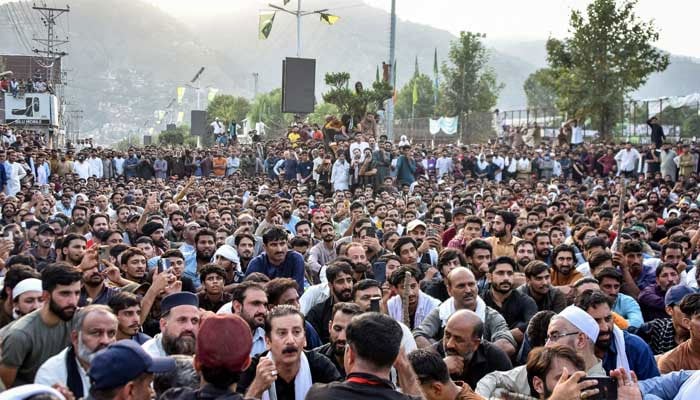
ISLAMABAD/ MUZAFFARABAD: In line with Prime Minister Shehbaz Sharif’s directives, a high-level government delegation on Thursday held talks with the Joint Awami Action Committee (JAAC) in Azad Jammu and Kashmir (AJK) to address its grievances.
The development came a day after three policemen among nine people were killed during the deadly protests in the AJK.
The government’s delegation includes Senator Rana Sanaullah, federal ministers Sardar Yusuf, Tariq Fazal Chaudhry and Ahsan Iqbal, former president of AJK Masood Khan and PPP’s Qamar Zaman Kaira.
Talking to journalists, Sanaullah said: “We have come here to listen to the demands of the friends of the action committee.”
He maintained that the premier had instructed to discuss the “legitimate demands” with the action committee. “The prime minister has instructed [us] to sit together and find solutions to the problems,” the senator added. Earlier, expressing deep concern over the unfortunate incidents during the protests in the AJK, PM Shehbaz ordered a transparent probe into the matter and directed the provision of immediate assistance to the affected families. In a statement, the prime minister said that peaceful protest was a constitutional and democratic right of every citizen, but the protesters should refrain from harming public order. “Government is always ready to resolve the issues of its Kashmiri brothers,” he assured. The AJK government, in a statement, said that nearly 172 police personnel were injured in the protests, with the condition of 12 reported as critical. Around 50 civilians also sustained injuries amid the violent demonstrations. The JAAC has issued a 38-point charter of demands, including ending 12 reserved seats for refugees and rolling back privileges of the elite.
Taking notice of the AJK situation, Shehbaz has appealed to the protesters to remain peaceful, assuring the resolution of their issues and committing to personally overseeing the negotiation process. He directed the law enforcement agencies to exercise restraint and patience with the protesters, ensuring respect for public sentiments and avoiding any unnecessary harshness.
He instructed the government’s negotiation committee to immediately travel to Muzaffarabad and find an immediate and lasting solution to the issues. The premier also announced that he would personally oversee the negotiation process upon his return to the country. He also appealed to the JAAC members and leadership to cooperate with the government’s negotiation committee, which would submit its recommendations and proposed solutions to the Prime Minister’s Office without delay for immediate resolution of the issues.
In a video message released before leaving for Muzaffarabad, the negotiation committee leaders stressed that most of the demands raised by the JAAC have already been accepted, while the remaining issues will be discussed through negotiations.
Planning Minister Ahsan Iqbal said the federal government would listen to the committee’s demands on the prime minister’s directive.
He warned that certain elements were attempting to undermine Pakistan’s peace and stability, urging restraint and constructive engagement.
AJK Prime Minister Chaudhry Anwar-ul-Haq said the negotiation process was being resumed, adding that most of the committee’s demands had been met and the rest would be addressed through further talks.
PPP leader Kaira also expressed concern over the situation, saying he was deeply saddened by recent incidents and stressed that problems could only be resolved through dialogue. “We are trying to restore normalcy as soon as possible,” he added.
A day earlier, federal minister Tariq Fazal Chaudhry offered negotiations to the JAAC amid ongoing protests.
“Ninety percent of demands have already been accepted … federal ministers stand as guarantors to ensure implementation of these demands,” he had said while addressing a press conference along with AJK Prime Minister.
Meanwhile, AJK Premier Haq also renewed the government’s invitation to talks, saying 90 percent of demands had been resolved and the remaining could also be discussed. He stressed that negotiations were the only civilised way to resolve disputes and insisted there was no benefit to continuing protests.
The prime minister added that the government was ready to resume talks from the point where they had stalled, and cabinet members were present in Muzaffarabad and Rawalakot for the purpose.
The AJK was witnessing an overwhelming shutdown and wheel-jam strike on the second consecutive day, amid intermittent skirmishes between law enforcers and activists in the state capital, Muzaffarabad.
Days of violent clashes between the protesters and police have gripped the AJK, with nine confirmed killed among scant news to emerge after an internet blackout.
Thousands first took to the streets of Muzaffarabad on Monday, demanding an end to lucrative benefits for the political class, such as free electricity and expensive cars.
Internet and mobile phone services have been blocked in the towering mountain valley, and local media were warned earlier by authorities against covering the daily demonstrations. “The politicians here behave like gangsters ruling over our heads; we want them gone and their privileges removed,” said Asad Tabbasum, a 51-year-old protester.
“They should stand with us.”
Security forces and police have flooded the streets of Muzaffarabad in response to the protests, firing tear gas to hold back the crowds that reached up to 6,000 at their peak.
According to an official statement by the Azad Kashmir government on Wednesday, six civilians and three policemen have been killed since Monday. More than 170 police personnel have been injured, along with 50 civilians, in the “violent demonstrations”, the government statement said.
Protest organisers say more than 100 civilians were wounded.
Interior Minister Mohsin Naqvi said in a statement to the media that a “few miscreants, on the enemy´s instigation, are attempting to disrupt peace and order in Azad Kashmir”.
Naqvi did not identify “the enemy”.
“Peaceful protest is everyone´s right, but taking the law into one´s own hands will never be allowed,” he said.
A day earlier markets and schools were closed as thousands of chanting protesters walked past buildings scorched by fire or with broken windows.
Protest leader Shaukat Nawaz, a JAAC member, claimed that police had fired at protesters.
“The bullets being fired at us are made in Pakistan to be used against the enemy and are now being used against us,” he said.
The government did not respond to his claims. Protesters also accused the authorities of harassing journalists and preventing coverage of their demonstrations.
“Our voice has been muted, not just that, they are reporting us as miscreants when we are here for our rights,” said 22-year-old Akash Kazmi.
Amnesty International on Thursday appealed for “an immediate, impartial and transparent investigation” into the clashes, including “the excessive use of force by law enforcement”.
It added that the ongoing communications blackout was causing panic among the population and fuelling misinformation.
Protests, as well as funerals, continued on Thursday. “Sometimes they call us betrayers, sometimes Indian agents, we are neither,” Nawaz roared through a microphone.
“We will keep fighting till we get our rights.”
Meanwhile, Islamabad police stormed the National Press Club (NPC) on Thursday afternoon during a protest organised by the AJK JAAC, assaulting journalists and damaging property in what senior media representatives described as one of the “worst incidents in history”.
The protest was scheduled for around 3pm at the NPC. When demonstrators gathered outside, police arrested them. Journalists on the scene began documenting the events with photos and videos, but police attempted to stop them, even trying to snatch cameras and mobile phones.
Minutes after the police were asked not to manhandle media personnel by senior journalists, police personnel forced open the doors of the press club, with some climbing the walls and entering the building as if “terrorists were inside”.
They attacked multiple journalists, smashed their equipment, and also stormed the cafeteria, beating journalists who were having tea.
Despite journalists repeatedly informing the police that no protesters were inside, the assault continued. Cameras were thrown to the ground, while media workers were assaulted.
Pakistan Federal Union of Journalists (PFUJ) President Afzal Butt condemned the incident, saying police broke NPC’s furniture, assaulted both employees and office holders, and even arrested some of the staff.
He said the level of aggression displayed by police was unprecedented.
“Even during dictatorships, such behaviour was not witnessed. The police used to wait outside for a wanted person rather than raiding the Press Club,” Butt remarked.
Meanwhile, journalists at the NPC were holding discussions on their next course of action following the assault.
Condemning the incident, Karachi Press Club (KPC) President Fazil Jamili said the violation of NPC’s sanctity was unacceptable. He also demanded accountability for those who tortured the journalists.
Furthermore, Pakistan People’s Party (PPP) leader Shazia Marri, Peshawar Press Club (PPC) president, and general secretary have also condemned the incident.
The journalists’ organisations, issuing a joint statement, strongly condemned the police raid on the NPC in the federal capital, describing it as an attack on press freedom and part of a wider campaign against journalists.
The Council of Pakistan Newspaper Editors (CPNE), PFUJ, and Association of Electronic Media Editors and News Directors (Aemend) denounced the assault on journalists, calling the raid an act of “terrorism”. They said the incident was a continuation of the ongoing actions against media workers.
The organisations demanded an end to smear campaigns, intimidation, and curbs on freedom of expression, stressing that journalists must be allowed to perform their professional duties without pressure.
The statement recalled that the media had acted responsibly during times of conflict, safeguarding national interests and defending the country’s ideological frontiers.
It also rejected attempts to equate reporters and freelancers with terrorists, saying such measures violated the principles of free journalism.
The journalist bodies underlined that the Constitution guarantees citizens unhindered access to information. They warned that the indiscriminate misuse of the Prevention of Electronic Crimes Act (Peca) had already validated their longstanding concerns.
Vowing resistance at every level, the CPNE, PFUJ and Aemend said they would use all constitutional and legal options to oppose actions taken against the media.
Meanwhile, Central Spokesperson of Pakistan Peoples Party Parliamentarians (PPPP) Shazia Marri strongly condemned the police attack on the NPC, terming it an unacceptable and regrettable act.
She said the vandalism carried out by police personnel in the cafeteria of the press club was highly condemnable.
“The use of force against journalists inside the club is absolutely unacceptable,” she added.
Expressing solidarity with the journalist community, the PPP leader said her party stood shoulder to shoulder with media professionals.
“Such incidents deserve the strongest condemnation. Action must be taken against those involved in this attack,” she demanded.
She urged that the reasons behind the police assault on the press club should be brought to light.
“Pakistan Peoples Party fully expresses its solidarity with the journalist fraternity,” she reiterated.
Meanwhile, Federal Interior Minister Mohsin Naqvi took serious notice of the incident at the NPC and directed immediate action against those responsible. According to a statement, the minister has sought a detailed report from the Inspector General (IG) Islamabad Police regarding the episode.
He also ordered a thorough inquiry into the alleged use of force against journalists and emphasised that strict disciplinary measures must be ensured against the personnel found guilty.
“Violence against the journalist community will not be tolerated under any circumstances,”? Naqvi asserted, adding that the government stands committed to safeguarding the rights and dignity of media professionals.
The minister instructed that all officials involved in the matter should be identified without delay and dealt with in accordance with the law.
He further directed the authorities to ensure that such incidents are not repeated in the future.
Shortly after the NPC incident, Minister of State for Interior Talal Chaudhry reached the press club.
Addressing a press conference at the NPC, Chaudhry said,” “I apologise on behalf of the Interior Ministry and Islamabad Police.” He said that he apologises to the journalists for the incident of police violence.


-
 Aurangzeb confirms Saudi Arabia $10bn interest, says B2B shift ongoing
 -
 Pakistan to build artificial island to boost oil exploration
 -
 Special pink bus service launched for women on Green Line route
 -
 Same number plates from other provinces lead to wrong e-challans for Karachiites
 -
 State institutions ‘fail’ to perform constitutional duties: KP CM
 -
 CTD orders psychological testing of police on VVIP security duty
 -
 Navy busts drug consignment valued at $130m
 -
 Three ex-secretaries in race for ETPB chief post