No UN aid needed, Rs4.3tr uplift budget enough for flood relief: Aurangzeb
Finance minister says Pakistan successfully repaid US$500m in Eurobond obligations in September
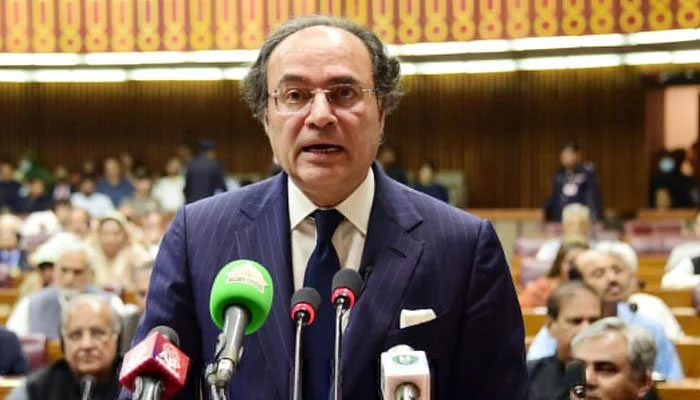
PESHAWAR: Federal Finance Minister Muhammad Aurangzeb on Thursday ruled out the need to appeal to the United Nations (UN) for flood-related assistance, stating that Pakistan has sufficient resources within its development budget of Rs4.3 trillion (US$12–13 billion) for rescue and relief operations.
He stated that effective prioritisation and coordination between the federation and provinces would allow the government to repurpose these funds to address the devastation caused by the recent floods, which badly hit agricultural lands across the country.
Addressing Pakistan Business Summit here as keynote speaker, the finance minister said Pakistan had made a significant improvement in remittances, which reached $38 billion last year and are projected to grow to $41-43 billion in the current fiscal year.
The federal minister said that Pakistan successfully repaid US$500 million in Eurobond obligations in September this year without market disruption and it is well-positioned to repay the US$1.3 billion Eurobond in April 2026.
The conference was the first major business activity in Khyber Pakhtunkhwa’s capital city in years as policymakers, investors and corporate leaders from across the country participated in the event under the theme of “Shaping What’s Next”.
The conference was jointly organised by Nutshell Group and Al Baraka Bank (Pakistan) Limited at the city’s lone five-star hotel.
The summit was also addressed by acting president and chairman Senate Yusuf Raza Gilani, KP Governor Faisal Karim Kundi, Federal Minister for Privatisation Mohammad Ali, KP Advisor for Finance Muzammil Aslam, former minister Mohammad Azfar Ahsan and others.
Aurangzeb said that the remittance inflows into the formal economy had increased. “Last year, we had US$38 billion in remittances. This year, we expect US$41-43 billion,” he said.
He maintained that the policy rate, which remains at 11 per cent, is expected to be lowered in the ongoing fiscal year. “Although the policy rate is very much the domain of the central bank, I think there is enough cushion that we can continue to push the rate south during the course of this fiscal year,” he added.
Aurangzeb said that in order to take the private sector forward, a structural reform agenda should be pursued effectively. He said that the government needed to restore the trust and credibility of tax authorities in the country. “We are making progress in both deepening and widening the tax base,” he added.
The finance minister said that the federal board of revenue has been reduced to a tax/revenue collection forum and the economic policymaking has been shifted to the finance division.
The budget for the next fiscal year would be delivered by the tax policy office of the finance division, he added.
On the privatisation front, Aurangzeb said that 24 state-owned enterprises have been handed over to the Privatization Commission.
About foreign direct investment and the road-to-international market, the finance minister said that recent visits to Beijing, Riyadh and New York yielded tangible results. In Beijing, he said 24 joint ventures not just memorandums of understanding (MoUs) were inked.
In New York, Aurangzeb said that the US and Pakistan reached important understandings in minerals, IT, AI, agriculture and pharma sectors. “The ball is in our court now. It is now up to us as to how we can gather maximum advantages of the progress we made in the leading world markets,” he added.
The minister said that climate change and population growth were the real challenges faced by the country, which required immediate and vibrant attention. “There is no room to wait for economic recovery first and focus attention on these challenges later. Unless these two challenges are properly addressed, no progress can be made,” he warned. Acting President Yusuf Raza Gilani on Thursday said that Pakistan’s economy was showing signs of stability, with sustainable growth, rising investment inflows, and improved economic indicators proving that the country was “moving in the right direction”.
Speaking at the Pakistan Business Summit, Gilani stressed that climate change was no longer a distant threat but a present challenge already impacting people’s daily lives, and urged timely and effective measures to counter its effects. He underscored the urgent need for a vibrant tax system, digital business incubation centres, and market-oriented higher education to strengthen the economy. “More reforms in the agriculture sector are required, and value addition must be prioritised to boost productivity,” he said, adding that greater focus was also needed on the textile industry and responsible mining in mineral-rich regions.
The acting president said Pakistan’s strategic location was one of its greatest assets, and regional connectivity projects must be advanced to fully utilise this advantage. He urged participants to turn the summit into a “movement for moving forward”.
Touching on youth empowerment, Gilani noted that 60 per cent of Pakistan’s population comprised young people, including women. He called for strategies to channel their talent into productive sectors, highlighting the global demand for skilled labour. “Skilled workers cannot be produced through the traditional FA and BA education, nor should attention be focused solely on IT and AI,” he remarked.
On tourism, he said Khyber Pakhtunkhwa (KP) had immense potential, especially for religious tourism, given its Buddhist heritage sites in Swat. He stressed that “security and liberty” were essential to unlock the sector’s growth.
Recalling his decisions as prime minister in the fight against militancy, Gilani said that military action was launched only after militants reneged on peace agreements. He claimed that Pakistan had set a global precedent by rehabilitating 2.5 million displaced persons in less than 90 days, despite personal sacrifices, including the kidnapping of his own son by militants.
On regional ties, Gilani reiterated Pakistan’s desire for an “independent, sovereign, stable and prosperous Afghanistan,” welcoming Kabul’s recent assurance that its soil would not be used against Pakistan. He also said Pakistan wanted better relations with all neighbours, including India, “but not at the cost of its own people.”
“We want peace and stability in the country, and for that, all Pakistanis—regardless of political affiliation—are united,” he concluded.
Governor Khyber-Pakhtunkhwa Faisal Karim Kundi lauded the organisers of the Pakistan Business Summit, saying the event would help attract much-needed business and investment to the province.
Highlighting KP’s strengths, he said the province had vast potential in tourism, religious tourism, natural resources, petroleum, gas, and cheap hydel power. He, however, regretted that commitments made at the time of the merger of erstwhile FATA into KP had not been honoured. “The Rs100 billion annually promised for the merged districts and the 3 percent share of the NFC award have yet to be released,” he said, alleging that whatever limited funds were allocated were spent under other heads.
Former investment minister and summit host Mohammad Azfar Ahsan said Peshawar was chosen as the venue to showcase the province’s untapped investment opportunities and to highlight the values of Pakhtun society. Federal Minister for Privatization Mohammad Ali also addressed the session.
At the summit, awards were presented to Dr Rahman of RMI, Dr Abdul Bari Khan of Indus Hospital, and squash legend Jahangir Khan for bringing international recognition to Peshawar through their achievements. Closing the summit, former Air Chief Marshal Sohail Aman said Pakistan was at an “opportune moment” where a favourable external environment, internal cohesion, a willing private sector, and government support created the “perfect time to lift off.”


-
 Aurangzeb confirms Saudi Arabia $10bn interest, says B2B shift ongoing
 -
 Pakistan to build artificial island to boost oil exploration
 -
 Special pink bus service launched for women on Green Line route
 -
 Same number plates from other provinces lead to wrong e-challans for Karachiites
 -
 State institutions ‘fail’ to perform constitutional duties: KP CM
 -
 CTD orders psychological testing of police on VVIP security duty
 -
 Navy busts drug consignment valued at $130m
 -
 Three ex-secretaries in race for ETPB chief post