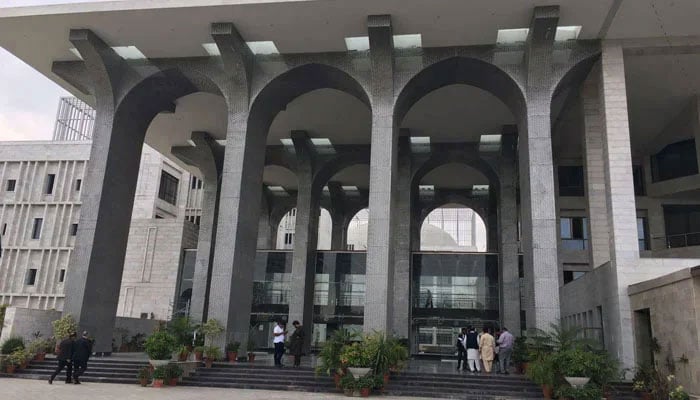
ISLAMABAD: The Islamabad High Court has dismissed a writ petition challenging an interim maintenance order, delivering a strongly-worded judgment that criticized the petitioner’s use of derogatory language against his estranged wife and condemned the practice of filing restitution of conjugal rights suits merely to obstruct maintenance claims.
Justice Muhammad Azam Khan heard the case in which petitioner Umar Akbar Ali Ghumman had challenged an order passed by the Guardian Judge, East-Islamabad, on March 6. The impugned order had fixed interim maintenance at Rs15,000 per month for his wife, Maria Javed Cheema, and Rs.30,000 per month for each of their two minor children, effective from December 2024.
The dispute arose after the respondent wife and children filed a suit for recovery of maintenance in November 2024, seeking past maintenance of Rs4,664,485 and future maintenance of Rs200,000 per month with annual enhancements. The couple, who married in March 2011, had been living separately due to irreconcilable differences. The petitioner had filed two separate suits for restitution of conjugal rights, first in Gujranwala in May 2024, which he withdrew, and then in Wazirabad in September 2024, which resulted in an ex-parte decree that was subsequently set aside.
The petitioner’s counsel argued that the maintenance order was excessive and unjust, claiming the wife had refused to reconcile despite his numerous attempts. He contended that she was disobedient and therefore not entitled to maintenance unless she rejoined him to fulfil her matrimonial obligations. The respondent’s counsel defended the trial court’s order as well-reasoned and appropriate given the circumstances.
Justice Khan rejected these arguments, describing the petitioner’s contention that his wife was disobedient and therefore not entitled to maintenance as reeking of bigotry and patriarchy, calling it a true reminder of archaic male chauvinism. The court observed that suits for restitution of conjugal rights are often filed by husbands to counterblast maintenance claims, with the intent to oust the wife’s right to maintenance camouflaged behind such legal actions.
The judgment cited the Supreme Court’s observation in a 2023 case that emphasized such claims must be lodged in good faith with genuine intent to reconcile, not as tools to frustrate legitimate claims for maintenance or dower. The court noted that many women are either thrown out of their homes or compelled to leave, and when they seek maintenance, husbands respond with restitution suits merely to prove their bona fides and deny maintenance rights.
Justice Khan clarified that Section 9 of the Muslim Family Laws Ordinance, 1961, places no conditions on a wife’s right to maintenance. The provision is unequivocal and does not permit the importation of extraneous conditions derived from commentaries on Mohammedan Law. The court emphasized that a legally wedded wife is entitled to maintenance during the subsistence of marriage without needing to satisfy additional criteria not found within the statute itself.
The judgment also addressed the status of D.F. Mulla’s Principles of Mohammedan Law, noting that while frequently cited in Pakistani courts, it is merely a reference book and not statutory law. The Federal Shariat Court has held that such texts can be consulted but are not binding, particularly when found opposed to justice, equity and good conscience. Courts retain the discretion to deviate from viewpoints expressed in such commentaries, especially when contrary to principles of fairness.
Recognizing that the maintenance suit must be concluded within six months as prescribed by law, the court directed the trial court to decide the matter preferably within two months to limit the petitioner’s burden of interim maintenance.
Justice Khan expressed concern over the language used by the petitioner against his wife throughout the proceedings. Terms such as “undaunted,” “selfish,” “wayward,” “arrogant,” “a woman of willfulness,” “bigoted attitude,” and “disobedient lady” were noted as reflecting mala fide intent behind filing the restitution suit. The court observed that such expressions contradict the very essence of restitution suits, which should aim to preserve the matrimonial bond with dignity and kindness, not humiliate or coerce the other party.
The court dismissed the petition as devoid of merit, finding no illegality, jurisdictional error, or factual irregularity in the trial court’s order.


-
 Aurangzeb confirms Saudi Arabia $10bn interest, says B2B shift ongoing
 -
 Pakistan to build artificial island to boost oil exploration
 -
 Special pink bus service launched for women on Green Line route
 -
 Same number plates from other provinces lead to wrong e-challans for Karachiites
 -
 State institutions ‘fail’ to perform constitutional duties: KP CM
 -
 CTD orders psychological testing of police on VVIP security duty
 -
 Navy busts drug consignment valued at $130m
 -
 Three ex-secretaries in race for ETPB chief post