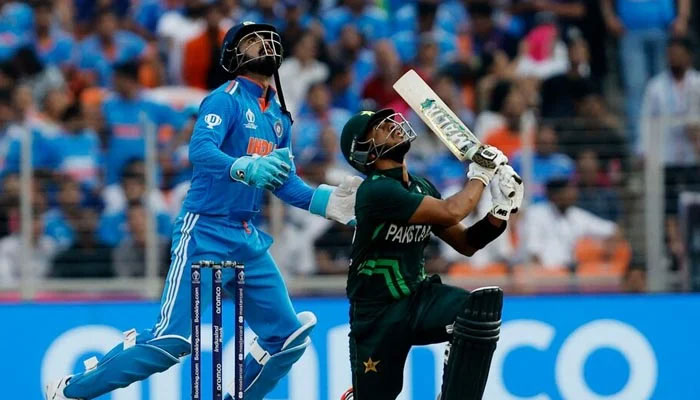
Pakistan and India played three cricket matches recently as part of the Asia Cup. India won all three. But did the Indians really win at all?
They began the tournament by refusing to shake hands with the Pakistan team, followed that by presenting their first victory as payback for Pahalgam and finished by refusing to accept the Asia Cup Trophy from the current president of the Asian Cricket Council, merely because he is a Pakistani.
The Indian cricket team was by no means alone in their conflation of war and sport. Hours after the match ended, Prime Minister Narendra Modi tweeted “#OperationSindoor on the games field. Outcome is the same – India wins”.
Does any of this matter? After all, why shouldn’t cricket be a continuation of politics by other means? What do we lose when a game can no longer be just a game?
To answer, what we lose is the ability to perceive a common humanity. The foundation of sports is not competition or the desire to dominate but the human need to play; to share a moment of joy. And if we see our opponents not as humans but as intrinsically evil, then all possibility of compromise or peace disappears. That way madness lies.
The sad part is that Pakistan and India know all too well the dangers of demonising the other. Those who survived Partition are now mostly gone but the horrors of that age live on in our memories. My late father was nine years old in 1947. He remembered being told by his father to shoot his mother and sisters first, if the walls of the house were breached. That trauma stayed with him for many years, till he started playing bridge with Yogesh Tiwari, then the Indian high commissioner to Singapore. And that friendship, forged through sport, was enough to wipe out the four decades for which he had carried around his hate.
The ironic part is that India’s demonisation of Pakistan (and its own Muslim citizens) does not make Pakistan weaker: if anything, it makes us a stronger, better country.
Three decades ago, the question debated over and over by secular liberals in Pakistan was: why Pakistan? Why carve a country out of united India? Today, that question is moot. Today, the ruling BJP openly campaigns using anti-Muslim slogans like “let’s burn this vermin”. Nobody now asks, “why Pakistan?” The answer is self-evident.
When India was secular, many Pakistanis felt the need to justify their country in expressly religious terms. That sentiment was in turn exploited for communal purposes by our own coterie of bigots, not just in terms of Muslim vs Hindu, but also Shia vs Sunni.
Today’s Pakistan is more emotionally secure. Our identity no longer requires us to demonise others (though many still try). One way to gauge this shift is to note the intensity with which the armed forces celebrate non-Muslim officers. Another shining example is that of Kartarpur which was inundated by the recent floods. The COAS made a special visit to Kartarpur to reiterate Pakistan’s support for minority rights and CM Maryam Nawaz then followed up by ensuring that Kartarpur was drained and cleared as expeditiously as possible.
Wasn’t this all just political theatre? Of course it was. But a state’s choice of script speaks volumes about its political choices. India has chosen to demonise its minorities. Pakistan has now chosen to embrace them.
I understand that Pakistan is no paradise for Christians or Hindus. But at least we are going in the right direction. What I see on the other side of the border is an open embrace of hatred. And yes, history teaches us that many times, hatred can fuel short-term political gain. But history also teaches us that bigots who fuel those fires are ultimately reviled.
What Pakistan lost on Sunday was a match. What India lost was its dignity.
The writer is a lawyer of the Supreme Court. The views expressed in this column do not represent the views of his firm. Twitter: @laalshah