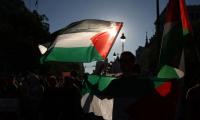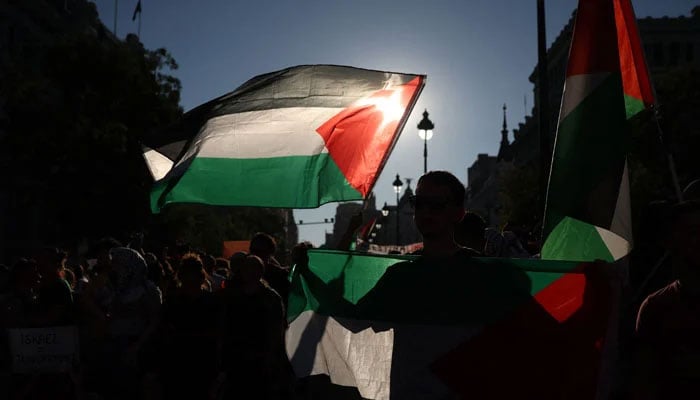
The vast majority of the world accepts the Palestinians have a state. And yet they continue to be treated as if they do not, with many experiencing the soul-crushing reality of statelessness at borders and in immigration detention.
As a freelance English-Arabic interpreter with Respond Crisis Translation, I frequently support asylum seekers in detention. I have seen firsthand what it is to be a Palestinian stuck in the increasingly inhumane US immigration system.
I met Mohammad (not his real name) while interpreting during his legal proceedings, and over time I interpreted for him on multiple occasions as his lawyer sought to secure his release from detention by the US Immigration and Customs Enforcement (ICE).
Mohammad decided to escape Gaza before Israel launched its genocidal war. But when he fled his home, he didn’t find freedom.
The journey was brutal and full of precariousness. He was stranded in countries that refused to recognise his homeland or the documents he was carrying; he was kidnapped by cartel groups, beaten, threatened, and robbed of his money. At last, he reached the US. There, believing that, perhaps, the “American dream” could offer him safety, sanctuary and freedom, he encountered ICE.
Mohammad had escaped one prison only to be thrown into another. The cruelty was so relentless that he went on a hunger strike – when he stopped eating, the voice of his hunger was his loudest and only voice, a desperate plea for release.
His hunger strike was more than a refusal of food. It was a refusal of invisibility. A body breaking itself to be heard. He reported being humiliated, placed in solitary confinement, and subjected to psychological pressure during his hunger strike. The hunger strike – meant to assert dignity – became another site of punishment.
Mohammad was forced to break the hunger strike after the court made clear that it would only consider him for release if he was deemed mentally stable and medically clear. To meet this requirement and have a chance at leaving detention, he had no choice but to break his hunger strike.
When Mohammad eventually decided to accept deportation, the court heeded his request. The judge and prosecutor agreed: If he did not wish to stay, he could be deported. But deported to where? The paperwork read “Palestine”, a word that holds meaning for him but exists only fleetingly in the US immigration system. The US does not recognise Palestine as a state, so the court defaulted to “Israel”. But Israel, which occupies the Palestinian territory, does not grant Palestinians free entry to Gaza, nor can they simply enter the West Bank.
For Palestinians, especially from Gaza, borders are not merely lines on a map – they are walls of steel, bureaucracy and laws. You may say that entry is possible through neighbouring countries. Before the war, Palestinians from Gaza could only go back home through Egypt or Jordan. Egypt’s Rafah crossing is now closed. Jordan bars entry unless a Palestinian holds special permits, rare and almost impossible to obtain. Even when “home” is written on a deportation order, it may remain unreachable.
Mohammad’s imagined “redemption” – which was going to the war – was a mirage. Leaving the US system did not mean regaining freedom. It meant facing the cruel truth: To be a Palestinian today is to live without exits, without safe havens, without the guarantee of a return even to the unknown. Even deportation, a process that for others may mean going “back”, for people from Palestine is only another trap.
Excerpted: ‘The world recognises Palestine, yet it treats the Palestinians as stateless’. Courtesy: Aljazeera.com