
Saudi-Pakistan defence pact highlights Gulf’s evolving strategic calculus: report
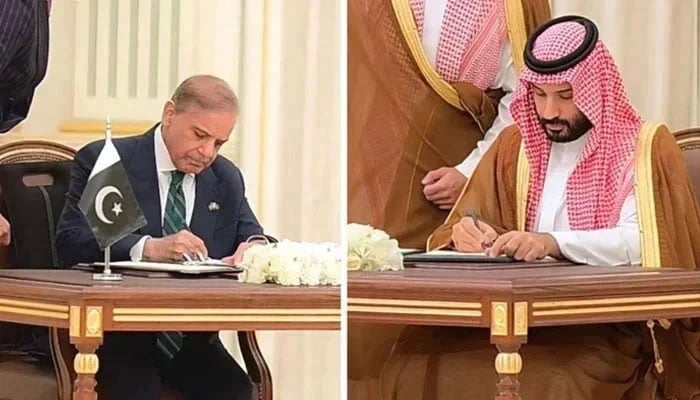
WASHINGTON: For Saudi Arabia, the surprise mutual defense pact signed last week with Pakistan during Prime Minister Shehbaz Sharif’s visit to Riyadh is a double deterrence tool, the Atlantic Council reported. The Strategic Mutual Defense Agreement (SMDA) “states that any aggression against either country shall be considered an aggression against both”, and “aims to develop aspects of defense cooperation between the two countries and strengthen joint deterrence against any aggression.”
Although no further content has been made public, the pact “encompasses all military means,” from armed forces and nuclear cooperation to intelligence sharing. Islamabad openly stated that it “will make available” its nuclear program to Riyadh if needed. This agreement is also designed to support Saudi defense autonomy in the long-term: defense industry collaboration, technology transfer, military co-production, capacity-building and training are also part of the pact.
The agreement strengthens Riyadh’s defense with respect to Israel. Signed in the wake of Tel Aviv’s shocking attack on Qatar earlier this month, the announcement’s timing is a warning message to discourage Tel Aviv from considering further attacks on the Gulf Cooperation Council (GCC) states.
However, the pact is the outcome of a long-negotiated agreement primarily aimed, in Riyadh’s perspective, at reshaping the Gulf security equation. Washington’s response over Israel’s unprecedented strike on one of its most key allies in the Gulf put on display for Saudi Arabia that Gulf security can no longer be assured by a single external security provider. US President Donald Trump’s administration, in fact, reaffirmed its support to the Israeli government, only providing verbal reassurances to Doha and the GCC states.
Looking at Gulf-Asia ties, the pact may have implications on the Saudi-India partnership, which has been on the rise in recent years, since it may complicate efforts to deepen the Saudi-India economic partnership, slowing the implementation of the India-Middle East-Europe Economic Corridor (IMEC). Furthermore, the mutual defense pact introduces a new security layer in the Gulf that could be replicated by other actors, triggering further mutual defense agreements between Gulf and Asian powers, likely the United Arab Emirates (UAE) and India.
The landmark pact with nuclear-armed Pakistan highlights Saudi Arabia’s evolving calculus with respect to its special relationship with the United States. In Riyadh’s multi-aligned policy, signing a mutual defense deal with Pakistan is complementary, not alternative, to Washington’s security guarantees—even though Islamabad is an ally of China.
Three emerging dynamics are challenging established balances for Saudi: the waning of US deterrence and Israel’s unrestrained military strategy. These factors are all pushing Riyadh, and the wider GCC to step up national defense through multiple deterrence strategies.
The mutual defense agreement: Upgrading historical Saudi-Pakistani cooperation
The agreement develops from the historical security and defense cooperation between Saudi Arabia and Pakistan, from the “Treaty of Friendship” signed in 1951 to the 1982 Organization Agreement that allowed Pakistani troops to station in the Kingdom for training. Regarding the Saudi-Pakistan relationship, both parties have incentives to cooperate: Saudi Arabia is the leader of the Islamic world, a major economic power, and close to become Islamabad’s largest external financier with over $6 billion in loans and deposits; Pakistan, meanwhile, possesses nuclear weapons and larger armed forces personnel.



-
 State institutions ‘fail’ to perform constitutional duties: KP CM
 -
 CTD orders psychological testing of police on VVIP security duty
 -
 Navy busts drug consignment valued at $130m
 -
 Three ex-secretaries in race for ETPB chief post
 -
 Punjab govt forms 71 JITs to probe cases against banned TLP
 -
 Some UNSC members ignoring broader reforms, seeking privilege: Pakistan
 -
 PAC body discusses non-recovery of Rs15bn gas cess
 -
 Pakistan received $2.29bn foreign loans in first 4 months of 2025