CPEC enters Phase-II as Pakistan, China draw roadmap for next decade : Resolution eludes issue of payment to Chinese IPPs as JCC meet ends in Beijing
Ahsan says 14th JCC was not just review of past progress, but reaffirmation of collective resolve to deepen cooperation
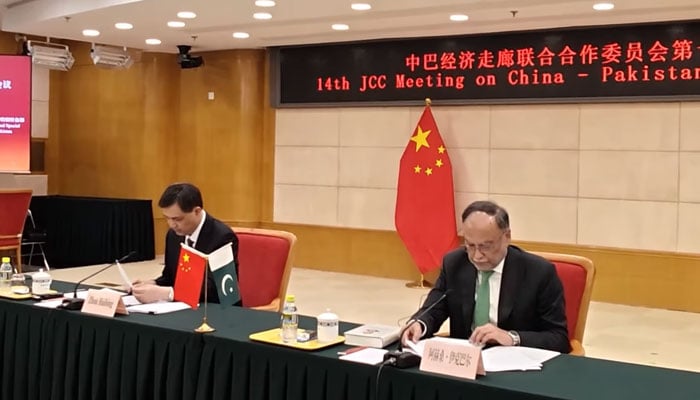
ISLAMABAD: Without resolving the lingering capacity repayments to Chinese Independent Power Producers (IPPs), the 14th Joint Cooperation Committee (JCC) meeting of the China-Pakistan Economic Corridor (CPEC) concluded in Beijing on Friday, marking a historic milestone as the partnership between Pakistan and China entered CPEC Phase-II.
“Together, these priorities will transform CPEC into a corridor of industrialisation, technology, sustainability, and shared prosperity,” Pakistan’s minister for planning stated. The convergence is not abstract, but anchored in the action plan to foster an even closer China-Pakistan community with a shared future, signed in Sept 2025. This plan lays out a comprehensive agenda covering industrial cooperation, Special Economic Zones, agriculture modernisation, maritime development, mining, and flagship connectivity projects such as ML-1 Railway, Karakoram Highway (KKH) realignment, and Gwadar development. However, the sources said that the Chinese IPPs issue could not be resolved as Islamabad wished to extend the repayment period. On the partial financing of the ML-1, China asks Islamabad for a certain commitment before finalising the financing agreement in the context of the ongoing IMF programme.
Federal Minister for Planning, Development, and Special Initiatives, Ahsan Iqbal, delivered the closing remarks, highlighting the shared vision, renewed determination, and ambitious roadmap that will shape the next stage of this transformative initiative. Addressing Vice Chairman of the National Development and Reform Commission (NDRC) Zhou Haibing, Chinese hosts, and delegates, Minister Ahsan expressed heartfelt gratitude for the wisdom and commitment that have defined the deliberations of the JCC. He underscored that the 14th JCC was not just a review of past progress, but a reaffirmation of the collective resolve to deepen cooperation and build a future of shared prosperity. Highlighting the forward-looking agenda, the Minister noted that CPEC Phase-II will be driven by the five corridors of growth, innovation, green development, livelihood, and regional connectivity. These will be aligned with Pakistan’s URAAN 5Es framework of Exports, E-Pakistan, Energy & Environment, and Equity & Empowerment. Minister Ahsan Iqbal stressed the urgency of implementing ML-1 and KKH realignment, noting their strategic importance for uninterrupted connectivity between Pakistan and China. He stressed that early execution of these projects would yield far-reaching economic dividends for the entire region. To ensure sustained momentum, he proposed holding JCC meetings every six months and convening Joint Working Groups quarterly during the first three years of Phase-II. This institutional strengthening, he said, will guarantee effective coordination, timely decision-making, and results-oriented progress.
Acknowledging the geopolitical challenges and propaganda by anti-CPEC forces, the minister urged swift agreement on the JCC minutes to send a strong signal of unity and decisiveness. He announced that Pakistan and China had agreed to publish an updated CPEC long-term plan within 90 days, reflecting the convergence of Pakistan’s 5Es with the five corridors of CPEC 2.0. Reassuring Chinese partners, Ahsan Iqbal affirmed Pakistan’s unwavering commitment to the safety and security of all CPEC projects and every Chinese national working in Pakistan. He described CPEC not only as a development initiative but as a symbol of the iron-clad friendship between Pakistan and China, underpinned by trust, stability, and mutual respect.
“CPEC is about making China and Pakistan not only all-weather friends, but also partners in high-quality development and innovation for the 21st century,” he said. Concluding his remarks, the minister extended deep gratitude to the leadership of both countries, the NDRC, and all delegates for their invaluable contributions. With renewed determination, he expressed confidence that the next decade of CPEC would bring even greater transformation than the last. He proposed that the 15th JCC meeting be held in May 2026 in Islamabad, coinciding with the 75th anniversary of diplomatic relations between Pakistan and China, further cementing the historic ties between the two nations.


-
 Aurangzeb confirms Saudi Arabia $10bn interest, says B2B shift ongoing
 -
 Pakistan to build artificial island to boost oil exploration
 -
 Special pink bus service launched for women on Green Line route
 -
 Same number plates from other provinces lead to wrong e-challans for Karachiites
 -
 State institutions ‘fail’ to perform constitutional duties: KP CM
 -
 CTD orders psychological testing of police on VVIP security duty
 -
 Navy busts drug consignment valued at $130m
 -
 Three ex-secretaries in race for ETPB chief post