Necropolitics of hunger
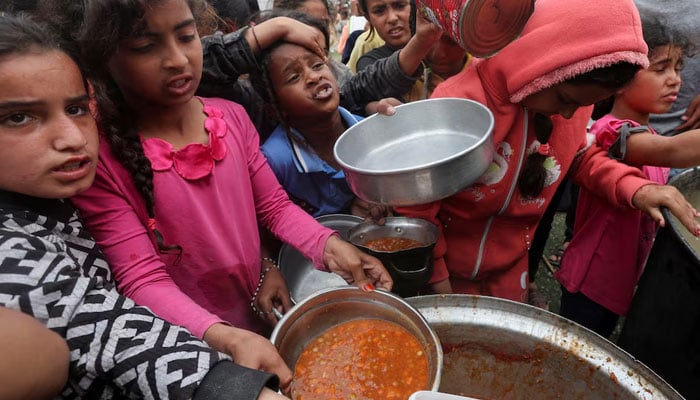
While starvation profoundly affects individuals across all age groups, this essay focuses specifically on Palestinian children to illuminate how deliberate starvation strategies are designed to compromise the futurity of the Palestinian nation by systematically destroying its youngest generation. Beyond the immediate devastation, Palestinian children’s physical health, mental well-being, and emotional development are being deliberately compromised through weaponized hunger. This analysis examines how starvation functions not merely as a byproduct of armed aggression, but as a calculated tool of necropolitical warfare aimed at foreclosing Palestinian futures (Mbembe, 2003) – a process enabled by the global racial hierarchies established through coloniality (Quijano, 2000).
Theoretical Framework: Necropolitics and the Politics of Unchilding: The genocide and the systematic starvation of Palestinian children must be understood as a manifestation of the enduring coloniality of power (Quijano, 2000), which establishes a global racial hierarchy that constructs non-European lives as expendable, and as a direct application of Achille Mbembe’s (2003) necropolitics: the sovereign power to decide who may live and who must die. This necropolitical power is exercised upon a population already prefigured as inferior and killable within Quijano’s colonial hierarchy. Applied to Palestine, this sovereign power operates through the calculated weaponization of basic needs against developing minds and bodies.
Palestinian scholar Nadera Shalhoub-Kevorkian’s (2019) concept of unchilding provides a complementary analytical lens, exposing “the political work of violence designed to create, direct, govern, transform, and construct colonized children as dangerous, racialized others, enabling their eviction from the realm of childhood itself” (p 122). Together, these frameworks reveal how hunger functions as a deliberate necropolitical tool, operating within and sustained by a global structure of coloniality that naturalizes Palestinian suffering.
The complete siege imposed after October 2023 intensified pre-existing conditions catastrophically. By early 2024, a UN-backed initiative classified the entire population of Gaza at risk of famine (IPC, 2024). The World Health Organization reported that acute malnutrition among children under two in northern Gaza soared from less than 1% before the escalation of the genocide to over 15% by February 2024 (WHO, 2024). Despite all these warnings, no serious action was taken. On August, 22, 2025, according to a new Integrated Food Security Phase Classification (IPC) analysis, “more than half a million people in Gaza are trapped in famine, marked by widespread starvation, destitution, and preventable deaths. Famine conditions are projected to spread from Gaza Governorate to Deir Al Balah and Khan Younis Governorates in the coming weeks.” (WHO, 2025)
Physical and Biological Impacts: The Neurochemistry of Necropolitical Violence: Severe malnutrition constitutes a systematic, biological dismantling of the developing brain, directly serving the necropolitical objective of foreclosing future potential. This process operates through a well-understood neurochemical cascade. Chronic hunger and the pervasive terror of bombardment trigger a constant state of fight or flight, leading to persistently elevated levels of the stress hormone cortisol. This hormonal deluge is acutely toxic to the hippocampus, a brain region fundamental for memory consolidation, learning, and emotional regulation (Carrion et al, 2007). Research demonstrates that in children, this exposure to extreme stress and cortisol correlates with measurable reductions in hippocampal volume – a physical shrinking of the brain’s architecture essential for forming the building blocks of education and stable mental health (Carrion et al, 2007). This is not a metaphorical assault but a literal, biological one: necropolitics operating through neurochemistry, where sovereign power dictates not just death, but a degraded form of life inscribed in the very matter of the brain.
The damage extends beyond isolated structures. Sustained high cortisol disrupts the healthy development of neural networks, effectively rewiring the brain for survival at the expense of growth. The brain prioritizes hyper-vigilance–constant scanning for threat – over the development of circuits dedicated to learning, memory, and higher-order cognition (Blankenship et al, 2019). Blankenship et al (2019) found that cortisol reactivity in preschoolers predicted altered functional connectivity in the hippocampus years later, demonstrating how early trauma embeds itself in the brain’s long-term communication pathways. For a child in Gaza, this neurobiological reality translates to a crippled capacity to concentrate in a classroom (if one exists), to form stable memories of lessons, or to regulate the overwhelming fear and anger that are natural responses to relentless trauma. The weaponization of hunger thus achieves a key necropolitical aim: it biologically engineers a population whose cognitive resources are so depleted by the demands of survival that the possibility of prosperity and growth is systematically erased.
Cognitive Devastation and Prefrontal Cortex Compromise: The cognitive impacts of this neurobiological assault are severe, measurable, and tragically persistent. The landmark Barbados Nutrition Study provides a decades-long view of this devastation. It tracked infants who suffered severe malnutrition but then received nutritional recovery and adequate healthcare in childhood. Despite this intervention, these individuals showed profound and persistent cognitive deficits into midlife, including significantly poorer IQ, attention, and executive function compared to matched controls (Waber et al, 2014). This finding is critical: even if the bombs stop and food eventually arrives, the cognitive damage inflicted during critical developmental windows is largely permanent. The study suggests that early malnutrition can cost a child a standard deviation in IQ – approximately 10-15 points – a loss that severely limits educational attainment and future economic potential.
Neuroimaging reveals the structural basis of this compromise. The prefrontal cortex, the brain’s executive center responsible for complex decision-making, impulse control, and future planning, is particularly vulnerable to early adversity. Studies show that severe stress and malnutrition are associated with reduced prefrontal cortex volume and weakened connectivity to other brain regions (Hanson et al, 2013). This is the neuroarchitecture of lost potential.
Excerpted: ‘The Necropolitics of Hunger: Man-made Famine and
Futurity of the Palestinian Nation’.
Courtesy: Counterpunch.org