PPP slams govt over wheat import, flood relief
ISLAMABAD: The Pakistan People’s Party (PPP) on Wednesday defended the Benazir Income Support Programme (BISP) while criticising the government’s handling of wheat imports and flood relief, saying that farmers and the poor were being pushed to the wall while the Punjab government was shirking its responsibility to provide relief to flood-hit farmers.
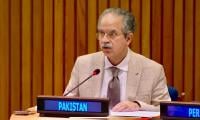
PPP leaders Nadeem Afzal Chan, the party’s Information Secretary, and Chaudhry Manzoor Ahmed, In-charge of the PPP Labour Bureau, addressed a press conference at the party secretariat where they outlined the party’s stance on welfare, agriculture, and the flood crisis.
Nadeem Afzal Chan said the Punjab government was failing to fulfil its responsibility of providing relief to farmers affected by the recent floods.
He emphasised that the Benazir Income Support Programme was the only welfare initiative in Pakistan that had received international recognition and praise. Initiated for the underprivileged, BISP was the dream of Shaheed Mohtarma Benazir Bhutto and was practically launched by President Asif Ali Zardari. Today, it benefits nearly 10 million poor families.
Chan criticised the Jamaat-e-Islami (JI) for recently branding BISP a fraud, reminding that it was the same Jamaat-e-Islami which recruited innocent citizens in the name of the Afghan Jihad and collected billions of rupees for that failed project. “Was the Jamaat-e-Islami’s Jihad project a success or a failure?” Chan asked, adding that the JI had sacrificed innocent lives in a futile war.
He said BISP’s reliable data could be used to provide relief to flood victims. “Will international institutions depend on patwari records for aid distribution?” he asked. “Our demand is not about whose picture is displayed on the aid packages. Anyone is free to put their picture, from the ballot box to the grave.”
Highlighting the PPP’s track record, he said that Pakistan had achieved a wheat surplus only during the PPP’s tenure.
He recalled that President Asif Ali Zardari had suggested setting the support price at Rs4,000, but the present government was instead benefiting foreign farmers at the cost of local ones.
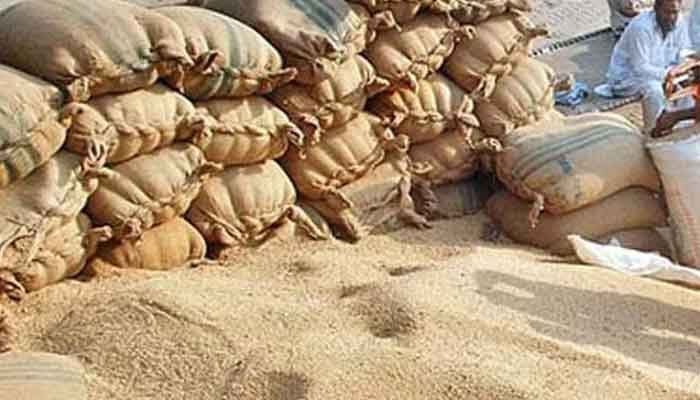
He revealed that wheat worth Rs2 trillion had already been imported, with another Rs5 trillion to follow, yet no relief was being provided to domestic farmers. Chaudhry Manzoor Ahmed, speaking next, said questions remained as to whether water had been deliberately used as a weapon. “If India carried out water aggression, how is it that East Punjab also faced devastation? Embankments were broken in many places—some to prevent greater damage, but others due to sheer negligence of the Punjab administration,” he said.
He emphasised that only BISP had the infrastructure reaching down to the Union Council level to deliver aid efficiently. “We are not demanding that Benazir’s picture be displayed on relief packages. But apart from BISP, there is no other mechanism with such reach,” he added.
Manzoor also accused the Jamaat-e-Islami of exploiting the poor by pushing them into Zia-ul-Haq’s so-called Jihad project. “That project was fraudulent, a failure, and history has proven it. The JI even won seats in elections under the cover of that scheme. They must confine themselves to politics instead of exploiting people’s lives,” he said.
The PPP Labour Bureau in-charge said the party did not wish to politicise the floods but wanted to present facts and figures.
He criticised the government for hiding behind IMF conditions instead of buying wheat from local farmers. By importing 3.5 million tons of wheat, he said, the government had economically devastated Pakistani farmers.
He said that only 800,000 tons of wheat were currently in reserve against the required 2.8 million tons. “Why is the government not allowing wheat to move to Khyber Pakhtunkhwa? Why impose a ban on inter-provincial transport of wheat, making bread more expensive in smaller provinces?” he asked.
On the scale of destruction, Manzoor said: “The greatest losses from the floods have been in East and West Punjab. The real question is: did we drown naturally, or were we drowned?”
He said that crops and the economy had suffered the most.
Referring to Punjab Chief Minister Maryam Nawaz’s announcement of Rs20,000 per flood victim, he asked: “On what basis was this figure calculated? Twenty thousand Indian rupees equals sixty-five thousand Pakistani rupees. In Indian Punjab, fertilizers and pesticides are cheaper, and farmers are exempt from electricity bills, while here, bills are waived only in areas where there is no power at all.”
Listing the devastation, he said maize, turmeric, cotton, and sugarcane crops had been destroyed, with each acre suffering at least Rs500,000 in losses.
He urged the government to provide alternative state-owned agricultural land to farmers whose lands had been rendered unusable by the floods. “The Punjab government is mocking our demands as well as the farmers’ plight. The BISP, with its geo-tagged database, is the only credible mechanism for relief distribution—and it has been used effectively in the past,” he concluded.


-
 Aurangzeb confirms Saudi Arabia $10bn interest, says B2B shift ongoing
 -
 Pakistan to build artificial island to boost oil exploration
 -
 Special pink bus service launched for women on Green Line route
 -
 Same number plates from other provinces lead to wrong e-challans for Karachiites
 -
 State institutions ‘fail’ to perform constitutional duties: KP CM
 -
 CTD orders psychological testing of police on VVIP security duty
 -
 Navy busts drug consignment valued at $130m
 -
 Three ex-secretaries in race for ETPB chief post