Trump new Gaza ‘peace’ plan presented to Muslim leaders: envoy

NEW YORK: US President Donald Trump has presented leaders from several Muslim-majority countries with a 21-point plan peace plan for the Middle East and Gaza, US special envoy Steve Witkoff said on Wednesday, adding that he is confident of “some sort of breakthrough” in the coming days.
Trump on Tuesday met leaders and officials from Saudi Arabia, the UAE, Qatar, Egypt, Jordan, Turkey, Indonesia and Pakistan to discuss the nearly two-year-long war in Gaza between Israel and Palestinian militants Hamas. The meeting was held at the UN on the sidelines of the annual General Assembly.
“We had a very productive session. We presented what we call the Trump 21-point plan for peace in the Mideast and Gaza. I think it addresses Israeli concerns and, as well, the concerns of all the neighbours in the region,” Witkoff told the Concordia summit in New York.
“We’re hopeful, and I might say, even confident that in the coming days we’ll be able to announce some sort of breakthrough,” he said.
Trump is due to meet Israeli Prime Minister Benjamin Netanyahu in Washington on Monday.
An October 7, 2023, Hamas attack on Israel triggered the war in Gaza. Hamas killed 1,200 people, mostly civilians, and about 251 were taken hostage, according to Israeli tallies. More than 65,000 people, also mostly civilians, since have been killed during the war in Gaza, according to local health authorities.—Reuters
News Desk adds: The US and eight Arab League and OIC member states issued a joint statement on Wednesday calling for an immediate ceasefire in Gaza, humanitarian access and a comprehensive reconstruction plan for the war-torn enclave.
The statement, released after a multilateral summit on the sidelines of the 80th session of the UN General Assembly on Tuesday, highlights “the unbearable situation in the Gaza Strip, including the humanitarian catastrophe and high human toll” and warns of its destabilising impact on the wider region and Muslim world.
The statement says the countries reject forced displacement in Gaza and emphasise the need to allow the return of those who had fled. The countries are calling for a ceasefire that would secure the release of hostages and ensure the delivery of sufficient humanitarian aid, describing it as the “first step toward a just and lasting peace”.
The joint declaration also speaks about the importance of safeguarding Jerusalem’s holy sites, ensuring stability in the West Bank and supporting Palestinian Authority reform. It endorses a Gaza reconstruction plan based on Arab and OIC proposals, to be backed by international assistance, with the goal of “rebuilding the lives of Palestinians in Gaza”.
The states have also pledged to work with US President Donald Trump and stressed “the importance of his leadership to end the war and open horizons for a just and lasting peace”, adding that the meeting be seen as the beginning of a process towards peace and regional cooperation.
The summit was co-hosted by President Trump and Qatar’s Amir Sheikh Tamim bin Hamad Al Thani. Other attendees included Prime Minister Shehbaz Sharif, King Abdullah II of Jordan, Turkish President Recep Tayyip Erdogan, Indonesian President Prabowo Subianto, Egypt’s Prime Minister Moustafa Madbouly, UAE Deputy Prime Minister and Foreign Minister Sheikh Abdullah bin Zayed Al Nahyan, and Saudi Foreign Minister Prince Faisal bin Farhan Al Saud. Trump’s delegation included US Secretary of State Marco Rubio and Treasury Secretary and Middle East Envoy Steve Witkoff.
While the joint statement outlines shared principles, Politico, a US-based political news outlet known for its in-depth coverage of government and policy issues, reported additional insights into the summit’s private discussions. In its exclusive news story, Politico cited six people familiar with the talks and stated: “President Donald Trump promised Arab leaders during a meeting Tuesday that he would not allow Israeli Prime Minister Benjamin Netanyahu to annex the West Bank”.
According to Politico, two of those sources said Trump was “firm on the topic” and pledged that Israel would not be permitted to absorb the West Bank, which is governed by the Palestinian Authority (not Hamas). Another person familiar with the discussions noted that, despite Trump’s promise, “a ceasefire to end Israel’s nearly two-year war against Hamas was nowhere close to fruition”.
Two additional sources told Politico that Trump’s team circulated a white paper outlining its war-end plan, which included the annexation pledge and proposals on governance and postwar security.
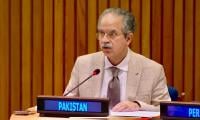
Talking to Shahzeb Khanzada on Geo News on Wednesday night, Defence Minister Khawaja Asif said Trump’s statement post-summit was encouraging in that Trump had “appreciated the talk that took place”. Asif said Muslim countries have together tried to offer a solution, adding that he wasn’t going to go into the details around that.
Asif said that a “seed has been sown” and that in the next “five or ten days perhaps some result will come through”. The defence minister said that, to his knowledge, Trump had “responded positively” to whatever took place at the summit.
Khawaja Asif also said that the streets of Western countries were seeing protests against Israel with scores of people in attendance, and that anti-Israel sentiment in the West was nearing 70 per cent. He said that this adds to the pressure and that some pressure was also building inside Israel.
On Trump and the US’s public stance regarding Israel, Khawaja Asif said that yes, their public stance has been pro-Israel, adding that Muslim countries have come up with a plan that would provide some respite to the people of Gaza and which would help reconstruct Gaza together and that the Muslim countries would then “guarantee the peace”.
Speaking about Pakistan’s role in today’s world, Khawaja Asif said that “these are not just optics. This also has substance....Pakistan and Prime Minister Shehbaz Sharif are getting a lot of importance here [New York]. Pakistan has secured a new place for itself in the international community. The way our armed forces have performed and the way our diplomacy has worked....Pakistan has made a place for itself in the international system”.
Meanwhile, South Asia analyst Michael Kugelman also wrote about Pakistan’s role in the current geopolitical situation, saying in an X (Twitter) post that “Pakistan is having its moment in the sun in global geopolitics, fleeting though it may be”. According to Kugelman, Pakistan is “leveraging its strategic value as a close partner of the Arab Gulf states—further amplified by its nuclear weapons status...”.


-
 Aurangzeb confirms Saudi Arabia $10bn interest, says B2B shift ongoing
 -
 Pakistan to build artificial island to boost oil exploration
 -
 Special pink bus service launched for women on Green Line route
 -
 Same number plates from other provinces lead to wrong e-challans for Karachiites
 -
 State institutions ‘fail’ to perform constitutional duties: KP CM
 -
 CTD orders psychological testing of police on VVIP security duty
 -
 Navy busts drug consignment valued at $130m
 -
 Three ex-secretaries in race for ETPB chief post