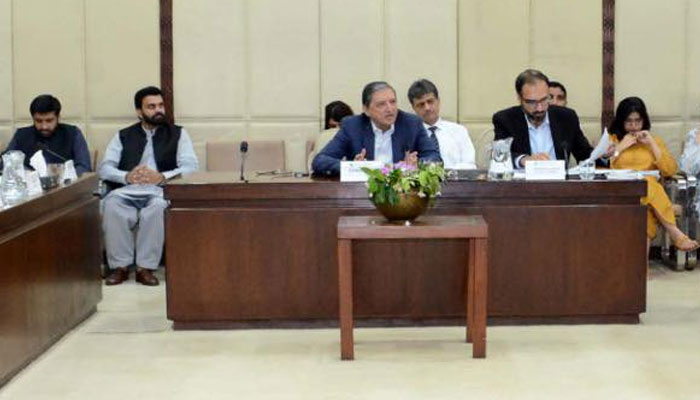
ISLAMABAD: The Senate Standing Committee on Finance expressed alarm on Wednesday over the steep rise in charges on overseas remittances, with Senator Faisal Vawda labelling the practice a “scam”.
The committee was informed that fees charged by Money Transfer Operators (MTOs) had jumped from Re1 to Rs4.5 per transaction, resulting in windfall gains of nearly Rs130 billion for banks and operators.
Briefing the committee, State Bank of Pakistan (SBP) Executive Director Inayat Hussain explained that under the Pakistan Remittance Initiative (PRI), remittances touched a historic $38 billion. The government had earlier incentivised inflows by paying banks and MTOs between 20 and 35 Saudi Riyals per transaction, but this has now been reduced to 20 Riyals for transactions of at least $200.
Inayat Hussain defended the charges, arguing that Pakistan’s average per-transaction remittance cost stands at $8.2, compared to $10.2 in India and $13.9 in Bangladesh. He added that rupee depreciation also contributed to higher operator costs.
Senator Saleem Mandviwalla, who chaired the meeting, pushed back, urging the SBP to restore the Re1 fee structure, arguing that the current charges enrich banks and MTOs without benefiting overseas Pakistanis.
Senator Vawda further alleged that MTOs were deliberately breaking down transfers to maximise fees. The SBP confirmed that last year the government paid Rs124 billion to subsidise remittance deductions, while this year’s outlay is projected between Rs80 and Rs100 billion.
The committee also raised concerns over charges collected by Visa and MasterCard on Pakistani credit cards denominated in US dollars, estimated to siphon off around $130 million annually. The SBP informed the panel that 70 per cent of cards in Pakistan are Visa and MasterCard, while 30 per cent are PayPak.
Meanwhile, the committee was informed by the Presidency’s Director General Law that the Federal Board of Revenue (FBR) had obtained a stay order from the Sindh High Court against a decision issued by the president. He contended that no court has the authority to overrule a presidential decision, terming the move unconstitutional.
Responding to the point, FBR Chairman Rashid Langrial explained that the Federal Tax Ombudsman (FTO) had previously ruled the matter outside its jurisdiction, prompting the applicant to approach the president. He clarified that the FBR accepts decisions upheld by both the FTO and the president, but since no ruling was given by the FTO in this case, the Board sought legal advice from the Attorney General.
Chairman Senator Saleem Mandviwalla recommended awaiting the Attorney General’s opinion before further deliberation. The matter was accordingly deferred.
Separately, the committee took up the Government Bill titled “The Virtual Assets Bill, 2025”, which had been referred by the House on August 15, 2025. Although discussed in the previous sitting, members reiterated the need for greater clarity from the relevant authorities. It was therefore decided to defer further consideration until the head of the proposed regulatory authority could brief the committee directly.
Separately, the Economic Coordination Committee (ECC) of the Cabinet approved the commercial import of five-year-old used vehicles with the imposition of a 40 per cent Regulatory Duty (RD), in addition to existing customs duties.
At present, customs duties on such vehicles, based on models and chassis numbers, hover around 70 per cent. With the added 40pc RD, the overall tariff will rise to about 110pc until 2026. Auto manufacturers have opposed the move, warning of halting local production and threatening to shift towards imports, but the government proceeded to meet commitments under the $7 billion IMF Extended Fund Facility (EFF).
The ECC decision, taken in a meeting chaired virtually from New York by Finance Minister Muhammad Aurangzeb, is part of the tariff rationalisation plan. The 40pc RD will be cut by 10pc annually until abolished in 2029-30, while normal customs duties of around 70pc will also be gradually reduced. Initially, the policy will cover only vehicles less than five years old, subject to meeting prescribed safety and environmental standards. The age limit restriction will be removed from July 2026.
Officials said stringent conditions are under consideration for overseas Pakistanis importing vehicles under baggage, gift, and transfer-of-residence schemes, including a proposal to increase the minimum stay abroad from six months to two years.
The ECC was informed that Pakistan has agreed with the IMF to remove all quantitative restrictions on the commercial import of used motor vehicles during the first quarter of FY26. For that year, tariff rates — comprising Customs Duties (CDs), Additional Customs Duties (ACDs), and RDs — will remain 40pc higher than for new cars, with this premium shrinking by 10 percentage points each year.
The Import Policy Order 2022 currently prohibits used vehicle imports except for specific categories such as ambulances, firefighting trucks, armoured vans, and bulletproof vehicles. However, in principle, stakeholders have agreed to the new framework, provided that safety and environmental standards are enforced. The Engineering Development Board will notify these standards for imported vehicles.
The Finance Division has also sought clarity on whether the import of used cars under personal baggage, gift, and transfer-of-residence schemes will continue. The National Tariff Policy Board, in its September 8 meeting, endorsed the additional duty, confirming it will remain in force until June 30, 2026, before being phased out.
On another summary moved by the Cabinet Division, the ECC considered and approved allocation of Rs800 million and Technical Supplementary Grant in favour of the Pakistan Virtual Asset Regulatory Authority (PVARA).


-
 Aurangzeb confirms Saudi Arabia $10bn interest, says B2B shift ongoing
 -
 Pakistan to build artificial island to boost oil exploration
 -
 Special pink bus service launched for women on Green Line route
 -
 Same number plates from other provinces lead to wrong e-challans for Karachiites
 -
 State institutions ‘fail’ to perform constitutional duties: KP CM
 -
 CTD orders psychological testing of police on VVIP security duty
 -
 Navy busts drug consignment valued at $130m
 -
 Three ex-secretaries in race for ETPB chief post