What does the pact mean?
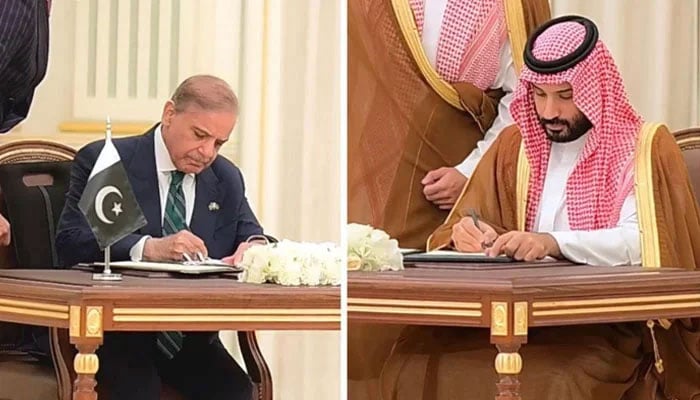
The recent defence treaty with Saudi Arabia is one of the most significant breakthroughs in Pakistan’s foreign policy. The pact’s mutual security clause stipulates that an armed attack on either Pakistan or Saudi Arabia will be considered an attack on both and will prompt a joint response.
This is the first time that Pakistan has signed a mutual security agreement. The 1954 US-Pakistan Mutual Defence Assistance Agreement didn’t have a mutual security clause. The agreement only covered the provision of US equipment and training to Pakistan’s armed forces. The 1950s US-sponsored defence alliances, including the South East Asian Treaty Organization (Seato) and the Central Treaty Organization (Cento), of which Pakistan was a member, didn’t have a collective defence clause as well.
The Seato or Manila Pact provided that the parties would develop their capacity “to resist armed attack and to prevent and counter subversive activities directed from without”. The agreement didn’t stipulate, as the North Atlantic Treaty Organization (Nato) did, that an armed attack on one member would be considered an attack on all members.
Likewise, the Baghdad Pact or Cento provided that the parties “will cooperate for their security and defence”, and that such measures as they agree to take “may form the subject of special agreements with each other”. Hence, neither Seato nor Cento set up any joint military command. Not surprisingly, those defence alliances didn’t help Pakistan during the 1965 war with India.
The recent Pakistan-Saudi pact builds on their 1982 Bilateral Security Cooperation Agreement. Under the 1982 treaty, Pakistan provided training and advisory support to Saudi armed forces and deployed its troops (reaching 20,000 on one occasion) on Saudi soil. Saudi Arabia also purchased arms, though not in significant terms, from Pakistan. The two countries have held several joint military exercises.
Although the Pak-Saudi Strategic Mutual Defence Agreement is the fruit of several years of negotiations, the timing of its signing is significant. The pact was signed in the wake of the September 9, 2025, Israeli attack on Qatar’s capital Doha to target political leadership of Hamas amid high tensions in the Middle East in recent months. It was the second occasion in three months when Qatar’s sovereignty was violated. Earlier, on June 23 this year, Iran struck an American air base in Qatar in retaliation for US strikes on Iranian nuclear facilities. The violations of Qatar’s sovereignty raised security concerns among the Gulf states.
The latest agreement with Pakistan addresses Saudi Arabia’s long-standing security concerns in what is politically one of the most volatile and economically one of the most virile regions in the world. Saudi Arabia is the largest country in the Middle East. It has special importance in Muslim world because of the holy places there. It is also the largest economy in the region and has the second-largest oil reserves, making it the second-largest oil producer and the largest oil exporter in the world.
The Saudi-Iran rivalry for supremacy in the region and the Muslim world is rooted in history and dates back several centuries. The two countries are approximately 789 miles apart, separated by the Persian Gulf, one of the world's key trade routes. Their rivalry turned into antagonism after Iran’s 1979 Islamic Revolution, as Riyadh suspected Tehran of exporting its revolution to its neighbours. Saudi Arabia sided with Iraq during the latter’s protracted war with Iran soon after the Islamic revolution.
Until the US raided the key Iranian nuclear facilities in June this year, Iran was suspected of being close to making a nuclear device – a charge Tehran denies. Like the Saudis, Iran too is a signatory to the Non-Proliferation Treaty (NPT), which prevents any signatory other than the five de jure nuclear powers from acquiring nuclear weapons.
In recent years, Saudi Arabia has also been embroiled in an armed conflict with the Iran-backed Houthis, based in Yemen. Though the conflict has largely subsided.
Saudi Arabia has never directly confronted Israel, the only nuclear state in the Middle East, the two countries being only 798 miles apart. Riyadh has so far remained outside the normalisation process with Israel, unlike Bahrain and the UAE, which formalised ties through the Abraham Accords signed during Donald Trump’s first term.
Some reports and statements had implied that the kingdom was willing to consider normalising relations with Israel, subject to certain conditions, at the top of which was conceding statehood to Palestinians. However, Israel’s ever-increasing atrocities in the occupied Palestinian territory after October 2023 made Riyadh harden its stance on the Zionist state. It also withdrew from talks with Washington regarding Israel.
In a September 2024 address to the Saudi Consultative Assembly (Shura Council), Crown Prince MBS stated: “The kingdom will continue to work diligently toward the establishment of a Palestinian state with East Jerusalem as its capital and will not establish diplomatic relations with Israel without this condition being met”. Netanyahu has consistently ruled out a Palestinian state, and so normalisation of Saudi-Israeli relations seems to have little prospect in the near future.
Meanwhile, the Saudis remain sceptical of both their own military capabilities and Washington’s willingness to defend the kingdom against external threats, despite Trump’s ‘landmark’ visit to the kingdom earlier this year. This made Pakistan appear as a more reliable guarantor of Saudi security.
The mutual security pact with Saudi Arabia is significant for Pakistan as well. The agreement will provide a significant boost to Pakistan’s defence industry. According to the Defence Export Promotion Organization, in Pakistan, 20 major public-sector organisations and more than 100 private-sector enterprises are engaged in manufacturing defense-related products.
Per the Stockholm International Peace Research Institute (SIPRI), Saudi Arabia is the world’s fourth largest arms importer ($2.3 billion annual imports). Between 2020 and 2024, the US accounted for 74 per cent of total Saudi arm purchases. The agreement may lead Riyadh to procure an increasing portion of its arms imports from Pakistan, as well as invest in the latter’s defence industry.
The defence agreement with Saudi Arabia will raise Pakistan’s stature in the Muslim and Arab world. The Gulf Cooperation Council (GCC), of which Saudi Arabia is a leading member, includes mutual security among the six member countries. Hence, the scope of Pakistan’s mutual security pact with the kingdom may, at a later stage, extend to cover all GCC countries.
Does the agreement have any potential problems? In particular, would it affect Pakistan’s relations with Iran, given its historic antagonism with its Arab neighbours? It may if an armed conflict breaks out between the kingdom and Iran or if the Houthi-Saudi clashes renew. In such events, Islamabad will face a difficult choice. At the other end of the scale, Pakistan’s shield may prevent an Iran-Saudi clash. Islamabad can also use its good offices to normalise relations between the two adversaries.
The writer is an Islamabad-based columnist. He tweets/posts @hussainhzaidi and can be reached at: hussainhzaidi@gmail.com