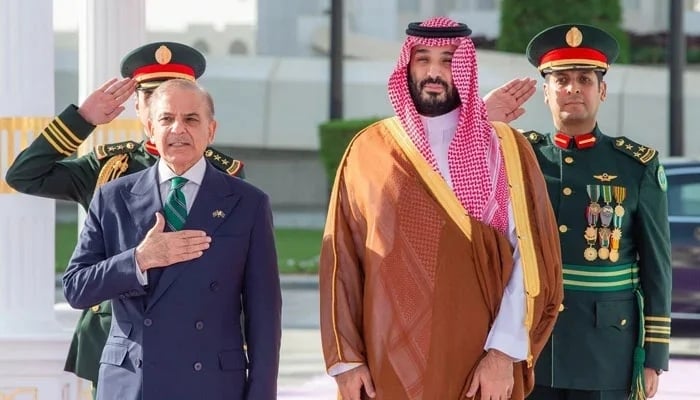
Pakistan and Saudi Arabia have signed the landmark Strategic Mutual Defence Agreement (SMDA) that could reshape Middle Eastern security. The pact elevates decades of cooperation into a formal military alliance: any aggression against one country will be treated as an attack on both.
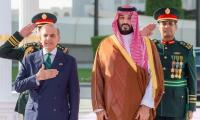
The signing ceremony, held at Al-Yamamah Palace on September 17, included symbolic gestures of solidarity such as Saudi Air Force jets escorting the Pakistani premier’s plane and a royal guard of honour.
The agreement comes at a moment of deep unease across the region. For decades, Gulf nations have relied on the US as their primary security guarantor, but Washington’s increasingly Israel-centric and unpredictable policies, evident more so now, have pushed many to reconsider their options. The urgency was sharpened by the September 9 Israeli airstrike in Doha, drawing widespread Arab condemnation and highlighting the fragility of existing security arrangements.
For Saudi Arabia, aligning militarily with Pakistan – the world’s only Muslim-majority nuclear power – is both a strategic calculation and a political statement. Riyadh signals that it is ready to diversify its security partnerships and strengthen deterrence in a region riven by proxy wars, nuclear anxieties and shifting allegiances. Pakistan brings a battle-hardened and well-organised military with long experience in both conventional and asymmetric warfare. Its nuclear capability – developed to balance India – now doubles as a potential security umbrella for Gulf allies, while its air force offers advanced technology and proven combat readiness.
The pact’s core elements include a mutual defence clause obliging each country to respond to attacks on the other and mechanisms for joint deterrence and strategic coordination. It builds on decades of collaboration, from Pakistani deployments to safeguard Islamic holy sites to ongoing military training exchanges. By formally codifying these ties, Islamabad and Riyadh have moved from informal cooperation to an overt security compact.
The implications extend well beyond the two signatories. The agreement could challenge Israel’s regional military edge and complicate US influence in the Gulf, where states are increasingly hedging their bets by forging new alliances. It may also revive the idea of a broader pan-Islamic security framework with Pakistan at its core, while prompting strategic recalculations in India.
This realignment unfolds against a wider global backdrop of intensifying great-power rivalry, with Russia locked in a grinding confrontation with a hawkish Nato, obviously backed by Washington, from Ukraine to the Black Sea and the Baltic, consuming vast resources and deepening East-West antagonism. China, meanwhile, faces its own ring of pressures: escalating trade wars and technology bans, high tariffs on electric vehicles and semiconductors, restrictions on rare-earth exports and persistent naval encirclement. These simultaneous flashpoints highlight a multipolar world in which traditional Western security guarantees look increasingly brittle.
At the same time, Israel and the US have not altered what many in the region see as a long-standing pattern of betrayal and hegemonic chauvinism. Beyond the recent strike in Doha, Israel has launched repeated attacks on Yemen, Iran, Lebanon, Syria and even targets inside Iraq, while continuing its devastating assault on Gaza – widely denounced as a genocide. These operations have created the image of a state consumed by war-making, reinforcing perceptions of an entrenched, militarized posture rather than a search for peace.
For Gulf States and much of the wider Muslim world, these developments highlight the need for a security architecture less dependent on Washington. Qatar’s occasional role as mediator is acknowledged, but no lasting guarantees have emerged. Against this backdrop, the Pakistan–Saudi Arabia agreement appears less as an abrupt pivot and more as the logical outcome of a long accumulation of crises and disappointments.
The pact also carries symbolic resonance. Pakistan’s role as a nuclear power with deep Islamic ties lends credibility to a vision of collective self-defence that is both technologically modern and culturally grounded. Saudi Arabia, the custodian of Islam’s holiest sites and a global energy heavyweight, brings economic muscle and geopolitical reach. Together they create a deterrent signal that cannot be ignored in Tehran, Tel Aviv, Washington or New Delhi.
Seen in this light, the new partnership signals an emerging security order in which Muslim-majority nations, backed by nuclear capability and growing regional autonomy, begin to shape their own collective defence architecture. With old guarantees fraying and conflicts multiplying, the accord reads as an inevitable next step – a potential cornerstone of a security axis capable of redefining the power map of the Middle East and, by extension, the wider Muslim world.
For Pakistan, the moment calls for decisive agency. Rather than relying on frameworks drafted in Washington, which now look dated and dangerously fluid, Islamabad must claim a proactive role. The contours of a New Gulf Order are coming into view and Pakistan is positioned to help draw them.
The writer is an expert on climate change and sustainable development and the founder of the Clifton Urban Forest. He tweets/posts @masoodlohar and can be reached at:
mlohar@gmail.com