
Afghanistan vaccination gaps threaten Pakistan’s polio-free progress: IMB
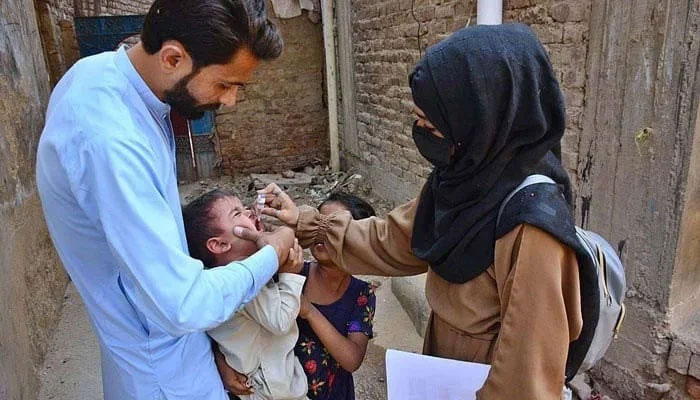
ISLAMABAD: The fight against polio faces fresh dangers as Pakistan and Afghanistan continue to struggle with the poliovirus in their most challenging areas, the Independent Monitoring Board (IMB) has warned in its latest report.
It stated that political upheaval, funding cuts, and poor vaccination coverage in high-risk pockets could derail the dream of a polio-free world. Pakistan has already reported 27 cases this year, with the latest confirmed on September 22 when authorities announced that an eight-month-old baby girl had died after testing positive for polio in Hyderabad, Sindh.
The IMB cautioned that, despite some progress, the global campaign is at a critical juncture. It highlighted the withdrawal of the United States from the World Health Organization, the closure of USAID, and possible budget cuts to the CDC as major shocks that could reduce funding and technical expertise for polio eradication. “The stakes could not be higher – not only for millions of children at risk of paralysis or death, but for the credibility of global health governance itself,” the report warned.
For Pakistan, the findings are sobering as the country experienced a massive 1,100 per cent rise in wild polio cases in 2024 compared to the previous year, with 99 cases by year’s end and hundreds of positive sewage samples. Although fewer cases have been reported in 2025, the virus is still circulating strongly in Karachi, Lahore, and especially south Khyber Pakhtunkhwa, where more than 100,000 children could not be vaccinated due to insecurity, refusals, and boycotts.
Karachi and Lahore are described as “hotspots” where the virus continues to be detected in the environment. Lahore, despite strong routine immunisation, is flagged as a city with a 50 per cent chance of new cases due to its role as a transit hub. Balochistan remains dangerously exposed because of poor routine immunisation and weak health services.
The IMB also expressed concern over Afghanistan’s failure to conduct door-to-door vaccination campaigns in its southern provinces. It warned that this gap is allowing the virus to circulate freely, creating risks not just for Afghan children but also for Pakistan due to constant cross-border movement. “Without house-to-house vaccination in Kandahar and surrounding areas, large numbers of children will remain unprotected and the virus will continue to flow between the two countries,” the report stated.
At the same time, the IMB acknowledged Pakistan’s efforts. Six major vaccination campaigns have been held since late 2024, reaching about 45 million children each time. Cross-border drives with Afghanistan have been carried out, and the Community-led Vaccination Initiative has helped reach 83 per cent of previously missed children in parts of south KP. The country also runs one of the strongest surveillance systems in the world, with over 120 environmental testing sites and 15,000 reporting points for polio cases. However, the report criticised the quality of campaigns, stating that almost half in recent years were worse than the previous round. It noted that most children who miss the vaccine do so not because of refusal but because of weak team performance, poor training, and supervision. “This is not just about refusals – this is about campaign quality,” the report stressed.
Floods in mid-2025 made matters worse. They damaged health facilities, disrupted vaccine cold chains, displaced hundreds of thousands of people, and mixed sewage with floodwaters, creating ideal conditions for the virus to spread. The IMB stated that delaying vaccination campaigns in flood-hit areas, though necessary, had created dangerous immunity gaps. The report also questioned whether the significant drop in cases during 2021–23 resulted from genuine programme progress or simply the effect of COVID-19 restrictions, which had reduced people’s movement and improved hygiene, inadvertently curbing the viral spread. It warned that substandard campaigns during those years left behind an immunity gap that enabled the virus to rebound so strongly in 2024.
Despite these warnings, the IMB praised Pakistan’s “whole-of-government” approach, with the prime minister, provincial chief ministers, and senior officials directly monitoring polio drives. It also welcomed new plans, such as recruiting 20,000 lady health workers with digital tablets to track children, and community-led approaches in south KP.
Public health experts say the programme now needs to re-strategise its social and behaviour change communication and employ more effective community engagement to improve vaccine acceptance. Field operations must be optimised to ensure no child is missed, while routine immunisation in polio hotspots must be rapidly increased to 80–90 per cent. Additional barriers against the virus can be created through a parallel focus on safe water, sanitation, hygiene, and better healthcare in high-risk union councils. Above all, the children in inaccessible pockets must be reached by all means possible, with the help of local communities.
Pakistan’s “Roadmap to Zero” by June 2026, endorsed by the Prime Minister-led National Task Force, hinges on these principles. Its successful implementation, experts say, requires a “whole-of-the-nation” approach if the country is to finish the job once and
for all.


-
 State institutions ‘fail’ to perform constitutional duties: KP CM
 -
 CTD orders psychological testing of police on VVIP security duty
 -
 Navy busts drug consignment valued at $130m
 -
 Three ex-secretaries in race for ETPB chief post
 -
 Punjab govt forms 71 JITs to probe cases against banned TLP
 -
 Some UNSC members ignoring broader reforms, seeking privilege: Pakistan
 -
 PAC body discusses non-recovery of Rs15bn gas cess
 -
 Pakistan received $2.29bn foreign loans in first 4 months of 2025