
SC tells parliament to legislate on civilian appeals against military trials
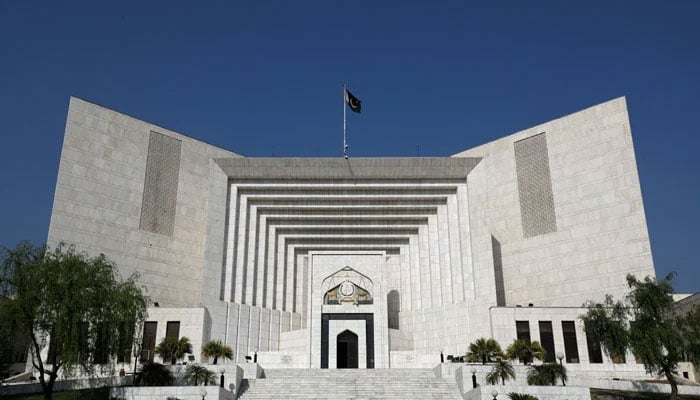
ISLAMABAD: The Supreme Court has issued a significant ruling requiring Parliament to legislate within 45 days. The new law must provide civilians with a critical legal protection — the right to appeal military court verdicts. This ruling will affect individuals tried under specific sections of the Pakistan Army Act, enabling High Court review of their cases.
A seven-member constitutional bench of the apex court, headed by Justice Aminuddin Khan, issued a detailed judgment on the Intra-Court Appeals (ICAs) filed by the Federal Government and Ministry of Defence against the court’s earlier judgment declaring the trial of civilians in military courts unconstitutional. Other members of the bench included Justice Jamal Khan Mandokhail, Justice Muhammad Ali Mazhar, Justice Syed Hasan Azhar Rizvi, Justice Musarrat Hilali, Justice Naeem Akhter Afghan, and Justice Shahid Bilal Hassan. The Shuhuda Foundation Balochistan, as well as the governments of Punjab and Balochistan, had also filed Intra-Court Appeals against the apex court’s judgment.
Earlier, the Supreme Court has held that the right to a fair trial and due process is fully protected and safeguarded, and the process of trial under the Army Act is compliant with recognised principles of criminal justice.
The 68-page detailed judgment, authored by Justice Aminuddin Khan, held that an independent right of appeal before an independent forum is a fundamental aspect of the doctrine of due process and the right to a fair trial, as enshrined under Article 10-A of the Constitution.
The court ruled that various provisions were vigorously highlighted by the appellants’ counsel to demonstrate that under the Pakistan Army Act, 1952 (“Army Act”) and the Rules framed thereunder, the right to a fair trial and due process is fully protected and that the trial process under the Army Act complies with recognised principles of criminal justice, as established in cases such as Brig. (Retd.) F. B. Ali (PLD 1975 SC 506), Shahida Zahir Abbasi (PLD 1996 SC 632), and District Bar Rawalpindi (PLD 2015 SC 401).
The judgment noted, “It was further averred that clause 2(d) was inserted into the Army Act vide Section 2 of the Defence Services Laws Amendment Ordinance, 1967, which is protected under Article 268 of the Constitution.”
The court observed that the learned Attorney General for Pakistan (AGP) also asserted that the right to a fair trial under Article 10-A of the Constitution, and due process of law, was available to all accused persons involved in the incidents of May 9 and May 10, notwithstanding the stipulations of Article 8(3) of the Constitution.
The court found that the adjudicatory authority exercised by military courts over civilians, when narrowly defined and legislatively prescribed, does not infringe the constitutional doctrine of separation of powers. Article 175(3) is not offended by the existence or operation of military courts within their legal remit. “The impugned judgment erred in concluding otherwise,” the court declared.
The detailed judgment noted that the Attorney General repeatedly sought time to obtain instructions from the Government on introducing a statutory right of appeal for civilians tried under sub-clauses (i) and (ii) of clause (d) of section 2(1), read with section 59(4) of the Army Act.
It further noted that even in the concluding session on May 5, 2025, the Attorney General reiterated that if the Constitutional Bench referred the matter to the Government or Parliament to amend the law and create an independent right of appeal beyond the provisions under section 133-B of the Pakistan Army Act, 1952, such a recommendation would be respected and seriously considered. “Therefore, the legislative framework must be supplemented to provide for an independent right of appeal to the High Courts for civilians convicted under the said provisions,” the court held.
The court referred the matter to Parliament for the enactment of appropriate amendments, expressing expectation that such institutional deference would be accorded due respect. “The Government and Parliament are urged to undertake the necessary amendments or enact suitable legislation in the Pakistan Army Act, 1952, and allied rules within 45 days to provide an independent right of appeal in the High Courts against convictions rendered by Court Martial or Military Courts in respect of offences under sub-clauses (i) and (ii) of clause (d) of subsection (1) of section 2, read with subsection (4) of section 59 of the Pakistan Army Act, 1952,” the judgment stated. “The question is answered in favour of the appellants, subject to the need for statutory reform to provide an external appellate forum for civilians,” the judgment added.
Justice Muhammad Ali Mazhar also issued a 47-page additional note. It is pertinent to mention that on May 7, 2025, the seven-member bench allowed the trial of May 9 suspects in military courts after restoring clauses of the Army Act 1952 that were previously declared ultra vires the Constitution and of no legal effect. By a majority of 5–2, the court allowed the Intra-Court Appeals and set aside the impugned judgment dated October 23, 2023.
“For reasons to be recorded later, subject to augmentation and explication in detail, the aforesaid ICA(s) are allowed by a majority of 5 (comprising J. Amin-ud-Din Khan, J. Muhammad Ali Mazhar, J. Syed Hasan Azhar Rizvi, J. Musarrat Hilali, and J. Shahid Bilal Hassan),” Justice Aminuddin Khan announced in a short order.
Justices Jamal Khan Mandokhail and Naeem Akhter Afghan dissented, dismissing the Intra-Court Appeals and holding that convictions and sentences awarded to civilians by courts martial for the events of May 9, 2023, were without jurisdiction and therefore set aside. Justices Mandokhail and Afghan directed that accused persons in custody be treated as under-trial prisoners and their cases transferred to competent civilian courts for trial.
The court restored sub-clauses (i) and (ii) of clause (d) of subsection (1) of section 2 of the Pakistan Army Act, 1952, and subsection (4) of section 59 of the Act, which had been struck down in the 2023 judgment.
A five-member larger bench of the apex court, headed by Justice Ijazul Ahsen, had on October 23, 2023, declared the trial of civilians in military courts unconstitutional and held that the 103 individuals—and others linked to the events of May 9 and 10—should be tried by criminal courts established under ordinary or special law.
That bench had ruled on petitions filed by former Chief Justice Jawad S. Khawaja, former Prime Minister and PTI Chairman Imran Khan, Barrister Aitzaz Ahsan, the Supreme Court Bar Association (SCBA), Karamat Ali, Zaman Khan Vardag, and Junaid Razzak, challenging the trial of May 9 and 10 suspects in military courts.



-
 State institutions ‘fail’ to perform constitutional duties: KP CM
 -
 CTD orders psychological testing of police on VVIP security duty
 -
 Navy busts drug consignment valued at $130m
 -
 Three ex-secretaries in race for ETPB chief post
 -
 Punjab govt forms 71 JITs to probe cases against banned TLP
 -
 Some UNSC members ignoring broader reforms, seeking privilege: Pakistan
 -
 PAC body discusses non-recovery of Rs15bn gas cess
 -
 Pakistan received $2.29bn foreign loans in first 4 months of 2025