What ails our protests?
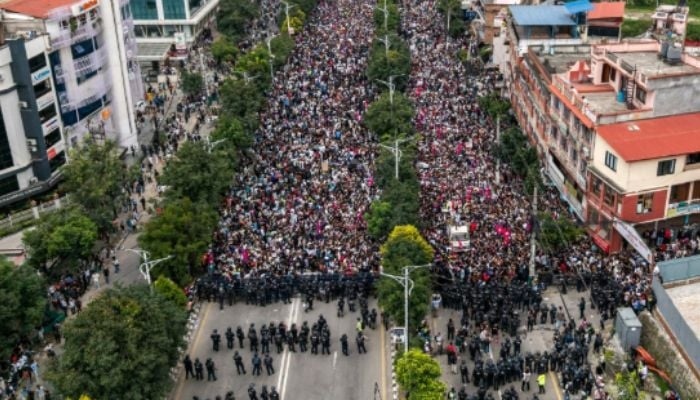
Public anger on the streets is no longer a shock. Take Nepal’s recent example: a mass movement shook the entire system, forcing the government to bend after a bloody clash that left 19 dead.
A public demonstration in Nepal was the latest in a series of similar uprisings. Even the US and Iran, despite their power and control, have not been spared from public demonstrations. From Isfahan to New York, people have taken to the streets to protest against inflation, corruption and questionable laws. Around the globe, protests have become a hallmark of public vigilance, a means of safeguarding democratic values and pressuring governments to listen.
Large-scale demonstrations against corruption were recorded in Serbia. In Mongolia, people took to the streets against government corruption and bullying and the prime minister had to resign. The people of Mali have been protesting since May. In Ukraine, public protests forced the government to roll back legislation. In Bangladesh, student protests turned the tables on the government. Kenya saw historic demonstrations over economic legislation.
Globally, such protests have become symbols of public vigilance, of keeping watch over democratic values and holding governments accountable.
The relationship between the public and the government in Pakistan is, however, quite peculiar. If we look at the past 15 years, there is hardly a single year in which protests have not dominated the political climate. The transition from Gen (r) Musharraf’s authoritarian rule to civilian democracy came with countless problems. Public sentiment towards governments was shaped not only by the lawyers’ movement for Chief Justice Iftikhar Chaudhry’s restoration, but also by political instability and violence. Suicide bombings took place, Punjab’s governor was assassinated, and unrest became constant.
During the PPP government, the PML-N spent years protesting with black armbands. Then, Dr Tahirul Qadri arrived from Canada under the shining slogan of ‘saving state, not politics’ and besieged the capital from behind a bulletproof stage.
In the 2013 elections, where the PML-N secured a sweeping victory and Nawaz Sharif became prime minister for the third time, protests erupted again. This time, Qadri joined hands with Imran Khan and the two became political cousins. Their main demand was electoral reforms. But just like Qadri’s earlier protest, this joint agitation also ended with no results. One cousin, however, succeeded in establishing a political profile and later emerged as an alternative force, winning a majority in 2018 and becoming prime minister.
No discussion of these protests would be complete without mentioning the 2017 Faizabad sit-in, which introduced a new face of religious politics. The Tehreek-e-Labbaik Pakistan went on to secure 46 per cent of the total religious vote in 2018, becoming the country’s largest religious party by ballot share. This movement added another front to anti-government campaigns.
Among all these, perhaps the only movement that achieved results was the movement that started post the Panama Leaks – though this is something Gen Z citizens may not even remember, since for them political history begins only where they start paying attention. In 2016, allegations of corruption and secret foreign bank accounts erupted. The Panama Leaks eventually led to Nawaz Sharif’s disqualification and removal by court order.
Since then, other protests have filled the timeline: PTM demonstrations for civil rights and peace; opposition campaigns against the PTI government; the 2022 no-confidence motion; Imran Khan’s ouster followed by mass protests; the events of May 9; and almost daily anti-government gatherings. Yet, none of these movements succeeded in securing public demands.
Whether it was Nawaz Sharif’s judicial removal or the no-confidence motion against Imran Khan, political interests were safeguarded while public interests were sold off. The result is simple: for ordinary Pakistanis, each passing day has become worse than the last.
The question hammering in the mind is this: from Bangladesh to Nepal to the US, protests deliver quick results. But in Pakistan, protests are so frequent one might think it is an anti-government country, yet the outcome remains zero.
A closer look reveals why. In Pakistan, public opinion regarding governance is largely simplistic or more simply biased: if the ‘right person’ sits in the seat of power, everything will be fine; if the ‘wrong person’ sits there, everything will go wrong. This very mindset explains how the PTI, despite a vague and undefined political struggle, managed to capture power after two years of rallies, and continues to dominate Khyber Pakhtunkhwa.
By contrast, in countries where protests succeeded, they were never about individuals. They were about systemic flaws that made people’s lives miserable. Students protested for education, farmers for their crops, workers against bad laws and citizens against national policies. That clarity of demands forced governments to retreat.
In Nepal, Gen Z youth, those born around the Musharraf era, marched without a political leader, shook the system and turned corrupt politicians into cautionary tales. In Pakistan, however, even a prime minister leading a protest ends up behind bars, whether it is Imran Khan or Nawaz Sharif.
The stark difference lies in the clarity of public opinion. In Pakistan, views about governments are always partisan. Those who found petrol at Rs70 expensive under Nawaz Sharif justified Rs150 under Imran Khan with 25 different excuses. The same people today queue at the pump for Rs270 petrol without a word. The same bias extends to perceptions about the military leadership and the bureaucracy.
People in Pakistan have yet to identify their own issues; the generation has to extend its observation with a civil rights lens. Workers in each sector must be professional to develop a narrative that will shift the balance in their favour. So far, superficial opinions are generating unnecessary political pressure. People have to come out of the debate regarding good politicians and bad politicians.
This is why protests in Pakistan rarely succeed. They do, however, ensure one thing: political instability.
The writer is a journalist.