IAEA chief praises Pakistan’s civil nuclear progress
ISLAMABAD: Pakistan’s peaceful nuclear programme drew international recognition this week, as the head of the UN nuclear watchdog lauded the country’s steady progress and close cooperation with the International Atomic Energy Agency (IAEA) — a nod that comes at a sensitive moment, days after Islamabad struck a defence pact with Saudi Arabia, and amid India’s unease over Pakistan’s strategic posture.
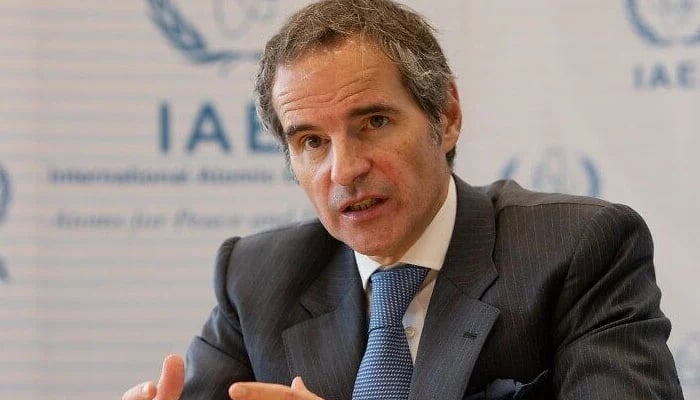
“Pakistan is moving forward with its civil nuclear programme at a good pace, including at Chashma NPP 5, where I witnessed the first concrete pouring in Feb,” Rafael Mariano Grossi said in a post following his meeting with Raja Ali Raza Anwar, Chairman of the Pakistan Atomic Energy Commission (PAEC), on the sidelines of the 69th IAEA General Conference in Vienna.
Grossi recalled witnessing the landmark February 2025 concrete pouring for Chashma Nuclear Power Plant Unit-5, describing it as a major step in Pakistan’s efforts to strengthen energy security through clean, sustainable nuclear power. He noted Islamabad’s active role in capacity-building, training and the application of nuclear knowledge for socio-economic development.
The talks between Grossi and Anwar also reviewed joint work under IAEA initiatives such as Atoms4Food, aimed at boosting agricultural productivity and food safety, and Rays of Hope, which seeks to expand access to nuclear medicine and cancer care across Asia-Pacific.
Grossi appreciated Pakistan’s contributions to regional cooperation, highlighting how its expertise in nuclear applications is being shared with other member states.
Reaffirming Islamabad’s stance, Anwar stressed that Pakistan’s nuclear power plants operate under “the highest safety standards” while providing reliable, low-carbon electricity. He said PAEC’s programmes remain aligned with IAEA’s mission of promoting nuclear technology “for peace, health, and prosperity.”
Pakistan also reiterated its resolve to work with the IAEA and partner nations to advance peaceful nuclear cooperation, sustainable development, and improved quality of life across the region.
Meanwhile, speaking to Geo News, Defence Minister Khawaja Asif said that after the agreement, the number of our troops in Saudi Arabia will increase, and Pakistan will also become economically stronger from the benefits of this agreement.
Khawaja Asif said that the agreement between Pakistan and Saudi Arabia is historic, and is a result of the triumph in ‘Marka-e-Haq’.
Khawaja Asif said that in the past 75 years, Pakistan had also made defence agreements, but when difficult times came, those who made the agreements did not help.
The defence minister said that after the agreement, the number of our troops in Saudi Arabia will increase, and defence agreements with other countries are also possible. Those who are not well-wishers of ours are unhappy with this agreement.
Khawaja Asif said that the Saudi crown prince reminded him that in 1971, Saudi Arabia had sent two gunboats to Karachi.
Meanwhile, talking to the media after chairing the first meeting of Members of Federation of Engineering Institutions of Pakistan in Lahore, Federal Minister for Planning and Development Ahsan Iqbal said that the defence agreement between Pakistan and Saudi Arabia is an important milestone, which has been warmly welcomed by all segments of society, and people from all walks of life have expressed great joy and happiness in this regard.
He added that after the Marka-e-Haq (battle of truth), Pakistan received more recognition, respect and dignity from around the world, so we have to move forward keeping in mind the future plans and challenges.
Before that, Iqbal said the launch of CPEC Phase-II was formally announced during Prime Minister Shahbaz Sharif’s visit to China.
“Now, the CPEC JCC meeting is being held in Beijing on September 26, and I am going to attend it. Insha Allah, we will make further progress.”
The success of defence for any country cannot be long-lasting unless it stands on a strong economy, he said, asserting, “I believe that success of ‘Uraan Pakistan’ Project, launched by the government, depends on the cooperation and role of engineers.”
He said Pakistan’s export would increase with innovated production and improved industrial capacity through extensive use of modern technology, and all this work has to be done by engineers.
He hoped that Federation of Engineers would also play a vital role in the national plan of action to combat climate change in the country.
“We cannot reverse climate change but to face it, however, we can create resilience in our economy and reconstruct better infrastructure that does not fall victim to climate change again. To do this, we will need the cooperation of engineers. Hydraulic studies should be done to see how Pakistan’s water flows work and how we can avoid floods.”
Meanwhile, Adviser to the Prime Minister on Political Affairs Rana Sanaullah has said that after the Pakistan-Saudi Arabia defense agreement, any terrorist attack on Pakistan from Afghanistan will now be considered an attack on Saudi Arabia as well.
Speaking on Geo News’ programme “Jirga,” Rana Sanaullah stated that the Pakistan-Saudi Arabia defence agreement is a major blow to our eternal enemy, India.
He said that after the Pakistan-Saudi Arabia defence agreement, an attack on Saudi Arabia will be considered an attack on Pakistan, and an attack on Pakistan will be considered an attack on Saudi Arabia. The response will be delivered in the same manner as the right to self-defence was exercised against India in ‘Marka-e-Haq’.
He further stated that after the defence agreement, any terrorist attack on Pakistan from Afghanistan will now be considered an attack on Saudi Arabia, and the response will be delivered in the same way as it was to India in ‘Marka-e-Haq’.


-
 Aurangzeb confirms Saudi Arabia $10bn interest, says B2B shift ongoing
 -
 Pakistan to build artificial island to boost oil exploration
 -
 Special pink bus service launched for women on Green Line route
 -
 Same number plates from other provinces lead to wrong e-challans for Karachiites
 -
 State institutions ‘fail’ to perform constitutional duties: KP CM
 -
 CTD orders psychological testing of police on VVIP security duty
 -
 Navy busts drug consignment valued at $130m
 -
 Three ex-secretaries in race for ETPB chief post