
India flags ‘mutual sensitivities’ to Saudi Arabia as Congress slams Modi over defence pact
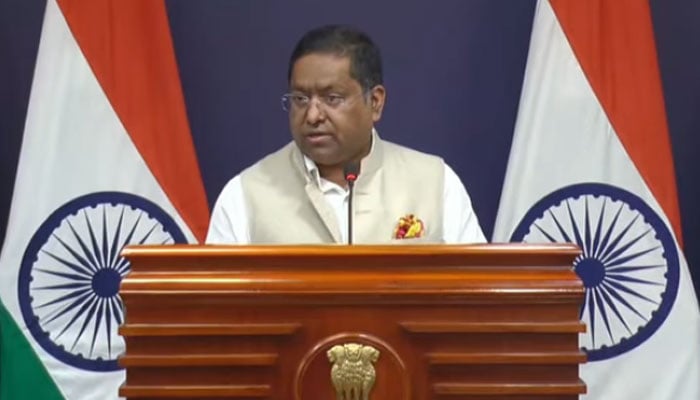
KARACHI: India on Friday said it expects Saudi Arabia to keep in mind “mutual interests and sensitivities” in their bilateral strategic partnership, following Riyadh’s signing of a strategic defence pact with Pakistan earlier this week.
The ‘Strategic Mutual Defence Agreement’ signed on Wednesday by Prime Minister Shehbaz Sharif and Saudi Crown Prince Mohammed bin Salman states that “any aggression against either of the two countries shall be considered as an aggression against both”.
“India and Saudi Arabia have a wide-ranging strategic partnership that has deepened considerably in the last few years”, India’s External Affairs Ministry spokesperson Randhir Jaiswal said on Friday during his weekly media briefing, adding that: “Our expectation is that our strategic partnership with Saudi Arabia will be pursued keeping in mind mutual interests and sensitivities, within the framework of this partnership”.
On the possibility of other countries such as the UAE and Qatar becoming party to the pact, Jaiswal said that India has wide-ranging ties with both these countries.
Reacting to the pact on Thursday, the Indian foreign ministry had initially said it would study the implications of the development for India’s national security as well as for regional and global stability.
“We have seen reports of the signing of a strategic mutual defence pact between Saudi Arabia and Pakistan. The government was aware that this development, which formalises a long-standing arrangement between the two countries, had been under consideration”, Jaiswal had stated in a statement on Thursday.
Meanwhile, the main opposition party in India has launched a sharp attack on the Modi government over the development, calling it a major diplomatic setback and warning of serious national security implications.
The Congress on Thursday described it as yet another “setback for the much-hyped personalised diplomacy” of Indian Prime Minister Narendra Modi.
In a post on X, Congress general secretary (communications) Jairam Ramesh said a month after Operation Sindoor was “abruptly” stopped, US President Donald Trump hosted COAS Field Marshal Asim Munir for lunch at the White House. And that just a few days after Modi’s “much-touted visit to China, President Xi threw open China’s secret military complex to Pakistan’s President Asif Ali Zardari”.
Ramesh added that: “Now, Saudi Arabia, where the prime minister [Modi] was when the Pahalgam terror attacks took place, has signed a ‘strategic mutual defence’ pact with Pakistan”. This, added Ramesh “has grave implications for India’s national security”.
“The Indian National Congress notes with concern yet another setback for the much-hyped personalised diplomacy of our prime minister”, Ramesh said.
On Friday, the Congress again criticised the Modi government, Congress general secretary Randeep Surjewala saying that the Modi government’s obsession with optics “has put India in a corner, compromised our security and left our diplomacy looking weak”.
In a post on X (Twitter), Surjewala said: “This is not a matter of politics; this is a matter of national interest and India cannot afford a government, whose foreign policy failures leave the nation vulnerable at its most critical hour”.
He also mentioned that Modi was in Saudi Arabia when the Pahalgam attack took place and added that “Instead of isolating Pakistan for terror, Modi’s foreign policy has allowed it to gain a powerful new defence umbrella, that also from India’s second biggest trading partner”.
Surjewala further asked how asked how India allowed “a key Gulf partner to drift so decisively into Islamabad’s corner without securing our own interests”, adding “How can the prime minister claim to be strengthening India’s global standing, when the very countries that confer their highest civilian awards on him are signing defence treaties with Pakistan, which is a perpetrator of terror?”
Surjewala continued: “....the hard reality is that Saudi Arabia, with whom India has expanded trade to over USD 42 billion [and] with whom Modi has built personal bonhomie, has chosen Pakistan when it comes to defence and security. It is not Pakistan winning, it is India at a disadvantage, because our leadership is caught up in optics while ignoring substance”.
“What message does it send to the world when New Delhi’s biggest Gulf partner undermines our security to bolster Islamabad?”, Surjewala said in his post.



-
 State institutions ‘fail’ to perform constitutional duties: KP CM
 -
 CTD orders psychological testing of police on VVIP security duty
 -
 Navy busts drug consignment valued at $130m
 -
 Three ex-secretaries in race for ETPB chief post
 -
 Punjab govt forms 71 JITs to probe cases against banned TLP
 -
 Some UNSC members ignoring broader reforms, seeking privilege: Pakistan
 -
 PAC body discusses non-recovery of Rs15bn gas cess
 -
 Pakistan received $2.29bn foreign loans in first 4 months of 2025