
ISLAMABAD: The government has deferred the revised PC-1 for the Kachhi Canal project, which has a total estimated cost of Rs5.6 billion for the restoration of flood damages that occurred in 2022.
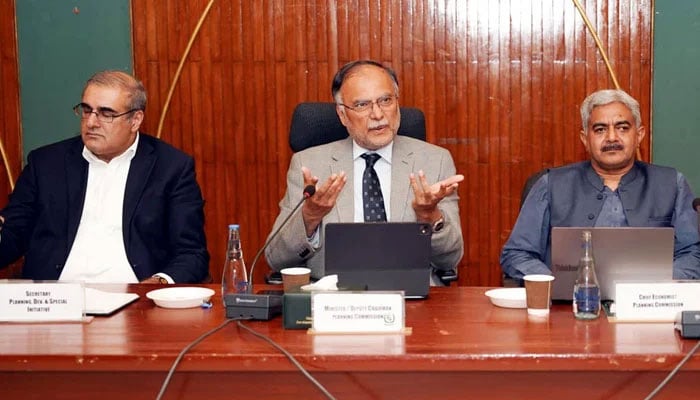
The Central Development Working Party (CDWP), led by Minister for Planning Ahsan Iqbal, deferred approval of the revised PC-1 for the Kachhi Canal Project. Due to a paucity of time, the Kachhi Canal project could not be discussed in the meeting and was therefore deferred.
According to details, torrential rains and flash floods in 2022 caused a total of 170 breaches and cuts in the Kachhi Canal. Of these, 129 are major cuts, while 41 are rain cuts or berm damages.
In addition to damages and breaches to the canal embankment and PCC lining, serious damage to some structures constructed over the Kachhi Canal has also been observed. Furthermore, due to the high volume of flood flows and extreme velocities, a considerable amount of silt has been deposited into the main canal prism at various locations through the breached sections. As a result, silt deposition of 8 to 16 feet has been recorded at some locations.
A PC-1 amounting to Rs8.28 billion was approved by the Executive Committee of the National Economic Council (Ecnec) on June 27, 2023, with a local component of Rs3 billion through the PSDP and Rs5.28 billion through foreign aid or a loan.
The procurement process was initiated accordingly by publishing a notice inviting tender in August 2023. Technical bids from substantially responsive bidders were opened on September 4, 2023. Subsequently, the financial bids opened on October 16, 2023, were evaluated by the Kachhi Canal consultants and project office. The evaluation process was completed in November 2023. However, work could not be awarded due to the non-availability of funds. The revised PC-I based on the lowest bid was received at a cost of Rs14.7 billion. After a series of meetings at the Planning Commission, it was finally decided to place the project before the CDWP forum for a decision. The PC-I was approved by CDWP on September 3, 2024, at a rationalised cost of Rs5.8 billion instead of Rs14.7 billion.
The PC-I was returned to the sponsors for necessary modifications in compliance with the CDWP decisions. The modified PC-I, compliant with the decisions, has not yet been received by the Planning Commission. Third-party validation (TPV) consultants hired by the Planning Commission conducted a validation. Wapda admitted that a proper survey was not conducted due to floodwater standing in the project area in 2022. A detailed joint survey is now under way and may take two months. The TPV highlighted that the technology used is the most accurate method of survey for cost estimation. Wapda does not agree with the TPV survey. NAB is of the opinion that the Retention Money and Security may be released for the completion of works to the existing contractor.
The TPV assessment presents a more accurate portrayal of the Kachhi Canal’s condition post-2024 flood. Validated cost estimations and measurements confirm the potential for substantial savings while supporting a robust, durable rehabilitation effort. The total cost of Rs3.903 billion for Package-01 to 4 reflects an efficient, thoroughly planned project that is poised for long-term resilience and structural integrity.
According to an official statement issued by the Ministry of Planning, the CDWP reviewed projects in the health and water sectors.
The CDWP recommended the revised Khyber Pakhtunkhwa Human Capital Investment Project (Health Component) to Ecnec at a total cost of Rs18.137 billion. The project will be implemented through an independent project management unit under the KP Health Department in line with World Bank procurement guidelines and financed through foreign assistance. Covering 13 districts including Peshawar, Nowshera, Swabi and Haripur, the project seeks to enhance the availability and quality of primary healthcare services for both host communities and refugees.
The forum also approved the position paper for the project titled “Strengthening Common Management Unit for AIDS, TB and Malaria and Accelerating Response to Control the three Diseases in Pakistan” at a cost of Rs2 billion. A strong Integrated Technical Support Unit will provide oversight, surveillance and technical guidance to provinces, ensuring harmonized national programming and enhanced capacity building.
While reviewing the position paper for the project titled “Responsive, Readiness and Resilient STEM Secondary Education in Punjab (ADB loan-based),” the planning minister stressed that early childhood education must remain at the core of provincial and national education policies.
“The most productive investment in a child is in the early childhood development phase. If we fail at this stage, no amount of spending at later stages of education can compensate for the loss,” he observed.
He said it is the basic right of every child studying in public sector schools to have quality science and computer labs. Provincial governments must ensure the provision of labs in schools so that we can raise a generation which is future-ready. He further emphasised, “A gap analysis should be carried out for union councils where there are no girls’ high schools. Each union council must have a girls’ high school.”
Discussing the concept clearance of the Flood Disaster Prevention Master Plan and Construction of a Storm Water Storage System in Multan for climate change adaptation, the minister directed the Punjab P&D Department to prioritise schemes for wastewater and sewerage management. Expressing concern over increasing pollution in rivers and groundwater, he said urgent action was required to safeguard public health and the environment.
Concluding the meeting, the minister directed that each PC-1 must clearly articulate concrete outcomes and measurable impact, reiterating that development spending without accountability and results-oriented planning cannot deliver the desired transformation.


-
 State institutions ‘fail’ to perform constitutional duties: KP CM
 -
 CTD orders psychological testing of police on VVIP security duty
 -
 Navy busts drug consignment valued at $130m
 -
 Three ex-secretaries in race for ETPB chief post
 -
 Punjab govt forms 71 JITs to probe cases against banned TLP
 -
 Some UNSC members ignoring broader reforms, seeking privilege: Pakistan
 -
 PAC body discusses non-recovery of Rs15bn gas cess
 -
 Pakistan received $2.29bn foreign loans in first 4 months of 2025