
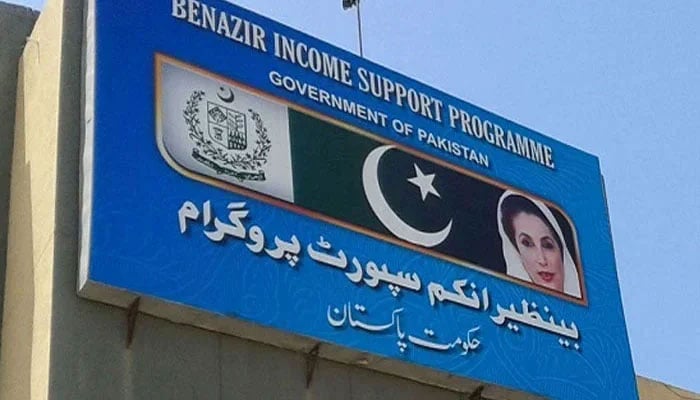
ISLAMABAD: The proposed framework for establishment of National Poverty Alleviation Coordination Council is pending requisite approvals from Federal Cabinet and the Council of Common Interests (CCI).
This was informed by Secretary for Ministry of Poverty Alleviation and Social Safety to Standing Committee of National Assembly
He said after endorsement this mechanism will be disseminated to the provinces to facilitate a unified, nationwide strategy for poverty reduction and to coordinate effectively with international donors.
The Standing Committee on Poverty Alleviation and Social Safety held its meeting under the chairmanship of Mir Ghulam Ali Talpur. The committee addressed national initiatives on poverty alleviation and financial inclusion, focusing on enhancing payment system for social welfare beneficiaries and advancing a unified framework for disaster risk management.
The primary focus of the meeting was operational challenges surrounding Point of Sale (POS) agents utilised by Benazir Income Support Programme (BISP). The committee regretted bureaucratic delays affecting this “critical service”.
The Chairperson and Secretary of BISP assured the committee measures are being advanced to enhance interoperability of payment system.
This initiative, he said, will empower beneficiaries to receive funds from any bank’s POS agent, eliminating their current reliance on a single specified agent and mitigating risks of exploitation.
An announcement was made concerning launch of digital wallets for BISP beneficiaries, which are linked to their Computerised National Identity Cards registered mobile numbers. These wallets are designed to function as full-service bank accounts, and will become operational upon next disbursement cycle, authenticated via a biometric verification system.
To ensure the initiative’s success, the committee advised a cautious, phased rollout beginning with pilot programmes in major districts, citing necessity of concurrent financial literacy campaigns as suggested by Deputy Governor of State Bank of Pakistan.
Given the complexity of the matter, further deliberation was deferred to the next meeting.
The Chief Statistician of Pakistan Bureau of Statistics presented a detailed briefing on Multidimensional Poverty Index (MPI) which utilises eleven indicators across health, education and standard of living. The committee was informed the most recent survey was conducted in 2019, with the next iteration scheduled for 2026. The committee directed the Bureau to provide a comprehensive comparative analysis of 2019 MPI data against 2023 census data, detailing percentage increases and decreases in indicators at national, provincial and district levels.
The National Disaster Risk Management Fund (NDRMF) delivered a presentation on National Catastrophe Model of Pakistan.
The committee instructed NDRMF to supply all members with printed atlases and national, provincial and district level risk maps. It also directed social vulnerability data for persons with disabilities be integrated into their NATCAT model to ensure inclusive disaster management planning.
The NDRMF confirmed the model is operational with its APIs being synchronised across government and private institutions, including insurance companies, to enhance national disaster risk financing and reinsurance capabilities.




-
 State institutions ‘fail’ to perform constitutional duties: KP CM
 -
 CTD orders psychological testing of police on VVIP security duty
 -
 Navy busts drug consignment valued at $130m
 -
 Three ex-secretaries in race for ETPB chief post
 -
 Punjab govt forms 71 JITs to probe cases against banned TLP
 -
 Some UNSC members ignoring broader reforms, seeking privilege: Pakistan
 -
 PAC body discusses non-recovery of Rs15bn gas cess
 -
 Pakistan received $2.29bn foreign loans in first 4 months of 2025