Pakistan remains China’s most reliable partner: Zardari
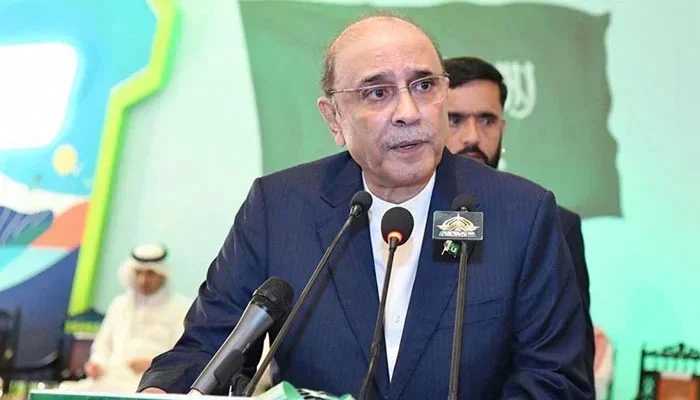
ISLAMABAD: President Asif Ali Zardari reaffirmed that the Pakistan-China friendship is unique, time-tested, and remains the cornerstone of Pakistan’s foreign policy. He stated that Pakistan would continue to collaborate with China in countering terrorism and extremism while expanding cooperation in agriculture, manufacturing, livestock, industry, mining, and new technologies.
President Asif Ali Zardari met Chen Xiaojiang, Communist Party Secretary of the Xinjiang Uyghur Autonomous Region, in Urumqi on Thursday. The Governor of the Xinjiang Uyghur Autonomous Region, Erkin Tuniyaz, was also present. Zardari expressed his delight at visiting Xinjiang again and deeply appreciated the unity of the Chinese people and the region’s impressive progress. He reaffirmed that the Pakistan-China friendship is unique, time-tested, and remains the cornerstone of Pakistan’s foreign policy.
He expressed hope that growing linkages between Xinjiang and Pakistan’s northern areas would further strengthen cultural and economic bonds. He added that he looks forward to the day when both countries can be easily accessed by road. Highlighting Xinjiang’s pivotal role in the China-Pakistan Economic Corridor (CPEC), the President encouraged greater industrial and agricultural collaboration, noting the potential of Special Economic Zones in Gilgit-Baltistan. He invited people from Xinjiang to visit Pakistan’s northern regions and underlined that Pakistan will always remain China’s most reliable partner and trusted friend.
Chen Xiaojiang, Communist Party Secretary of the Xinjiang Uyghur Autonomous Region, warmly welcomed the President and recalled his earlier visit to Urumqi in 2011 to attend an Expo. He also noted the President’s visit to Beijing in February this year, where he met President Xi Jinping and witnessed the signing of several cross-sectoral agreements and MoUs.
He further highlighted the recent visit of Prime Minister Shehbaz Sharif to China for the SCO Summit and the 80th Anniversary of Victory over Fascism, during which CPEC’s second phase was fast-tracked with agreements worth billions of dollars in industry, agriculture, mining, and other sectors. The Party Secretary underlined that Xinjiang has become a hub of prosperity, social stability, and lasting peace, with its GDP surpassing 5.6 trillion yuan. He said the region is advancing in agriculture and livestock while addressing the root causes of extremism and terrorism. He also pointed out that the Governor of Balochistan and the Chief Minister of Gilgit-Baltistan had recently visited Xinjiang.
Chen Xiaojiang added that eight sister-city arrangements exist between Pakistan and China, including between Urumqi and Peshawar. He said Xinjiang looks forward to deepening government-to-government and business-to-business cooperation with Pakistan, particularly in agriculture, livestock, mining, and industry. He assured that China and Pakistan would maintain zero tolerance against terrorist groups targeting both countries and reaffirmed the desire to work closely on security and counter-terrorism. The meeting was followed by a dinner hosted by Chen Xiaojiang in honour of the President and his delegation. Senator Saleem Mandviwalla, Sindh Energy Minister Nasir Shah, Pakistan’s Ambassador to China, and the Chinese Ambassador to Pakistan also attended the meeting.
Meanwhile, President Asif Ali Zardari visited the Urban Operations and Management Centre in Urumqi, where he was received by the Mayor of Urumqi and the Vice Governor of Xinjiang.
The President and his delegation were briefed about the Centre, which digitally connects more than 30 municipal departments and provides over 200 services to citizens. Officials explained how the Centre serves as a one-stop hub for public services, enabling real-time coordination on issues such as health, education, road safety, utilities, and emergency response.
President Zardari showed keen interest and that such an approach to city management offers valuable lessons for Pakistan and expressed hope that urban planners in Pakistan would draw inspiration from this model.
The president later visited the Xinjiang Islamic Institute in Ürümqi. He was received by Mukhtirei Sifu, President of the Xinjiang Islamic Institute. Mukhtirei Sifu explained that the Institute plays a central role in providing structured theological education and training religious scholars, imams, and khatibs for service across Xinjiang.
He highlighted the Institute’s efforts to blend religious education with modern learning, emphasising the importance of preparing students to serve both their faith and society. The president was informed that the Institute offers courses in the Quran, Hadith, Islamic jurisprudence, Arabic, theology, and general subjects, including history, computer literacy, ethics, and sciences. The curriculum also includes Mandarin Chinese, civil law, and regional religious policies.
The Institute has the capacity to host approximately 1,000 students at its main campus, with affiliated institutes in other parts of Xinjiang. Facilities include a central mosque, library, lecture halls, classrooms, dormitories, and administrative buildings. Students receive scholarships, housing, meals, and stipends during their studies. Since 2001, more than 28,000 graduates of the Institute have gone on to serve in religious, educational, and administrative roles across the region. The Institute also contributes to the translation and publication of Islamic texts and assists with Haj logistics. The president appreciated the services provided to the for Muslims and noted the significance of academic and cultural exchanges in fostering greater understanding between Pakistan and China.
Senator Saleem Mandviwalla, Pakistan’s Ambassador to China, and the Chinese Ambassador to Pakistan were also present on the occasion.


-
 Aurangzeb confirms Saudi Arabia $10bn interest, says B2B shift ongoing
 -
 Pakistan to build artificial island to boost oil exploration
 -
 Special pink bus service launched for women on Green Line route
 -
 Same number plates from other provinces lead to wrong e-challans for Karachiites
 -
 State institutions ‘fail’ to perform constitutional duties: KP CM
 -
 CTD orders psychological testing of police on VVIP security duty
 -
 Navy busts drug consignment valued at $130m
 -
 Three ex-secretaries in race for ETPB chief post