Building flood resilience
I find myself writing, once again, about the recurring flood tragedies in Pakistan. Through my research on climate-induced displacements, I already emphasised that floods are not inevitable. With prudent planning ex ante, both loss of life and large-scale devastation can be significantly mitigated ex post. Yet, every monsoon, we are forced to relive the same nightmare.
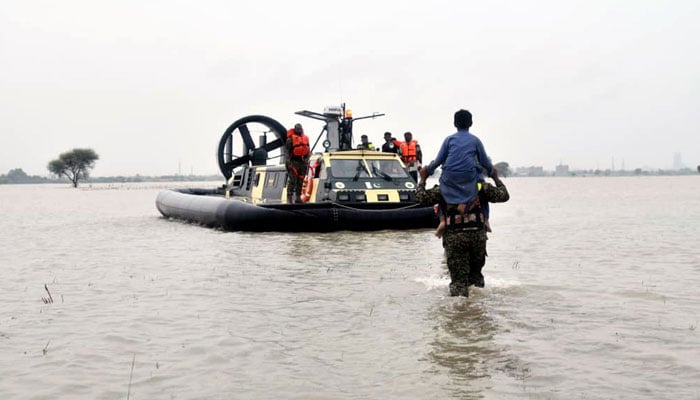
This year, once again, Pakistan lies submerged. Families are stranded in makeshift shelters, awaiting salvation as apocalyptic floods sweep across the country. From Gilgit-Baltistan to Sindh, and with Khyber Pakhtunkhwa and Punjab being hit the hardest, entire villages as well as cities have been inundated.
The National Disaster Management Authority (NDMA) reports over hundreds of deaths in Khyber Pakhtunkhwa alone, with thousands of livestock lost and homes destroyed. Punjab too reels under the same devastation and is facing unprecedented floods in its history – hundreds have died, 2.4 million people are affected, and thousands of settlements lie inundated. However, these figures remain underreported as recurrent floods continue. Sindh and Balochistan are now anticipated to be next in line to endure the force of this deluge.
Flooding in Pakistan is no longer just nature’s wrath but a consequence of human failures that have become path-dependent. Absence of dams, unchecked deforestation, messy and hidden urbanisation, river encroachments, blocked waterways, dysfunctional drainage systems and failure to incorporate technology to address this crisis have all contributed to a disaster.
When these vulnerabilities are ignored, heavy rainfall, glacial melt or even the release of water from across our border inevitably turns into a catastrophe. This year’s devastation is so overwhelming that instead of mapping the affected zones, it would be easier to highlight the rare pockets left untouched.
It is apparent that the 2025 floods are not an anomaly, but rather a pattern that can be studied. The catastrophic floods of 2022 displaced more than eight million people and affected 33 million in total. In its response, the government announced the Resilient Recovery, Rehabilitation and Reconstruction (4RF) framework. Yet, three years later, rehabilitation remains incomplete, scores of people still remain displaced, and 2025’s floods are tearing open wounds that never healed.
Poverty, now at 44.7 per cent, will surge as crops are being destroyed and livelihoods are vanishing. Food insecurity will deepen. Health systems will now be further strained under outbreaks of waterborne diseases and dengue. Families already living at the margins of survival will be further plunged into depths of impoverishment.
Pakistan is now ranked the world’s most climate-vulnerable country in the latest climate risk assessments. But instead of scaling up climate resilience, our national priorities continue to remain misplaced. The federal budget for 2025–26 slashed environmental protection spending by 56 per cent. While allocations for climate adaptation, response and rehabilitation have increased slightly, preparedness, which is the most critical component, has been cut by 28 per cent.
Preparedness is a necessity. Pakistan is already a signatory to the Sendai Framework for Disaster Risk Reduction (2015–2030), which provides a clear roadmap – understand risks, strengthen governance, invest in resilience and enhance preparedness. But in practice, we continue to fall short on every front.
We must stop treating floods as episodic tragedies and start addressing them as systemic failures. Temporary relief packages and international aid will not save us, but we require actionable and sustainable solutions. Pakistan needs to shift its national focus toward preparedness, resilience and prevention; otherwise, history will keep repeating itself every monsoon, only with greater intensity and higher costs. Building dams, efficient drainage systems and climate-resilient infrastructure are essential for survival; however, most significantly, there is a dire need to incorporate the use of technology for timely warnings.
One example is the use of IoT (Internet of Things) sensors in flood monitoring, which is more effective than conventional water monitoring systems. IoT sensors are smart devices that can identify and gauge changes in the physical environment, including water levels, rainfall, and temperature, and can be installed in large numbers along a river system.
These sensors collect real-time data with accuracy and cost-effectiveness. Hence, once anomalies are detected in water levels, they can issue real-time SMS alerts, giving communities hours or even days to evacuate. Countries such as Japan, Singapore and Indonesia have already adopted these technologies, while Bangladesh is in the process of doing so.
An early warning system is not a stand-alone operation. It must be developed using a synergised approach with the coordination of all relevant stakeholders, spearheaded by the government, along with community participation. If floods strike and we are already prepared, large-scale destruction can be prevented.
This would make recovery and reconstruction much easier, as fewer people would be left displaced or severely affected. Otherwise, under the current circumstances, the question we must ask, with urgency and honesty, is: how many more lives must be lost before we finally act?
The writer is a research associate at the Graduate Institute of Development Studies, Lahore School of Economics.