Punjab floods affect 4.3pc of cultivated land, spark economic fears
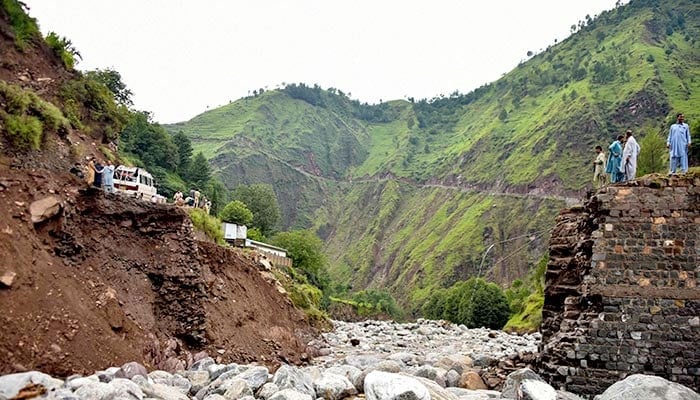
Punjab, Pakistan’s most populous province and its agricultural heartland, has been devastated by weeks of floods and torrential rains, with experts warning that the damage to farmland could have far-reaching consequences for the country’s economy.
The climate-driven flooding and rains began in late June and has since killed more than 900 people nationwide, submerging large areas of land and making this the worst disaster of its kind since 2022.
Punjab has borne the brunt of the destruction. About 4.3% of the province’s cultivated area has been affected, according to provincial agriculture minister Muhammad Ashiq Hussain Shah Kirmani.
“Approximately 1.3 million acres of farmland has been inundated in the province [to date],” Kirmani told The News. “While according to GIS-based imagery, initial estimates for the crop affected area are: rice: 9%, sugarcane: 7%, and cotton: 2%.”
In total, 28 districts in Punjab have been hit, particularly those along the Ravi, Chenab and Sutlej rivers so far.
Kirmani stressed that these are preliminary figures and that the full scale of losses will only be clear after the floodwaters recede.
Agriculture is central to Pakistan’s economy, contributing about 24% of the GDP, employing half the labour force and serving as the country’s largest source of foreign exchange earnings, according to the Pakistan Bureau of Statistics. And much of that production is concentrated in Punjab, often described as Pakistan’s breadbasket.
A report published on September 7 by the Karachi-based research firm Arif Habib Limited warned that the disaster has added fresh uncertainty to Pakistan’s economic recovery in 2025.
Titled ‘Monsoon Floods Test Pakistan’s Resilience’, the report estimated the economic cost of the floods at Rs409 billion ($1.4 bn), equal to about 0.33% of GDP.
“Agriculture has absorbed the heaviest blow, with losses exceeding PKR 302bn ($1 bn). This accounts for nearly three-fourths of the total and about 0.24% of GDP, reflecting the sector’s acute vulnerability to climate shocks and the risks these events pose to food security and rural livelihoods,” the report stated.
It added that the final damage estimate is likely to be higher.
The firm also cautioned that a 15% to 20% drop in agricultural output could shave 0.5% to 1% off GDP in the current fiscal year.
Then there are secondary repercussions, including the impact of stagnant water on soil salinity, damage to irrigation systems and supply chain breakdowns, which could drive food inflation higher by 20 to 30% in the country, it warned.
The floods are also expected to weigh on Pakistan’s trade balance. The combined effect of higher cotton imports and weaker exports - in textiles, rice, and sugar - would amount to a trade balance impact of around $1.93bn in the financial year 2026, the report forecasted.
Adil Mansoor, a Karachi-based food security analyst and researcher, also said that losses of this scale will ripple through the economy, adding that the government will need to do more than set up relief camps and compensate affected farmers in
Punjab.
“In the short term, it must provide targeted cash support, reschedule farm debts, and ensure affordable seed and fertilizer for the next planting season,” he told The News.
While in the longer run, he added, the government must face the hard truth: floodplains are not farmland.
“Farmers and settlements must be relocated out of high-risk zones, cultivation in floodplains [should be] banned during peak monsoon months, and cropping patterns reimagined to adapt to a climate change,” Mansoor said.


-
 Aurangzeb confirms Saudi Arabia $10bn interest, says B2B shift ongoing
 -
 Pakistan to build artificial island to boost oil exploration
 -
 Special pink bus service launched for women on Green Line route
 -
 Same number plates from other provinces lead to wrong e-challans for Karachiites
 -
 State institutions ‘fail’ to perform constitutional duties: KP CM
 -
 CTD orders psychological testing of police on VVIP security duty
 -
 Navy busts drug consignment valued at $130m
 -
 Three ex-secretaries in race for ETPB chief post