
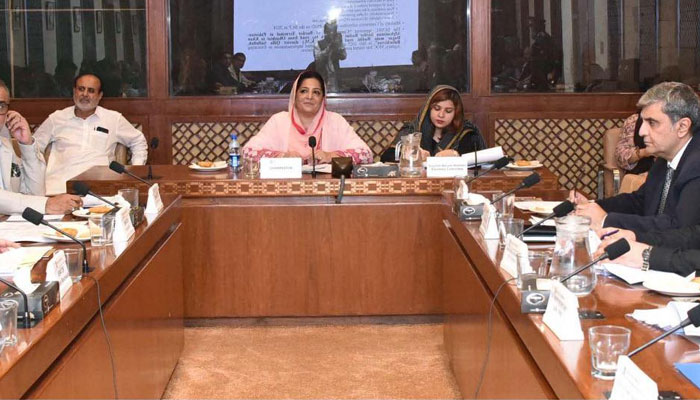
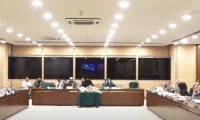
ISLAMABAD: The Senate Standing Committee on Commerce, chaired by Senator Anusha Rahman, on Thursday scrutinized the functioning of State-Owned Enterprises (SOEs), raising concerns about privatization status and accountability frameworks.
The Senate panel observed that most SOEs were run by private sector representatives, with oversight carried out through the Central Monitoring Unit (CMU) working under the Ministry of Finance.
The committee directed that the Privatization Division and CMU be invited to the next meeting for detailed discussions on the nomination process, performance evaluation, and the status of entities undergoing privatization.
The issue of releasing retrospective salary payments was briefly discussed, with clarification that such matters fall under the authority of the boards concerned. The committee examined the status of the Badini Border opening and expressed concern over delays in opening the border despite commitments from the ministry to open it by September 12, 2025. The crossing, inaugurated in September 2020, remains non-functional after 10 months of opening due to poor road conditions, lack of basic amenities, and inadequate support from the Afghan side. The committee underscored the need to fast-track the 40-km road project and called for improved coordination among the Ministry of Commerce, the Ministry of Interior, and the government of Balochistan.
It was stressed that a focal person be appointed to monitor progress, while all relevant stakeholders be engaged in the upcoming proposed meeting on September 18. The committee emphasized that parallel efforts must be made on the Afghan side and proposed a site visit to the Afghan side of the border in late September 2025. The committee discussed problems faced by traders under the current barter trade arrangement with Iran, particularly in relation to SRO 642(1)/2023. Concerns were also raised over bureaucratic delays by the Commerce Ministry while materialising the notification of SRO 642(1)/2023. The committee directed that the barter trade framework remain facilitative, allowing business-to-business transactions under clear conditions, and urged the Ministry of Commerce to coordinate with MoFA, FBR, and Law Division to finalize amendments that protect trader interests while ensuring compliance with international obligations.
On the matter of opening of chambers of commerce of foreign countries, the committee was informed that while many countries operated well-established chambers to facilitate their business communities, Pakistan’s system remained weak. The process suffers from bureaucratic hurdles, lack of clear protocols, and outdated policies. The committee noted delays in processing applications, unresolved deficiencies in pending cases, and inactivity of some chambers over long periods without compliance. It emphasized the need to streamline procedures, appoint focal persons, and align practices with successful international models. It was directed that policies be reviewed to allow reciprocal establishment of chambers, ensure embassy-based verification instead of NOC, and engage trade officers abroad to lobby for Pakistan’s chambers of commerce. A revised policy framework was sought by early October to provide clarity, remove ambiguities, and strengthen international trade facilitation to achieve the goals set by the prime minister.
The committee reviewed MoUs and Protocols and underscored the implementation of the prime minister’s directive and setting up implementation mechanisms to ensure that the agreements translate into tangible outcomes. It was apprised by the ministry that they had shared a list of 148 companies with the Board of Investment (BOI) for follow-up, with BOI tasked to directly engage these companies and monitor progress. The committee highlighted the need for coordinated efforts between Ministry of Commerce, BOI, and TDAP to avoid duplication or gaps in follow-up. It was also emphasized that chambers of commerce with Chinese-speaking representatives could be instrumental in maximizing potential under these agreements.
The committee was further briefed on the activation of sector-specific export councils, initially established as 17 and now increased to 20, with TDAP functioning as the secretariat. These councils include representatives from associations, leading exporters, relevant departments, research institutions, and TDAP. The committee stressed the importance of meaningful consultation with stakeholders, particularly the chambers in Balochistan, given the province’s significant role in exports such as rice, potatoes, kinnow, seeds, and mangoes. Concerns were raised by stakeholders about weak infrastructure, lack of expertise among officials, high energy costs, and insufficient cold chain facilities, which continue to restrict growth.
The committee emphasized that export roadmaps must not only be sector-specific but also address cross-cutting supply chain issues. Safeguarding domestic produce from non-tariff barriers was also highlighted as a priority, alongside closer consultations with chambers of commerce to strengthen the councils’ effectiveness.
In attendance were Senators Amir Walliuddin Chishti, Rahat Jamali, Saleem Mandviwalla, Ahmed Khan, Sarmad Ali, the secretary incharge and the additional secretary from the Ministry of Commerce, along with senior officials from the department concerned.


-
 State institutions ‘fail’ to perform constitutional duties: KP CM
 -
 CTD orders psychological testing of police on VVIP security duty
 -
 Navy busts drug consignment valued at $130m
 -
 Three ex-secretaries in race for ETPB chief post
 -
 Punjab govt forms 71 JITs to probe cases against banned TLP
 -
 Some UNSC members ignoring broader reforms, seeking privilege: Pakistan
 -
 PAC body discusses non-recovery of Rs15bn gas cess
 -
 Pakistan received $2.29bn foreign loans in first 4 months of 2025