Pakistan-India crisis: Need stressed to decolonise Western-centric narratives
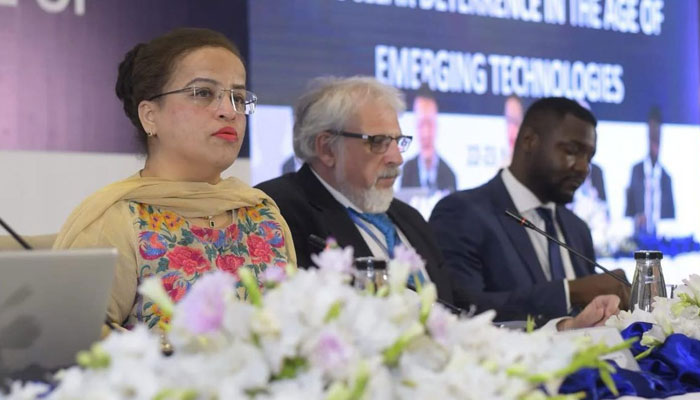
ISLAMABAD: Dr Asma Shakir Khawaja, Executive Director, Centre for International Strategic Studies (CISS) Azad Jammu and Kashmir, Thursday stressed the need to “decolonise” Western-centric narratives, particularly those concerning terrorism that have been instrumentalised against Pakistan.
Addressing a gathering of Arms Control and Disarmament Centre (ACDC) here, she emphasised Pakistan should advocate for forensic transparency through platforms like United Nations to counter the narratives. She said India’s so-called “new normal” was illegal, unrealistic and against UN Charter. “Pakistan needed to tell the world South Asia could not afford any wars”, she said, asserting Pakistan’s “Quid Pro Quo Plus” response was the new normal.
She underscored the data asymmetry that existed between Pakistan and India, which the former needed to address in order to have greater traction for its narrative. She suggested Pakistan must not only highlight subjectivity of these biased narratives, but also work to establish reliable crisis de-escalation mechanisms to prevent future wars instead of leaving the region’s fate to extremist ideologies like Hindutva. The ACDC organised the launch of its latest Islamabad Paper, titled “Commentary on Western Assessments of Pakistan-India Crisis of May 2025”, authored by Ambassador Zamir Akram. It was held at Institute of Strategic Studies Islamabad (ISSI).
The Director General ISSI and former Foreign Secretary, Ambassador Sohail Mahmood, noted May 2024 Pakistan-India conflict was one of the most consequential events of the recent past for the two countries, the region, and possibly internationally.
While Pakistan and India had advanced their respective narratives, the third-party analyses were also part of the equation in shaping global perceptions, he said. For obvious reasons, it was critical Pakistan’s point of view should come out clearly regarding the actual conflict, its strategic consequences, and the future trajectory, he remarked.
Ambassador Zamir Akram had focused on four distinct threads, including terrorism, military engagements, restraint and India’s so-called “new normal”. He had analysed what Indian narrative was on these subjects, and how it was absorbed and amplified by experts and academics in UK and US think-tank community.
Sohail Mahmood underlined India started rewriting its own narrative after May 2025 conflict, seeking to turn an evident setback into a “victory” of sorts. The Western assessments’ proximity to India’s official line was a function of several structural factors, including Indo-US strategic partnership, he said.
Malik Qasim Mustafa, Director ACDC, referring to the papers, said these assessments were based on May 2025 conflict, where South Asia witnessed 87 hours of fighting between India and Pakistan that almost brought the region to the brink of an all-out war.
Dr Naeem Ahmad Salik reminded lack of transparency regarding India’s own military losses during May 2025 conflict and its role in escalating crises was often overlooked in Western narratives. “The narratives also readily accepted the assumption any terrorist activity in India was backed by Pakistan, which had dangerous implications”, he commented.
This bias was evident in publications that used only Indian sources and disregarded critical facts, such as the number of downed Indian aircraft, he said. He highlighted lack of academic vigour and intellectual integrity in such commentaries was a matter of concern.
Ambassador Zamir Akram highlighted challenges for Pakistani analysts due to lack of opportunity to project their views and publish them in Western academic and policy circles. He argued the few Pakistani scholars who did get published often adopted a pro-Western stance, which was more detrimental than the narratives presented by Western scholars themselves. He pointed to the “Five Eyes” framework as an example of a system where these allied nations aligned their perspectives and policies on various issues, further marginalising alternative viewpoints. He noted Pakistani scholars in Western spaces often admitted facing publication barriers. Ambassador Khalid Mahmood, Chairman BoG ISSI, said Islamabad Paper dealt with a subject that was vital for Pakistan’s security. “The war of narratives was one of many challenges Pakistan facing today, and it must succeed in it through concerted efforts”, he said.


-
 Aurangzeb confirms Saudi Arabia $10bn interest, says B2B shift ongoing
 -
 Pakistan to build artificial island to boost oil exploration
 -
 Special pink bus service launched for women on Green Line route
 -
 Same number plates from other provinces lead to wrong e-challans for Karachiites
 -
 State institutions ‘fail’ to perform constitutional duties: KP CM
 -
 CTD orders psychological testing of police on VVIP security duty
 -
 Navy busts drug consignment valued at $130m
 -
 Three ex-secretaries in race for ETPB chief post