Not sweeter than honey
During his visit to New Delhi earlier in August this year, Chinese Foreign Minister Wang Yi stated that China and India should view each other as partners rather than adversaries or threats. Reciprocating, his Indian counterpart Jaishankar said that India and China were seeking to “move ahead from a difficult period in our ties”.
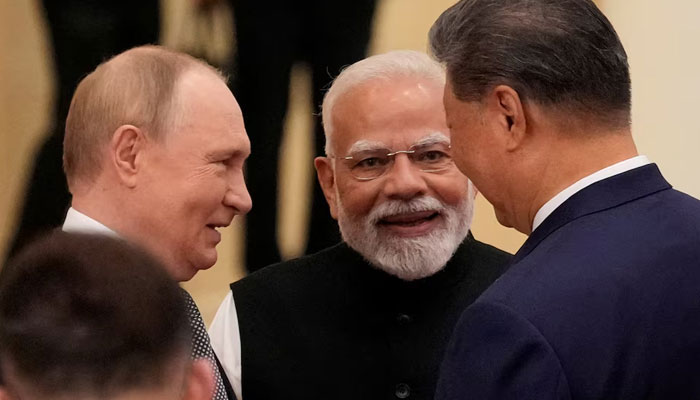
Two weeks later, Indian Prime Minister Narendra Modi flew to Tianjin to attend the Shanghai Cooperation Organization’s summit hosted by China and on the sidelines of the event, met Chinese President Xi Jinping. That was Modi’s first visit to China in six years. Though not a bilateral visit, the occasion provided an opportunity for the two leading countries in the Global South to re-establish direct contacts at the top level.
The recent weeks have seen a sudden upswing in Sino-India relations. However, for various reasons, it’s doubtful that the current bonhomie will translate into a long-term or strategic partnership between the two Asian giants.
For one thing, the upswing isn’t driven by any internal dynamics; instead, it’s pushed primarily by the downswing in India’s relations with the US. Washington and Beijing remain strategic adversaries, eager to woo each other’s allies. The US is wooing Pakistan in the same context.
The strain in India-US relations is essentially undergirded by a clash of egos. Trump and Modi have much in common, including inflated egos. The downswing in the bilateral ties could’ve been averted had New Delhi acknowledged, just as Islamabad did, that Trump mediated the ceasefire when a brief war broke out between Pakistan and India in May this year. The acknowledgement would, however, have given a lie to Modi’s claim that, contrary to his predecessors in the PM Office, no one can influence him. In fact, day in and day out, the ruling BJP and its supporters in both the public and the media churn out that the history of a ‘truly independent’ India began when Modi came to the helm in 2014.
The purchase of Russian oil has only been used as a pretext by the Trump administration to slap Indian exports with the high import tariffs of 50 per cent. During Trump’s first term, India maintained a robust trade with Iran, on which his administration reimposed the menacing sanctions after walking out of the 2015 Joint Comprehensive Plan of Action (Iran nuclear deal). But Washington didn’t punish India and just winked at Indo-Iran trade.
Hence, the current setback in US-India relations is only temporary. Once Trump and Modi sort out their differences, the ties will be back to normal. At any rate, the setback will not survive Trump’s departure from the White House in early 2029.
Beyond the current dip in their relations, both India and the US have high stakes in their long-term ties. On the other hand, China and India have some veritable differences, which have the potential of holding back any attempt to make them strategic partners.
China claims the entire Indian state of Arunachal Pradesh as part of its Tibet Autonomous Region. Located in the northeast of India, Arunachal Pradesh has a 1,100 km-long disputed border with Tibet. The northern border of Arunachal Pradesh, known as the McMahon Line, remained a point of contention between British India and China. The McMahon Line, drawn in 1914, represented the division of Tibet into outer and inner territory by the British, which the Chinese never accepted.
In 1959, Chinese Premier Zhou Enlai, in a letter addressed to his Indian counterpart Jawaharlal Nehru, said: “The so-called McMahon Line was a product of the British policy of aggression against the Tibet Region of China and has never been recognised by any Chinese Central Government and is therefore decidedly illegal”. In the 1962 China-India war, Chinese troops crossed the McMahon Line and took several posts situated inside what’s now the state of Arunachal Pradesh. Later, however, the Chinese vacated the posts and withdrew behind the Line. But Beijing continues to regard Arunachal Pradesh as Chinese territory.
The US Indo-Pacific Strategy also puts India and China in opposing camps. Also known as the Asia-Pacific, the Indo-Pacific region includes countries along the Indian and Pacific Oceans, including the US, China, India, Pakistan, ASEAN nations, Australia, New Zealand, Russia, Japan and South and North Korea. In fact, the term ‘Indo-Pacific’ was coined by Washington to counter the rise of China. The region has a network of US allies, including India, South Korea, Japan, the Philippines, Taiwan, Australia, New Zealand and several American military bases, that encircle China.
In 2022, the US and its allies, including India, signed the Indo-Pacific Economic Framework for Prosperity. The framework aims to foster a free, open and secure Indo-Pacific region, addressing both economic and security challenges. The Quadrilateral Security Dialogue (Quad) is another important forum in the region. Comprising the US, Australia, India and Japan – the four ‘liberal democracies’ – the Quad is an informal alliance to tackle security, economic and health issues.
Beijing regards both the Indo-Pacific Economic Framework for Prosperity and the Quad as key elements of Washington’s global anti-China strategy. It also sees New Delhi as an important player in this strategy. As long as India is a member of such anti-China platforms, a real breakthrough in its relations with China will remain highly improbable.
China and India are rivals when it comes to the leadership of the Global South or emerging economies. Both are nuclear powers and have the two largest armed forces in the world. They’re also the two largest developing countries, the two most populated nations, the two biggest emerging economies and represent two of the oldest civilisations in the world. In the recently held 25th Summit of the Shanghai Cooperation Council (SCO), Chinese leader Xi Jinping announced a New Global Governance Initiative to put in place a new world order as an alternative to the West-dominated international order.
Since the end of World War II, the US leadership in the West has never been contested. And it’s doubtful that India will be content with allowing China to assume the leadership of the Global South. Instead, New Delhi itself must be eying the lead role. Not only that, in its envisaged leadership role, India enjoys the full backing of the US, which sees China as the only threat to its hegemony. Already, the US and its Western allies have supported India to replace China as the key manufacturing hub.
Not surprisingly, India is the only country in South Asia which hasn’t joined China’s flagship Belt and Road Initiative. Instead, it’s part of a US-sponsored proposed economic corridor, announced in 2023 by the Biden administration, linking India, the Middle East, and Europe.
Like most other developing nations, India is keen to graduate to the status of a developed country. Towards that end, it must have unhindered access to the latest cutting-edge technologies. Such technologies can be provided by the US or its Western or Asian allies, not by China, which itself lacks them. Take the current era’s key tech component: semiconductors or chips. Of the top 10 chip-making enterprises in the world, six are American, two are South Korean and one each is from Taiwan and the Netherlands. India can afford to turn its back on the US only at the expense of its economic development.
Hence, the current downturn in US-India relations is only a temporary phase. The US needs India to check China’s rise. India needs the US to become a developed country and also to achieve its long-standing dream of leading the Global South. By implication, the current upsurge in Sino-India relations isn’t sustainable as well.
The writer is an Islamabad-based columnist. He tweets/posts @hussainhzaidi and can be reached at: hussainhzaidi@gmail.com