KARACHI: Subdued inflation, a stable exchange rate, prudent fiscal policy and improved credit ratings are expected to support Pakistan’s economic recovery, though intense monsoon rains and flooding may present certain challenges, the central bank said on Wednesday.
The State Bank of Pakistan (SBP), in its mid-year banking sector review, said that banks’ performance is expected to remain steady in the second half of 2025 amid the optimistic backdrop of the country’s economic recovery. However, it cautioned that recent heavy rains and flooding could pose challenges to this recovery.
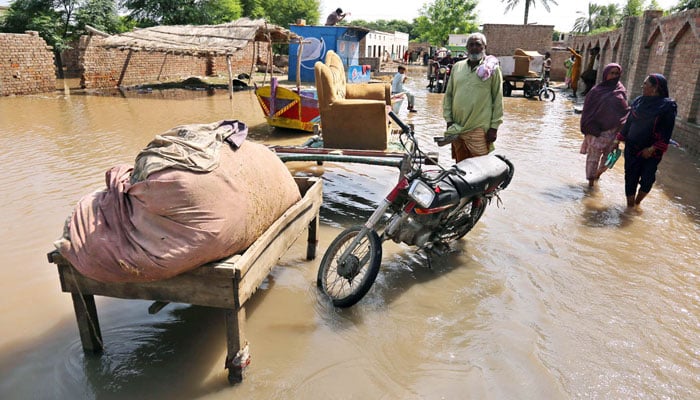
More than four million people have been affected by devastating floods in Pakistan. Over the past week, heavy rains have caused three rivers in Punjab, the country’s most populous province, to swell, leading to widespread destruction in the agricultural heartland. Historically, such disasters have not only diminished agricultural output and rural incomes but have also caused ripple effects throughout supply chains, driven up food inflation, and slowed economic growth. According to initial estimates, the economic cost of the latest floods is projected to be around Rs409 billion (approximately $1.4 billion), which is equivalent to 0.33 per cent of GDP.
Demand for bank loans seen increasing“Amid easing financial conditions, economic recovery, and a seasonal demand, banks’ advances are expected to rise in H2CY25,” the SBP’s review said.“Particularly, with the relatively lower tariff rate of 19 per cent compared to regional competitors, textiles exports to the US may see some uptick, translating into higher credit demand,” it added.
While continued fiscal consolidation, realisation of planned official inflows, and an increase in non-tax revenue can taper the government’s needs for bank credit, recent flooding could exert pressure on the fiscal account, the SBP said.
Banks’ overall gross advances, both domestic and overseas, declined by 15.2 per cent from January to June, totalling Rs14.338 trillion. Within domestic advances, private sector lending experienced a contraction of 16.9 per cent during the first half of this calendar year. Nonetheless, fixed investment advances to small and medium businesses continued to grow. SMEs took Rs657 billion worth of loans in the first six months of 2025, compared with Rs474 billion a year earlier.
The central bank expects that the cumulative reduction in the policy rate may lead to lower interest earnings for lenders. However, with an expected increase in lending due to easier monetary conditions and a recovering economy, the volume effect on earnings may outweigh the impacts of lower rates.
The SBP also said that the credit risk for banks is expected to remain manageable, as there is likely to be an improvement in borrowers’ repayment capacity. While the recent heavy floods may negatively affect the repayment capabilities of agricultural borrowers, the overall stability of the banking sector is expected to be preserved. This is due to the relatively small share of agricultural advances in the total loan portfolio and the adequate capital cushions that banks currently maintain.
Banks likely to show resilience
The SBP, citing results of the latest macro stress tests, stated that the capital adequacy ratio (CAR) of the banking sector is expected to remain comfortably above the minimum regulatory requirement of 11.5 per cent under both baseline and hypothetically severe stressed macro-financial scenarios over the two-year forecast horizon. Results also indicate strong resilience of banks to withstand hypothetical shocks to credit and market risk factors.
CAR improved to 21.4 per cent in the first half of this year from 20.6 per cent in December 2024.
Banking sector performed steadily in H1
The SBP’s review highlighted that banks managed to grow their asset base by 11 per cent in H1CY25. Investments in government securities primarily supported the asset growth, reflecting the government’s needs from the banking sector. Deposits grew at an impressive pace of 17.7 per cent, leading to a decline in banks’ reliance on borrowings.
The report said that the non-performing loans (NPLs) of the sector declined during the January-June 2025 period; however, due to contraction in advances, the gross NPLs to loans ratio marginally deteriorated to 7.4 per cent in June. Nonetheless, as the banks hold a higher stock of provisions for loan losses, the net NPLs to net loans ratio clocked at negative 0.5 percent, reflecting muted risks on a net basis.
The earnings of the sector remained steady, backed by rising volumes of earning assets. Accordingly, the return on assets and return on equity remained steady at 1.3 per cent, respectively.


-
 Aurangzeb confirms Saudi Arabia $10bn interest, says B2B shift ongoing
 -
 Pakistan to build artificial island to boost oil exploration
 -
 Special pink bus service launched for women on Green Line route
 -
 Same number plates from other provinces lead to wrong e-challans for Karachiites
 -
 State institutions ‘fail’ to perform constitutional duties: KP CM
 -
 CTD orders psychological testing of police on VVIP security duty
 -
 Navy busts drug consignment valued at $130m
 -
 Three ex-secretaries in race for ETPB chief post