A better mobility policy
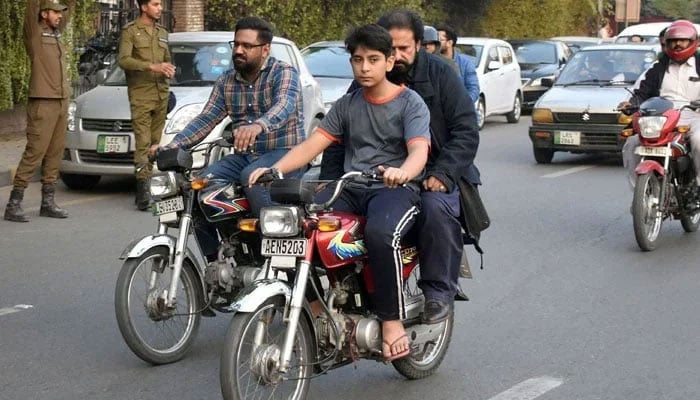
Motorcycles have become the backbone of mobility in Pakistan, comprising nearly 77 per cent of all registered vehicles in the country, according to the Pakistan Economic Survey 2022–23.
Out of 34.9 million registered vehicles nationwide, around 26.9 million are motorcycles, underscoring their overwhelming presence on the roads. The trend extends into households as well. A Pew Research Centre study reveals that 43 per cent of Pakistani households own at least one motorcycle, highlighting how two-wheelers have become an essential part of everyday life for millions of families.
Industry data further illustrates this dominance. Between 2007 and early 2025, more than 20.4 million motorcycles were sold compared to just 2.6 million cars, according to Gallup Pakistan and the Pakistan Automotive Manufacturers Association (PAMA). This translates into a striking 8:1 ratio of motorcycle to car purchases, spiking to as high as 27:1 during times of economic pressure.
Globally, there is no universal fixed percentage set by traffic authorities. Instead of saying ‘congestion begins if motorcycles exceed 50 per cent’, engineers use Passenger Car Equivalent (PCU) values to measure road capacity. A motorcycle is typically assigned 0.3–0.5 PCU, compared to 1 PCU for cars. This means that while a higher share of motorcycles increases flow density, their erratic weaving, overtaking and bunching behaviour makes the problem more about road discipline and infrastructure than just numbers.
In countries like Vietnam, Indonesia, and Thailand, where motorcycles often make up 70–80 per cent of vehicles, traffic challenges are well-documented. Lane discipline tends to collapse when motorcycles exceed 50–60 per cent of mixed traffic. Side friction rises due to weaving and shoulder encroachment, while intersections lose efficiency as motorcycles squeeze into every available gap, slowing car movement. Studies from Thailand show that once motorcycles make up more than 60 per cent of total traffic, the Level of Service (LOS) drops sharply unless dedicated lanes are provided.
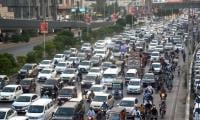
For Pakistan, the challenge is even more pressing. With motorcycles making up around 77 per cent of all registered vehicles, the country is already in the ‘high share’ category. This leads to bottlenecks at intersections as motorcycles bunch at the front, instability in mixed lanes as cars react to sudden manoeuvres, and higher accident risks in a system still designed around cars.
Transport studies suggest a general rule of thumb. When motorcycles are below 30 per cent, traffic remains manageable as they act as ‘gap fillers’. Between 30 and 60 per cent, traffic flow becomes unstable without lane management measures. Beyond 60 per cent, serious problems emerge unless governments introduce dedicated motorcycle lanes, tailored signal systems, and stricter safety enforcement.
The rising number of motorcycles on Pakistani roads has become one of the biggest challenges for traffic management and has made road users more vulnerable to fatal accidents. While the sheer number of motorcycles is a concern, the deeper issues lie in rider behaviour, the lack of an efficient public transport system in urban areas, the affordability gap in better commuting options and social attitudes that normalise unsafe practices. Very few motorcycles on the roads meet the required safety standards, and perhaps the most critical weakness is the poor enforcement of motorcycle safety laws.
Hardly any motorcycle owners maintain their bikes properly. In many cases, headlights, brakes and tires are in poor condition, while tail-lights and rear-view mirrors are missing altogether. The situation is even worse among delivery riders and ride-hailing drivers, who rarely follow traffic rules. They are often in a hurry, frequently violating one-way restrictions and even entering roads through greenbelts or crossing over separators, creating serious safety hazards for themselves and others.
Motorcycles are designed for two riders, but in Pakistan, due to poor economic conditions, they have effectively become family vehicles. It is common to see a husband, wife and three small children crowded onto a single 70cc motorcycle. The unsafe side-saddle position in which many women sit adds to the risk, turning an already overloaded ride into a serious safety hazard. As a result, many accidents involve motorcycles, with women and children frequently among the injured.
The use of helmets among motorcycle drivers has become common, but passengers often ride without helmets or other safety gear. While the traffic police have enforced the mandatory helmet law with some success, other critical safety measures are largely ignored. Motorcycles without functioning headlights, taillights, or rear-view mirrors continue to ply the roads unchecked, even though these are just as important for preventing accidents as helmets.
In Pakistan’s congested cities, road widening projects, interchanges, U-turns and signal-free corridors are being developed primarily for light transport vehicles. However, these initiatives rarely make provisions for motorcycles. As a result, motorcyclists often find themselves stranded on wide roads and interchanges, forced to weave from the left lane to the right to take U-turns, or to ride in the middle of the road when going straight to avoid unsafe left turns. This puts them directly on the path of fast-moving cars and larger vehicles, leaving them highly vulnerable. Such projects should include thoughtful planning for motorcycles before implementation, ensuring safer integration of the country’s most widely used mode of transport.
Motorcycles are no longer just an alternative mode of transport in Pakistan; they are the dominant reality on the roads. Ignoring them in traffic planning, infrastructure design, and law enforcement only deepens the risks faced by millions of daily riders and their families. If Pakistan is to reduce accidents, ease congestion, and build a safer transport system, motorcycles must be placed at the centre of mobility policies, with dedicated lanes, stricter safety compliance and viable public transport alternatives. Without such measures, the country’s most common vehicle will remain its biggest road safety challenge.
The writer is the director of the Executive Development Centre at the Pakistan Institute of Development Economics (PIDE). He can be reached at: nadeem@pide.org.pk