Drowning in negligence
I went for Hajj in 1994, when the government used to issue travellers’ cheques to pilgrims instead of foreign currency. Most pilgrims, many of them illiterate rural folk, had no idea how to use these checks. They wandered helplessly through Makkah and Madina, holding pieces of paper worth thousands but unable to buy even a meal. They had the money but didn't know how to access it.
Three decades later, Pakistan faces a similar situation, with floods and challenges in water sector management. Pakistan had $11 billion pledged by international donors after the 2022 floods. Three years later, we have utilised less than $3 billion. Like those confused hajis clutching useless traveller's checks, we hold billions in pledges but lack the basic competence to access them. While our pledges, like the ‘traveller's cheques’, gathered dust in PowerPoint presentations, the rivers did exactly what everyone predicted they would do.
After 2022's devastating floods, the world pledged $11 billion for reconstruction and flood prevention. That money could have repaired embankments, built flood storage systems and saved the villages from drowning today. Instead, it gathered dust. Finance Minister Muhammad Aurangzeb admitted what should shame every bureaucrat in Islamabad: Pakistan couldn't even prepare the project proposals needed to access the funds. We as a nation are as helpless as those hajis, holding billions in pledges but clueless about how to encash them.
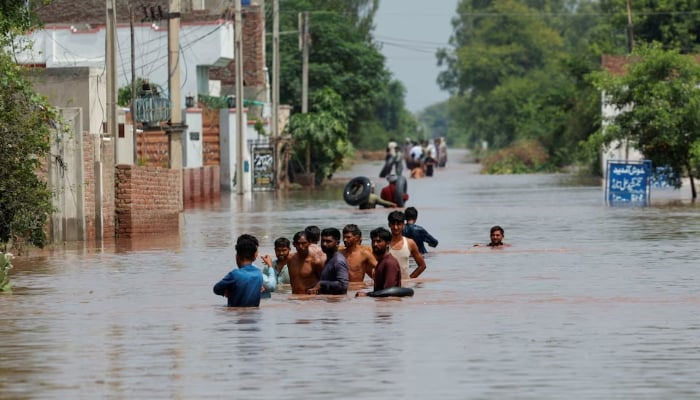
The human cost of this incompetence is measured in lives, such as those of small farmers like Muhammad Azhar. His rice field in Hafizabad is now a lake. The water reaches his chest, where green shoots promised a good harvest months ago. The ‘bund’ that protected his village has washed away. His family's fields are under chest-high water; both his buffalo have drowned. "This isn't an act of God," he says, "This is betrayal”. He's absolutely right.
The 2025 Punjab floods, which displaced an estimated two million people and submerged over 2,000 villages, are not just a natural disaster. They are a human-made catastrophe rooted in criminal negligence.
But unused foreign aid is only half the betrayal. The other half lies in our budget choices. This year's federal budget tells the whole story. Water infrastructure allocations were slashed by 46 per cent, from Rs259 billion to Rs140 billion. Even the flagship Diamer-Basha Dam lost Rs5 billion in funding. Meanwhile, politically popular road projects continued receiving full funding.
The message couldn't be clearer: politically visible projects like motorways and flyovers trump water sector management and flood protection. Under IMF pressure to cut spending, governments preserve projects that win votes and slash ones that save lives.
Punjab has excellent flood laws. The 2016 Floodplain Regulation Act gives authorities the power to mark danger zones and remove illegal construction. The 2023 Irrigation Act mandates scientific flood planning. These are among South Asia's most progressive water management laws. They have never been implemented. Giving water its path is embedded in our past, too. Our Indus Valley ancestors built elevated settlements and designed fields to work with seasonal flooding. The knowledge exists. What is missing is political will.
As far as I know, no flood zone has been officially declared. No illegal encroachment on riverbeds has been removed. No provincial flood strategy exists beyond VIPs' aerial observations and scrambling for photo ops across villages that are underwater.
Urban Pakistan might think floods are a rural problem. They're catastrophically wrong. When farmland disappears under water, the entire nation faces a food security crisis. Food prices have already skyrocketed. Flour has risen 12 per cent and tomatoes 15 per cent. For the 40 per cent of Pakistani households already spending more than half their income on food, these price hikes force impossible choices between food and medicine, between education and nutrition.
The floods will devastate key export sectors. The $18 billion textile industry faces a crisis as cotton rots in flooded fields. Rice worth $3 billion is submerged, eliminating crucial foreign currency earnings. Most critically, flood-hit farmland may not dry for months, making winter wheat planting impossible. Rural families have lost grain stores and seeds. This creates massive new wheat demand. The government did not procure any wheat this year, and without a strategic stock, Pakistan will have to import wheat, burdening the foreign exchange reserves and exacerbating inflation.
Azhar, the Hafizabad farmer, might sow wheat if the land dries and he can afford seed. But his buffalo are gone forever. The real tragedy is not his loss, it is that his loss was preventable.
After the 2010 floods, Justice Mansoor Ali Shah's commission’s ‘A Rude Awakening’ report diagnosed exactly these failures: weak embankments, illegal encroachments, poor early warnings and underfunded disaster management. His recommendations were filed away and forgotten. Fifteen years later, the 2025 floods replay the same script – the same villages flood; the same people suffer; the same officials express shock at predictable disasters. This is willful negligence.
Pakistan's development budget has become a political instrument. Roads get built in constituencies that matter. Water infrastructure gets neglected because villages lack lobbying power. But floods don't respect political boundaries. When rural Pakistan drowns, the whole country suffers through food inflation, export losses, and economic instability.
The 2025 floods reflect our governance failures, a state that leaves foreign pledges unused, domestic laws unenforced and vulnerable villages undefended. Science tells us the rivers will rise again. Climate change guarantees more extreme weather. What's uncertain is whether Pakistan will finally honour its obligations to the people who feed this nation.
Will we spend the coming months filing damage reports and begging for new aid? Or will we finally use money already pledged, enforce laws already passed, and build infrastructure to address the issue?
Every village that will drown in future floods is being condemned by today's policy choices. Every farmer who will lose everything is being betrayed by the current budget allocations. The next flood is already being written, not by weather, but by bureaucrats who will spend the coming months shuffling papers instead of building embankments.
Until we treat water management as a priority rather than a political afterthought, every monsoon will bring not just water, but verdicts on a state that refuses to act.
The cruel irony is complete: those hajis in 1992 wandered confused through holy cities, unable to convert their traveller's cheques into sustenance. Today, Pakistan's villages drown while billions in pledged aid remain locked away in bureaucratic procedures we are too incompetent to navigate. We are drowning not from lack of resources, but from our inability to access the lifelines already extended to us. The difference is that in Makkah, confused pilgrims faced hunger. In Pakistan, our politico-bureaucratic confusion sentences entire communities to devastation and poverty due to floods.
The writer is a former Punjab minister for irrigation and finance, with extensive experience in Pakistan’s provincial and federal legislatures.