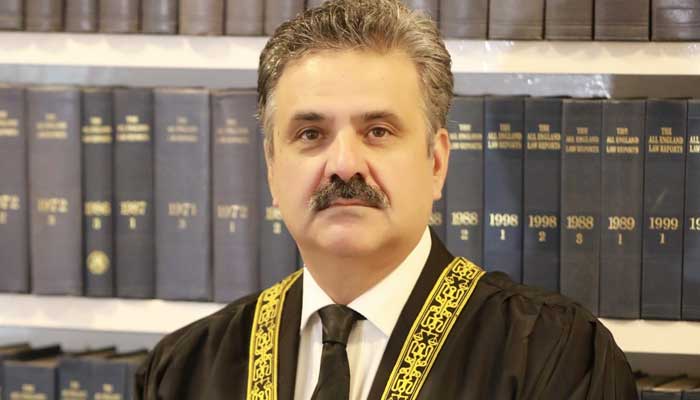
ISLAMABAD: Chief Justice of Pakistan (CJP) Yahya Afridi Monday said that the judiciary has always worked for the supremacy of law and the Constitution, and that transparency in the judicial system is the only way to ensure the delivery of justice.
The CJP, according to Geo News, also clarified draft rules had been shared with judges for feedback, while a full court meeting has been convened to review the rules.
Addressing the Judicial Conference held at the Supreme Court to mark beginning of the new judicial year 2025, the chief justice said that this tradition started in the 1970s and since 2004 has been celebrated regularly. He said this is an occasion for all to review their performance.
The event was attended by judges of the Supreme Court and high courts, the attorney general, officials of the Pakistan Bar Council and Supreme Court Bar Association. The CJP said that after assuming the responsibilities of his office, he felt the need for judicial reforms and initiated reforms based on five pillars, including technology, transparency and legal framework.
He added that eight sections of the Supreme Court prioritised speedy justice and six sessions were held to discuss reforms. He said that digital case filing and tracking are being introduced in the Supreme Court, under which 61,000 files will be scanned, and the project will be completed within six months.
After that, he added, cases will be scheduled through AI, although the judiciary is not yet fully prepared for it. He also said that the Supreme Court belongs to everyone, and the Facilitation Centre established in it would become fully operational from October. He further said that quick disposal of cases remains a top priority, and that the judiciary has always worked for the supremacy of law and the Constitution.
On this occasion, the chief justice said that the Supreme Judicial Council (SJC) has already decided 64 complaints against judges of the higher judiciary adding that 72 complaints have been referred to members for opinion, and the remaining 65 cases would also be decided soon.
Speaking about his security, he said earlier his convoy included nine security vehicles, but now it has been reduced to only two, as additional security is not required in the Red Zone. Highlighting the rationale of wide-ranging reforms initiated during the last judicial year, Justice Yahya underscored that the goal was to reduce backlog, shorten timelines, and make the judicial processes more citizen-centric. He outlined five foundational reform pillars -- improving service delivery through technology, enhancing access and transparency, strengthening the legal and regulatory framework, leveraging international and external resources, and revitalising attached institutions.
Key achievements included the introduction of digital case filing, e-notices, video-link hearings, an anti-corruption hotline, a public feedback portal, an external audit of court accounts, the establishment of an Overseas Litigants Facilitation Cell, and the notification of the new Supreme Court Rules, 2025.
The chief justice also highlighted major initiatives under the Federal Judicial Academy, the Law and Justice Commission and the National Judicial (Policy Making) Committee, including time-bound trials, expanded mediation facilities, a Charter on Ethical Use of AI, and reforms in family and criminal laws.
Presenting the apex court’s performance data, he noted that from September 2024 to September 2025, the Supreme Court disposed of 22,863 cases against 20,811 instituted, reducing overall pendency from 60,635 to 56,943 cases - a meaningful step in restoring balance.
However, he also called upon the Bar to cooperate in reducing adjournments, which had risen sharply during the year. The CJP expressed gratitude to his fellow judges, members of the Bar, court staff, and all stakeholders for their unwavering commitment. He reaffirmed that the judiciary’s mission in the New Year is to build on the foundations laid, ensuring that justice in Pakistan becomes stronger, swifter and more accessible.
Justice Afridi said internal audit procedures had been completed, and draft rules had been shared with judges for feedback. “We have convened a full court meeting to review the rules. Members with objections should submit them in writing so they can be duly considered,” he added.
He also clarified rules regarding judges’ leave, saying that during judicial vacations no permission was required, though outside public holidays prior intimation was mandatory. Addressing the occasion Attorney General Mansoor Usman Awan said that the prompt delivery of justice has always been the judiciary’s foremost priority.
He said that upholding the Constitution and law ensures transparency, and fulfilling constitutional requirements is its beauty. He added that compared to last year, the number of adjournments in cases has decreased, for which the judges and relevant officers of the Supreme Court deserve appreciation.
He said special benches have been formed for hearing constitutional cases, and that technology and AI should also be used in the Supreme Court to make the justice system more effective.
Similarly, Pakistan Bar Council Vice Chairman Tahir Nasrullah praised the services of Chief Justice Yahya Afridi and assured that the legal fraternity stands with the judiciary. He said that recently internet and solar facilities were provided in courts located in remote areas to ensure access to justice, and that the use of video-link arguments has facilitated litigants while reducing pending cases in the Supreme Court.
He emphasised that justice delivery in district courts must also be made easier, bail applications should be scheduled more promptly, and more facilities should be provided to litigants. Likewise, Supreme Court Bar Association President Rauf Atta said that the Supreme Court has set a new direction for the coming year.
The CJP has introduced new thinking in the court, and successes have been achieved in implementing electronic filing, video-link facilities and the establishment of the Facilitation Centre.
The SCBA president also expressed concern over the increase in court fees, saying it will make it even harder for poor litigants to access justice. Later, the chief justice inaugurated the newly constructed Facilitation Centre, Media Station and cafeteria in the Supreme Court.


-
 Aurangzeb confirms Saudi Arabia $10bn interest, says B2B shift ongoing
 -
 Pakistan to build artificial island to boost oil exploration
 -
 Special pink bus service launched for women on Green Line route
 -
 Same number plates from other provinces lead to wrong e-challans for Karachiites
 -
 State institutions ‘fail’ to perform constitutional duties: KP CM
 -
 CTD orders psychological testing of police on VVIP security duty
 -
 Navy busts drug consignment valued at $130m
 -
 Three ex-secretaries in race for ETPB chief post