Eurasia’s evolving architecture
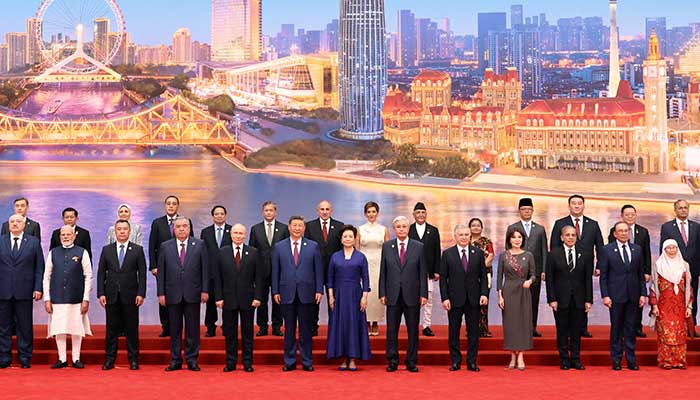
The recently concluded Shanghai Cooperation Organisation (SCO) Summit in Tianjin has once again underlined how global politics is moving steadily away from traditional Euro-Atlantic frameworks towards Eurasian-led mechanisms of cooperation, security and economic development.
Most important in this was Chinese President Xi Jinping’s renewed call for a new world order that prioritises the Global South, with an emphasis on genuine multilateralism, collective security and economic integration that bypasses Western-dominated institutions.
Against this backdrop, Prime Minister Shehbaz Sharif articulated Pakistan’s longstanding demand for a structured SCO-led process to resolve South Asia’s entrenched disputes, highlighting that peace and stability in the region cannot be achieved through confrontation, hegemonism or selective narratives of terrorism. This appeal is not just a rhetorical exercise; it is a recognition of the hard realities facing South Asia, where historical disputes, terrorism, economic fragility and climate disasters have created a combustible mix that demands regional ownership and the SCO’s guiding hand for resolution.
President Xi’s statement that “global governance has reached a new crossroads” was a thinly veiled reference to the crisis of legitimacy engulfing Western institutions, especially the US-led security and financial systems. His rejection of “hegemonism and power politics” resonated strongly in the SCO’s multilateral setting, which brought together over twenty world leaders, including Russian President Vladimir Putin, Indian Prime Minister Narendra Modi, Turkish President Recep Tayyip Erdogan and leaders from Central Asia.
The symbolism of Putin and Modi walking jovially towards Xi before the summit was interpreted as a carefully choreographed message of unity and Eurasian solidarity. Yet, beneath this imagery lies the complex reality of divergent national interests, especially between India and Pakistan, which continue to obstruct South Asia’s collective progress. Prime Minister Shehbaz Sharif’s call for dialogue under the SCO’s umbrella is therefore both timely and strategic, as the organisation provides the rare multilateral platform where both Islamabad and New Delhi sit as equals.
Putin, grappling with sanctions and isolation from the West due to the Ukraine war, echoed Xi’s vision by stressing that the SCO has revived “genuine multilateralism”. He underlined that the growing use of national currencies in mutual trade settlements within the bloc is laying the groundwork for a new Eurasian stability and security framework, one not dictated by the West’s dollar-based order. This proposal has far-reaching implications for Pakistan, which continues to face economic vulnerabilities exacerbated by dollar shortages, rising debt obligations and exposure to global financial shocks.
A new SCO development bank, as proposed by Xi, could potentially become a game-changer by offering countries like Pakistan financing options without the strings often attached by the IMF or World Bank. With Pakistan’s external debt standing at over $126 billion in 2025 and its foreign exchange reserves hovering around precarious levels despite temporary relief from Gulf countries and China, an alternative Eurasian financial mechanism would be more than welcome.
The SCO increasingly represents an alternative model of economic cooperation and political stability. President Xi’s vision of a SCO development bank and an alternative payment system directly challenges the West’s financial hegemony, and Putin’s push for national currencies strengthens this trajectory. For Pakistan, this is more than abstract geopolitics. Its own financial crisis, exacerbated by climate-induced disasters such as the devastating monsoon floods of 2022 and the ongoing torrential rains in 2025, has laid bare the unsustainability of relying exclusively on Western-dominated financial institutions.
Just this year, torrential rains in Pakistan have already displaced millions and wiped out crops worth billions. Reconstruction costs are estimated to surpass $15 billion, yet international pledges remain sluggish and conditional. Against this backdrop, SCO-led financial mechanisms could provide Pakistan with the breathing space it desperately needs.
The Tianjin Declaration, adopted unanimously by SCO members, reflected this shared commitment to fighting terrorism, separatism, and extremism in all forms. It specifically condemned the terrorist incidents such as Jaffar Express, Khuzdar and Pahalgam, showing that the organisation is willing to collectively acknowledge attacks across different member states. This recognition strengthens Pakistan’s case that terrorism cannot be instrumentalised by any state to pursue narrow political ends.
Importantly, the declaration also stressed the inadmissibility of using terrorist and extremist groups for “mercenary purposes”, a clause that directly resonates with Pakistan’s longstanding accusations against India’s role in fueling unrest in Balochistan. While India continues to deny such allegations, the SCO forum provides Islamabad with a multilateral platform where its concerns are formally acknowledged and addressed by key regional powers.
On the geopolitical front, Prime Minister Shehbaz Sharif reaffirmed Pakistan’s principled stance on Palestine and condemned Israel’s aggression against Iran and Gaza. Pakistan’s voice here is significant, not just because it aligns with the Muslim world’s position, but also because it reflects the SCO’s growing appetite for taking strong positions on issues that Western institutions often address selectively.
Similarly, on Afghanistan, Shehbaz reiterated Pakistan’s support for a stable and peaceful neighbour, pointing to trilateral cooperation with China and Afghanistan as a hopeful mechanism. The SCO’s regional security platform, particularly through the Regional Anti-Terrorist Structure (RATS), remains crucial for stabilising Afghanistan, countering drug trafficking and preventing extremist spillovers.
However, the most consequential element of Pakistan’s address was its call for the SCO to initiate a structured process for dispute resolution in South Asia. This is both bold and pragmatic. Bold, because it directly addresses India, another full member of the SCO, with whom Pakistan’s relations remain frozen over Kashmir and cross-border terrorism accusations. Pragmatic, because no bilateral track has yielded results in decades, and New Delhi has often resisted external mediation.
The SCO, with China, Russia and the Central Asian States as stakeholders, provides a uniquely neutral yet powerful platform to encourage dialogue. Whether the SCO can practically mediate is uncertain, but Pakistan’s push signals an important recognition: the path to South Asian peace does not lie in isolation or confrontation, but in structured dialogue facilitated by trusted multilateral mechanisms.
Of course, challenges remain. India’s participation in the SCO is often seen as symbolic, with New Delhi reluctant to engage substantively in any dialogue that questions its unilateral policies in Kashmir. The optics of Modi and Putin walking towards Xi at Tianjin cannot mask the reality that India remains strategically aligned with the US-led Quad in the Indo-Pacific, which directly contradicts the SCO’s anti-hegemonism narrative. For Pakistan, this means that, while the SCO offers a platform, it is not a silver bullet. Islamabad will have to carefully balance expectations, leveraging the influence of China and Russia within the SCO to ensure that its calls for dispute resolution are not dismissed outright.
The Tianjin summit, therefore, should be seen as an inflexion point. With the Global South increasingly asserting its agency, Pakistan’s active role in the SCO allows it to frame its security and economic challenges within a multilateral narrative rather than in isolation. By aligning with Xi’s vision of a Global South-led order and Putin’s push for de-dollarisation, Islamabad positions itself not as a peripheral actor but as a central stakeholder in Eurasia’s evolving architecture.
At the same time, by advocating for South Asian dispute resolution, condemning terrorism, highlighting climate vulnerabilities and voicing solidarity with Palestine and Iran, Pakistan projects itself as a principled and responsible actor, one that prefers dialogue over conflict, multilateralism over unilateralism, and justice over selective narratives.
The real test will be whether the SCO can move beyond declarations to establish practical mechanisms for dialogue, mediation, and cooperation. If it succeeds, it could fundamentally alter the trajectory of South Asia, unlocking peace dividends that have eluded the region for decades. If it fails, the summit will risk being remembered as yet another moment of rhetorical solidarity.
For now, Pakistan has done well to place its case on record. The challenge ahead lies in persistence, diplomacy and leveraging the SCO’s growing weight in global affairs to ensure that South Asia’s disputes do not remain frozen, but are finally addressed under a multilateral, Eurasian-led framework that prioritises peace, stability and collective progress.
The writer is a trade facilitation expert, working with the federal government of Pakistan.