
Industrial policy: Plea for phasing out super tax, cutting corporate income tax

ISLAMABAD: The Industrial Policy draft has recommended to the government to gradually phase out the Super Tax, bring down the Corporate Income Tax (CIT) rate by 1 percent per year, and allow adjustments in the exchange rate.
Instead of managing the exchange rate artificially, the policy has recommended to the government allow it to adjust to market signals to mitigate cost disadvantages.
It also recommended that the Super Tax on exporters be abolished in one go from the tax year 2026 if ‘The Fund’ agrees. It further proposes that the application of the super tax on manufacturers be based on ‘incremental’ income rather than a flat slab, effective from the following tax year, 2027. Another option on the table is for the Super Tax to be halved over five years, with a one percent reduction each year, bringing the maximum rate down to five percent in the fifth year. If the primary balance becomes positive by the fifth year, the super tax would be abolished in the sixth.
The super tax was introduced for one year and continuing it without reform is considered unfair and detrimental to growth. Federal Board of Revenue (FBR) data shows that collection, excluding the banking sector, hovered at Rs204.76 billion. The highest contribution of Rs192 billion came from the highest income earners in the Rs500 million slab. Exporters paid Sales Tax to the tune of Rs1.3 billion, while manufacturers’ Sales Tax collection was Rs93 billion. Following the identified reform approach, the speed and modality will be determined in coordination with the FBR and depend on the fiscal space available during the ‘Fund’ programme.


-
 State institutions ‘fail’ to perform constitutional duties: KP CM
 -
 CTD orders psychological testing of police on VVIP security duty
 -
 Navy busts drug consignment valued at $130m
 -
 Three ex-secretaries in race for ETPB chief post
 -
 Punjab govt forms 71 JITs to probe cases against banned TLP
 -
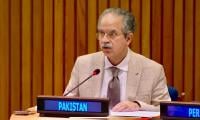 Some UNSC members ignoring broader reforms, seeking privilege: Pakistan
 -
 PAC body discusses non-recovery of Rs15bn gas cess
 -
 Pakistan received $2.29bn foreign loans in first 4 months of 2025