
SC moved for fixing pleas against 26th Amendment before full court
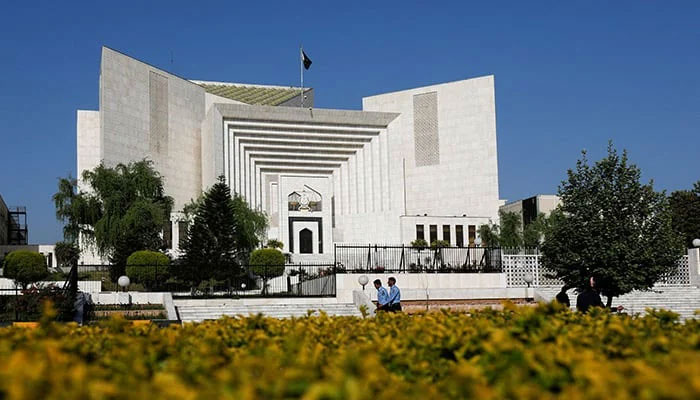
ISLAMABAD: A constitutional petition was filed in the Supreme Court on Thursday, seeking implementation of a majority decision of the committee established under the Supreme Court (Practice and Procedure) Act 2023, which directed the fixing of identical petitions—challenging the 26th Constitutional Amendment—before a full court.
The petition was filed in the apex court by Mustafa Nawaz Khokhar, a former senator and representative of Tehreek-e-Tahafuz-e-Aeen Pakistan, an alliance of political parties that advocates for the rule of law, independence of the judiciary and protection of the Constitution.
The petition was filed under Article 184(3) of the Constitution, naming the Registrar of the Supreme Court and the Federation of Pakistan (through the Secretary of the Ministry of Law and Justice) as respondents.
Mustafa Nawaz Khokhar prayed the apex court to declare that the decision of the committee constituted under Section 2 of the Supreme Court (Practice and Procedure) Act 2023—which directed the fixation of pending petitions before the Full Court—is binding and must be implemented forthwith.
The petitioner further prayed the apex court to direct the respondent, the law secretary, and all authorities concerned to immediately fix the pending petitions challenging the 26th Constitutional Amendment before the Full Court, in compliance with the committee’s decision dated 31 October, 2024.
Similarly, the petitioner prayed the apex court to declare that any administrative act or explanation negating or obstructing the implementation of the committee’s order is without lawful authority and of no legal effect.
The petitioner questioned whether the Supreme Court Practice and Procedure Act, 2023—intended to promote transparency, collegiality and institutional decision-making, as currently practiced—is consistent with the constitutional mandate of judicial independence and the enforcement of fundamental rights.
“Whether the orders passed by the committee constituted under Section 2(1) of the Act exist legally and are binding on the Office of the Supreme Court and all its functionaries,” the petitioner asked.
The petitioner further questioned whether the exercise of discretion by the Chief Justice of Pakistan in not implementing the orders of the committee—after informal consultation with non-member judges—was available to him under the law and consistent with the Constitution, the statute, and the principles of judicial transparency and collegiality.
“And whether the newly inserted Article 191A constitutes a valid reason for not implementing the orders of the Committee under the Act, which remains the only validly constituted committee under the law for the fixation of cases,” Khokhar questioned.





-
 State institutions ‘fail’ to perform constitutional duties: KP CM
 -
 CTD orders psychological testing of police on VVIP security duty
 -
 Navy busts drug consignment valued at $130m
 -
 Three ex-secretaries in race for ETPB chief post
 -
 Punjab govt forms 71 JITs to probe cases against banned TLP
 -
 Some UNSC members ignoring broader reforms, seeking privilege: Pakistan
 -
 PAC body discusses non-recovery of Rs15bn gas cess
 -
 Pakistan received $2.29bn foreign loans in first 4 months of 2025