
China unstoppable, says Xi with Shehbaz, Putin, Kim at his side
BEIJING: Chinese President Xi Jinping declared that the rejuvenation of the Chinese nation is “unstoppable” as the country marked the 80th anniversary of victory in its war of resistance against Japanese aggression and the World Anti-Fascist War.
Describing the war as “arduous and great,” Xi noted it was China’s first complete victory against foreign aggression in modern times. He made the remarks while addressing a grand commemorative gathering held in Beijing. Xi also holds the positions of General Secretary of the Communist Party of China (CPC) Central Committee and Chairman of the Central Military Commission.
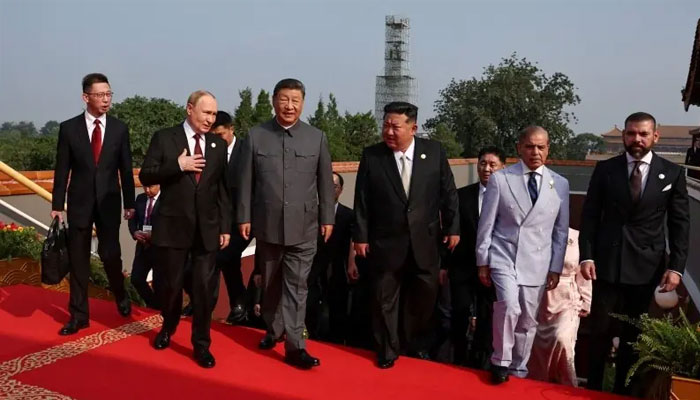
North Korean leader Kim Jong Un and Russia’s Vladimir Putin flanked Xi Jinping at a massive military parade in Beijing. In unprecedented scenes, Xi walked down a red carpet at Tiananmen Square with Putin to his right and Kim to his left, shaking hands and chatting with both leaders.
Kicking off the parade, Xi warned that the world was still “faced with a choice of peace or war.” He declared that China’s rise was “unstoppable.”
Xi said the victory was achieved through a national united front against Japanese aggression, as advocated by the CPC. He emphasised that the Chinese people had made a major contribution to saving human civilisation and defending world peace. This came at immense sacrifice and formed a significant part of the global Anti-Fascist War.
He stated that lasting peace could only be achieved when nations treated each other as equals, lived in harmony, and supported each other. According to Xi, this approach would safeguard common security, eliminate the root causes of war and prevent historical tragedies from recurring.
“Humanity is again faced with a choice — peace or war, dialogue or confrontation, win-win outcomes or zero-sum games,” Xi warned.
He affirmed that the Chinese people would continue to stand on the right side of history and human progress. They would follow the path of peaceful development and work with the rest of the world to build a shared future for humanity.
At the parade, China unveiled its growing military capabilities in a highly choreographed show of force. One of the highlights was the debut of the DF-5C intercontinental ballistic missile (ICBM), which reportedly has a range of over 20,000 kilometres. This could make it the longest-ranged missile in the world.
President Xi inspected the assembled troops and weaponry from an open-topped limousine as he travelled down Beijing’s Chang’an Avenue. After the inspection, he joined his guests in a seating area above a portrait of Mao Zedong at Tiananmen, the gate to the historic Forbidden City.
A large number of military vehicles and heavy weaponry rolled past the dignitaries. Slick state media broadcasts showed thousands of troops marching in perfect formation, jumping in and out of armoured vehicles, and showcasing new military technology.
Among the new hardware displayed were underwater drones, supersonic missiles, and the latest models of intercontinental ballistic missiles (ICBMs). Residents of Beijing came out onto the streets to witness a flypast involving dozens of warplanes and helicopters, some of which formed the number “80” in the sky.
The event commemorated the millions of Chinese who were killed during the prolonged war with Imperial Japan in the 1930s and 40s, which later became part of the global conflict following Japan’s 1941 attack on Pearl Harbor.
All eyes were on how Xi, Putin and Kim Jong Un interacted with each other. However, state media offered only brief glimpses of the three together. Foreign journalists were kept at a distance and were instructed not to film or photograph the leaders closely.
For the first time, China publicly displayed all types of its fifth-generation combat aircraft currently in active service. This marked the debut appearance of five different stealth fighter jet models in a single parade — a first in the world.
The showcased aircraft included the J-20, J-20A, J-20S, and J-35A of the People’s Liberation Army (PLA) Air Force, as well as the PLA Navy’s J-35. They flew past Tiananmen Square in several arrowhead-shaped formations, thrilling the audience at the conclusion of the 70-minute parade.
This also marked the maiden public appearance of the J-20S, the world’s first and only twin-seat stealth jet. Also on display were the J-20A, an upgraded single-seat variant of the J-20, and the J-35, China’s first radar-evading combat aircraft designed for carrier-based operations.
In another historic first, China unveiled its land-, sea-, and air-based nuclear deterrent in a concentrated formation, signalling the emergence of its strategic triad.
The parade featured the JL-1 air-launched long-range missile, the new JL-3 submarine-launched ballistic missile (SLBM), and upgraded land-based systems, including the DF-61 and DF-31BJ intercontinental ballistic missiles (ICBMs).
The highlight of this triad was the JL-3 SLBM, considered China’s next-generation submarine missile. With a reported range of approximately 10,000 kilometres, the JL-3 allows Chinese nuclear submarines to strike global targets from waters close to China’s coast. This greatly reduces the need for such vessels to venture into open oceans, where they are more vulnerable to detection.
China also introduced the DF-5C, a new liquid-fuelled ICBM. With an estimated range of over 20,000 kilometres, it potentially has the longest reach of any missile in the world. Unlike older models that required time-consuming preparation before launch, the DF-5C is modular, transported in three sections to shorten launch time.
Experts say the missile can carry multiple independently targetable warheads (MIRVs), decoys, and other counter-defence technologies, making interception more difficult. It uses a combination of inertial navigation, celestial tracking and the Beidou satellite system. This guidance enables a circular error probable (CEP) of just tens of metres — a remarkable level of accuracy for a missile with global reach.
The highly choreographed event provoked sharp reaction abroad. US President Donald Trump accused the three leaders of conspiring against the United States, stating on Truth Social: “Give my warmest regards to Vladimir Putin, and Kim Jong Un, as you conspire against The United States of America.”
The European Union’s foreign policy chief criticised the presence of Putin and Kim alongside Xi. She called it “a direct challenge to the international system built on rules.” “A new global order is in the making,” she warned.
Finland President Alexander Stubb has warned the West, especially the United States, that it risks “losing the game” to the Shanghai Cooperation Organisation (SCO) if it doesn’t adopt a more respectful and cooperative approach when it comes to foreign policy in the Global South, particularly towards countries like India.
“My message to you, my European colleagues, and particularly to the US, is that if we don’t engage in a more cohesive and dignified foreign policy, especially with regard to Global South countries such as India, we will lose,” Stubb said while speaking to reporters alongside his Lithuanian counterpart Gitanas Nauseda.
He pointed to last week’s SCO summit in China, which was attended by Prime Minister Narendra Modi and Russian premier Vladimir Putin, as a reminder of what is at stake. “I think this meeting in China (the 25th meeting of the SCO Heads of State Council) is a good reminder to the Global West of what is at stake. We are trying to preserve the remnants of the old order,” Stubb added. According to the Finnish President, the SCO is actively working to “weaken Western unity”.
Meanwhile, Prime Minister Shehbaz Sharif held a series of high-level meetings with executives from China’s leading enterprises in Beijing. His goal was to promote business-to-business (B2B) investment between the two countries. The meetings focused on expanding cooperation in key sectors. These included textiles, IT, agriculture, industry, mining, road and digital connectivity, e commerce, and space technologies.
During his visit to Beijing’s Anzhen Hospital, PM Shehbaz directed Interior Minister Mohsin Naqvi to establish simple, reliable, and sustainable infrastructure at Pakistan’s under-construction healthcare facilities. These include the Jinnah Medical Complex, which should model itself after China’s high standards.
Pakistan participated in its largest-ever B2B event under CPEC Phase-II, held on Thursday in Beijing. The gathering brings together 898 companies from both countries, with a focus on forging joint ventures, technology transfer, and deeper industrial collaboration.
According to senior officials, the event includes 343 Pakistani companies (represented by 579 delegates) and 549 Chinese firms. They are engaged in structured matchmaking sessions.
The SIFC has curated a set of priority sectors for the B2B meetings, including agriculture (87 companies), electric vehicles and auto parts (58), ICT, software and fintech (57), iron, steel and copper (37), chemicals and petrochemicals (28), solar and energy storage (32), textiles (35), leather (10), and real estate and development (12).
The objective is to connect Pakistani firms with Chinese partners who can bring capital, technology, and global supply chain access.
High-level government participation underscores the event’s importance. Prime Minister Shehbaz, Chief of Army Staff Field Marshal Syed Asim Munir, and Deputy PM Ishaq Dar are attending, backed by over 60 senior officials. These include ministers and secretaries from Planning, Commerce, Industries, and the Board of Investment. Federal Minister for Petroleum Ali Parvaiz Malik is focused on chemicals, petrochemicals, and mining sectors.
This event arrives at a critical economic juncture. In FY2024 25, Pakistan exported US $2.38 billion to China, while imports reached $16.31 billion. This resulted in a trade deficit exceeding $14 billion.
The previous year recorded a similar gap: exports at $2.56 billion, imports at $14.51 billion. Despite two Free Trade Agreements, Pakistani exports to China remain low, while imports of machinery, electronics, solar equipment, and telecom hardware continue to rise.
Experts say the issue isn’t market access, but market capacity.
“The FTA gives you market access, not market share,” said a senior official. “Pakistan has failed to leverage the Chinese market due to limited industrial depth, weak compliance with technical standards, and a lack of strategic export planning.”
There is hope that these B2B engagements will not only attract Chinese investment, but also embed Pakistani firms deeper into regional and global value chains—especially in high-growth sectors like electric vehicles, clean energy, software services, and agri-tech.
While the scale and ambition of this engagement are unprecedented, success hinges on follow-through. These are initial conversations, not finalised deals. Converting matchmaking into tangible investment will require more than enthusiasm. It will demand regulatory reforms, supportive industrial policy, land access in SEZs, and sustained improvements in Pakistan’s business climate. What distinguishes CPEC Phase-II is its aim to move beyond infrastructure and toward economic productivity. The focus is now on factories, farms, software parks, and supply chains. This strategic shift supports Pakistan’s goals of reducing imports, increasing exports, and creating skilled jobs. These aims are more complex but also more impactful than building power plants and highways.
If even a small fraction of the 898 proposed partnerships materialises, Pakistan could begin to rebalance its trade dynamics and unlock new sources of growth. Without deep institutional reforms and targeted exporter support, however, this opportunity may again fade behind high-profile optics.


-
 State institutions ‘fail’ to perform constitutional duties: KP CM
 -
 CTD orders psychological testing of police on VVIP security duty
 -
 Navy busts drug consignment valued at $130m
 -
 Three ex-secretaries in race for ETPB chief post
 -
 Punjab govt forms 71 JITs to probe cases against banned TLP
 -
 Some UNSC members ignoring broader reforms, seeking privilege: Pakistan
 -
 PAC body discusses non-recovery of Rs15bn gas cess
 -
 Pakistan received $2.29bn foreign loans in first 4 months of 2025