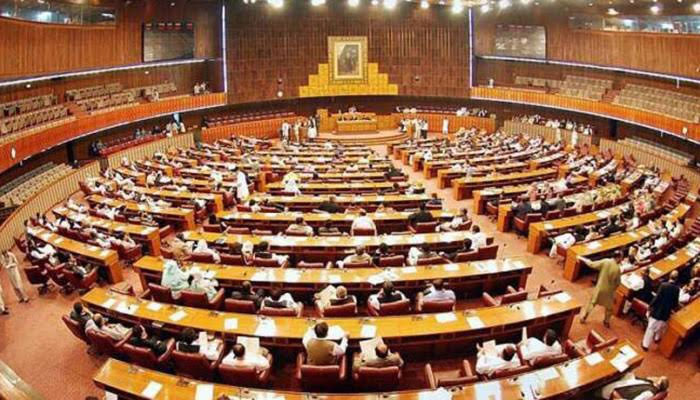
ISLAMABAD: The Senate Standing Committee on Finance and Revenues on Thursday directed the government to submit legal amendments to revoke the powers of regulatory bodies to increase employee salaries and perks through their policy boards.
The committee recommended that the Finance Division introduce changes to the laws governing all regulatory bodies—including the State Bank of Pakistan (SBP), Securities and Exchange Commission of Pakistan (SECP) and Pakistan Medical and Dental Council (PMDC). The aim is to restrict the authority to approve salary increases solely to the federal government, with parliament’s approval. The panel stressed that there should be no exceptions among the 18 regulatory bodies. It noted that state-owned enterprises (SOEs) follow similar rules and do not have independent powers to raise salaries.
The meeting, chaired by Senator Saleem Mandviwalla at the Parliament House, reviewed an audit report by the Auditor General of Pakistan regarding the SECP’s allocation of Rs267 million for employee salaries. The members expressed concern over the unchecked authority of regulatory bodies to increase pay. Currently, only three bodies—SECP, SBP and PMDC— can independently adjust salaries. The committee called for rationalising these powers and for their transfer to the federal cabinet and the prime minister. It recommended that the Finance Division submit the necessary legal amendments within one month.
The SECP chairman told the panel that the commission, under its Act, operates with administrative, financial, and functional independence. He added that the federal government is tasked with promoting and maintaining this independence. Senator Farooq Naek questioned whether the judiciary, including the Supreme Court and high courts, can increase their own salaries. The law secretary responded that judicial salaries are set by the president, based on the prime minister’s advice.
The committee was briefed by the Competition Commission of Pakistan (CCP) on its legal and enforcement progress. CCP Chairman Kabir Ahmed Sidhu said over 200 cartel and market dominance cases remain pending in the Supreme Court, involving key sectors like cement, sugar and energy. He noted that active follow-up had reduced the total case backlog from 567 to 280 in a year, recovering Rs449 million in fines.
The CCP inherited a backlog of over 567 cases due to a lack of quorum from March 2022 onwards. Following legal restructuring, the CCP decided 224 cases across forums: 121 by CAT, 40 by the Sindh High Court, 39 by the Lahore High Court, 13 by the Islamabad High Court, and 11 by the Supreme Court. In addition, 20 inquiries into cartelisation and abuse of dominance were completed, along with 18 inquiries into deceptive marketing practices. Fourteen enforcement orders were issued, imposing penalties of over Rs1 billion during the year.


-
 Aurangzeb confirms Saudi Arabia $10bn interest, says B2B shift ongoing
 -
 Pakistan to build artificial island to boost oil exploration
 -
 Special pink bus service launched for women on Green Line route
 -
 Same number plates from other provinces lead to wrong e-challans for Karachiites
 -
 State institutions ‘fail’ to perform constitutional duties: KP CM
 -
 CTD orders psychological testing of police on VVIP security duty
 -
 Navy busts drug consignment valued at $130m
 -
 Three ex-secretaries in race for ETPB chief post