As Pakistan marks its independence, we celebrate the resilience of a nation that has endured immense challenges.
However, for women, that independence remains incomplete. Their voices are still missing from the narratives that shape their own lives. In courts, survivors of sexual violence are forced to relive trauma only to have fingers pointed back at them. In property disputes, daughters and sisters are deprived of their rightful inheritance through manipulation and coercion.
Where remarriage fails as a reason, financial independence becomes an excuse to disqualify a mother from the custody of her children. In workplaces, women face harassment and discriminatory treatment. Across communities, honour killings are rampant in the name of tradition. Independence may have given us a state, but it has yet to guarantee women a voice.
Too often, the stories of women are narrated through others, typically their fathers, brothers or male judges, lawyers and bureaucrats, while their own words are lost. In rape trials, the perspective of the vengeful husband, brother, father or male relative is amplified through every step. It is bad enough when the victim is killed, but when she survives, the system makes it worse. She is forced to relive her assault and present her trauma in a language the system will accept. People are only outraged when the violence is too brutal to ignore, but by then it is too late for her.
Inheritance rights are guaranteed by religion and law, yet daughters and sisters are routinely sidelined. Women are pressured to gift their property to brothers, uncles or male relatives, coerced into signing documents or threatened into silence. The language used by families and even courts often reduces women to dependents of husbands or fathers, rather than recognising them as autonomous rights holders.
The same pattern is also evident in custody disputes. Courts interpret the law of hizanat to privilege fathers, even where mothers are primary caregivers. Working mothers are too busy. Financially independent mothers are too self-reliant. Single mothers lack male support. Meanwhile, a father’s income is enough to prove fitness. These decisions show how the law upholds patriarchy by treating autonomy as inadequacy.
Child marriage is another place where girls have no voice, even before they are grown. Despite child marriage laws in each province setting a minimum age, in reality, many girls far younger than even 16 are married off. And no one questions it.
In employment and civil service, women’s participation is framed through quotas rather than equal participation. Their promotions are often hindered by obstacles not faced by their male counterparts, and their pensionary entitlements are contingent upon marital status. This assumes that women always exist as dependents of men and parents rather than individuals in their own right.
The most brutal form of silencing is found in honour killings, where women are denied not only their voices but their own lives. The video of the recent killing in Balochistan captured the woman’s last words: a fragment of her story. The narrative in the public record was constructed entirely through others: her brother, who objected to her marriage; the elders ordering her death; and the state promising to deliver justice.
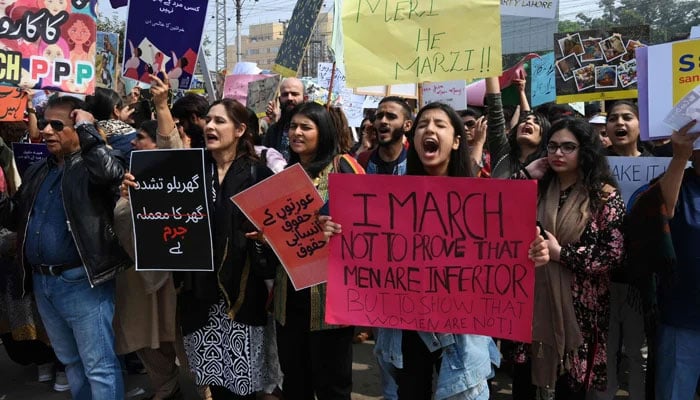
Across these areas, a structural flaw emerges: women’s stories are often told in the third person. Women are often seen as daughters, wives, mothers, or sisters, but rarely as individuals in their own right. We speak for her. We legislate for her. We defend her. But do we ever ask her what she wants?
Since 1947, Pakistan has made undeniable progress. Parliament has passed progressive laws on, among others, workplace harassment, sexual and domestic violence, child marriage, property and custody. Courts have penned judgments advocating gender equality and women’s autonomy. But the real question is whether these reforms are meant to genuinely change women’s lives or simply words to be publicised as proof of progress. One can only hope that decades from now, we are not still asking why women’s rights remain words on paper rather than lived realities.
The writer is a judicial law clerk at the Supreme Court of Pakistan.