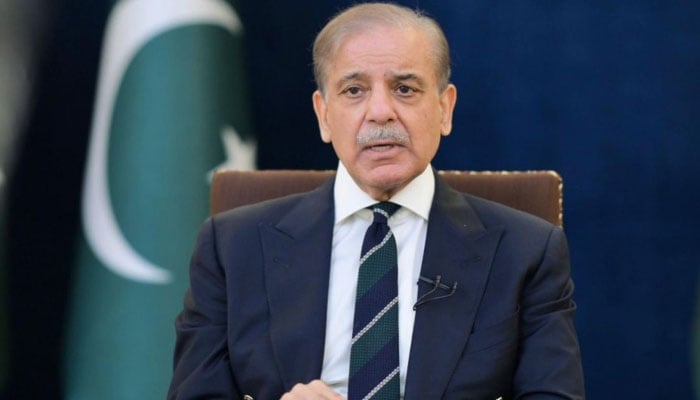
ISLAMABAD: Prime Minister Shehbaz Sharif on Tuesday said the country remains among the hardest-hit nations with regard to climate change, despite contributing very little to global emissions.
“The devastating floods of 2022, and the loss of over 700 lives due to extreme weather events this year alone are stark reminders that Pakistan cannot face this crisis alone,” he said, urging the international community to provide both technical and financial support.
The prime minister formally launched Pakistan’s New Energy Vehicle (NEV) Policy 2025-30 at a ceremony here. He called the policy a landmark initiative for clean transport, climate resilience, industrial transformation and youth empowerment. He said the new policy represents a national commitment to reducing emissions, promoting clean technology, and shifting to sustainable transport solutions. He applauded the efforts of Industries and Production Minister Haroon Akhtar Khan and Federal Minister Rana Tanvir Hussain for crafting, what he termed, “a comprehensive and forward-looking framework”. He also acknowledged the technical support extended by the British government and the UK High Commissioner in shaping the policy framework.
As part of the launch, the prime minister and federal ministers distributed e-scooters to a group of top-performing students from across Pakistan. The students had scored the highest marks in general science and medical at the intermediate level.
The prime minister reiterated that the distribution was strictly merit-based, with a 10 percent additional quota for students from Balochistan. He also announced that 100,000 laptops will soon be distributed to high achievers and proposed expanding the programme’s budget from Rs9 billion to Rs90 billion in the next fiscal year.
In his remarks, the industries and production minister described the NEV Policy 2025-30 as “not just a statement of intent, but a blueprint for Pakistan’s clean transport revolution.” He emphasised that the policy is part of a larger national strategy to cut fuel imports, drive innovation and empower youth.
“Pakistan spends billions annually on petroleum imports, while urban air pollution costs us over Rs105 billion in healthcare and productivity losses. We are moving beyond vehicle assembly to battery production, charging infrastructure and advanced parts manufacturing,” Akhtar said.
Meanwhile, chairing the progress review meeting on faceless appraisal of Customs, the prime minister directed the relevant authorities to ensure transparency by integrating the Customs inspection and assessment system with modern technology and making it faceless.
Prime Minister Shehbaz Sharif called for minimising delays in inspection and assessment procedures, ensuring coordination among relevant institutions, and aligning reforms with international best practices. The PM also called for a transparent appeal system and faster cargo movement from ports to destinations.
Officials briefed the meeting on progress, including the upcoming launch of an AI-based risk management system to speed up Customs clearance.
Meanwhile, during a call-on paid by Chief of Air Staff Air Chief Marshal Zaheer Ahmed Baber Sidhu, the prime minister paid glowing tribute to the Pakistan Air Force (PAF) for its outstanding role in safeguarding the country’s sovereignty and territorial integrity.
Acknowledging the PAF’s legacy of courage and professionalism, Shehbaz said the “valiant Shaheens of the Pakistan Air Force stand as an impregnable shield in the defence of our motherland”. He added that during the decisive battles of the nation’s history, the PAF dealt telling blows to the adversary, including shooting down enemy aircraft in combat. The meeting also reviewed professional matters relating to the PAF, with both sides reiterating their commitment to strengthening Pakistan’s aerial defence capabilities.
Meanwhile, in a statement, the prime minister lauded the officers and personnel of the Counter-Terrorism Department (CTD) and police for their professionalism and bravery during a successful security operation in Lower Dir, where nine militants were neutralised. Referring to the militants as “Fitna-ul-Khawarij”, he congratulated the security agencies for thwarting what he described as their “evil intentions.”


-
 Aurangzeb confirms Saudi Arabia $10bn interest, says B2B shift ongoing
 -
 Pakistan to build artificial island to boost oil exploration
 -
 Special pink bus service launched for women on Green Line route
 -
 Same number plates from other provinces lead to wrong e-challans for Karachiites
 -
 State institutions ‘fail’ to perform constitutional duties: KP CM
 -
 CTD orders psychological testing of police on VVIP security duty
 -
 Navy busts drug consignment valued at $130m
 -
 Three ex-secretaries in race for ETPB chief post