Famine strikes
History shows that famines are, for the most part, engineered. Be it through carelessness, selfishness or plain malice on the part of officialdom, creating the circumstances under which a population expires to hunger is a matter of construction. As the economist and Nobel Laureate Amartya Sen so powerfully showed in Poverty and Famines: An Essay on Entitlement and Deprivation (1981), the focus on the cause of famines should be less on the food supply and more on the economic, social and political factors surrounding them. Food prices might severely spike. Food distribution systems can fail. Certain groups in society may lose their means of employment, thereby preventing them from purchasing essential foodstuffs.
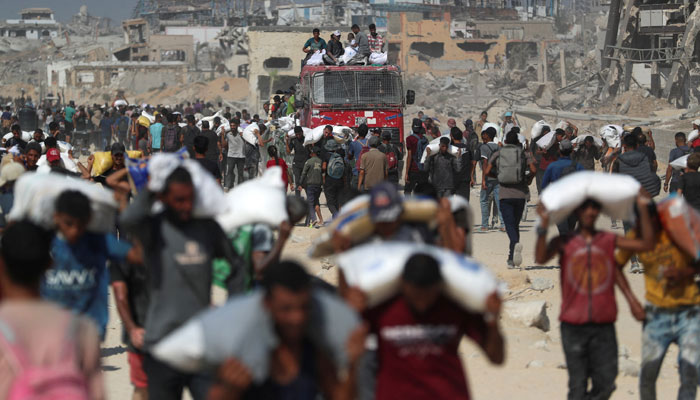
In Gaza, the conditions of famine have been in the making for months. From March, when the Netanyahu government purposely halted all food from entering Gaza, only to ease the blockade in May through a handful of food distribution points murderously overseen by the Israeli Defense Forces and the Gaza Humanitarian Foundation, the only question was when that ghastly outcome would be realised. “As was the case for the UK government in Ireland in the 1840s and Bengal in the 1940s, Israel is responsible for this famine because it controls almost all the Gaza strip and its borders,” writes Ilan Noy, an expert on the economics of disasters and climate change. “But Israel has also created the conditions for the famine.”
By the end of July, the New York Times, citing data from the Gaza Governorate Chamber of Commerce and Industry, listed a number of basic food items that had become obscenely priced: sugar, costing $106 per kilogram, as opposed to 89 cents prior to the war; flour, costing $12 per kilogram compared with the pre-war price of 42 cents; and tomatoes: $30 per kilogram, a shocking increase from the pre-war level of 59 cents. Hebrew University academic and economic historian Yanni Spitzer, casting his eye over the soaring food prices, observed that the situation had shifted from the start of the war, given the testimonies coming from the Strip.
On August 22, the Integrated Food Security Phase Classification (IPC) Famine Review Committee (FRC) published a report claiming that 514,000 people – a roughly a quarter of Gaza’s population – faced famine conditions for the period July 1 to August 15, described in technical terms as IPC Phase 5. The body defines IPC 5 as “the highest phase of the IPC Acute Food Insecurity Scale, and is attributed when an area has at least 20% of households facing an extreme lack of food, at least 30% of children suffering from acute malnutrition, and two people for every 10,000 dying each day due to outright starvation or to the interaction of malnutrition and disease.” The Committee was satisfied that reasonable evidence was available showing that the IPC Phase 5 conditions were affecting the Gaza Governorate.
Excerpted: ‘Making it Official: Famine Strikes Gaza City’. Courtesy: Counterpunch.org