Parliamentary proceedings: AG urges Senate to allow conditional judicial review

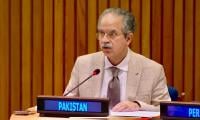
ISLAMABAD: Attorney General for Pakistan Mansoor Usman Awan Monday urged the Senate to ‘conditionally’ keep the doors open for judicial review of parliamentary proceedings.
He made appearance in the House after the chair summoned him a few weeks back for an explanation on the alleged interference of the judiciary in the internal parliamentary processes. The matter was raised by the PPP’s Saleem Mandviwala and some other members.
Awan referred to Article 69 of the Constitution under which the validity of any proceedings in the parliament cannot be called in question on the ground of any irregularity of procedure, but insisted that the bar was not absolute.
He believed that there was a lot of sanctity attached to it, but it was not absolute and referred to April 4, 2022 judgment of the Supreme Court, declaring unconstitutional the ruling of the then deputy speaker of the National Assembly on the no-confidence motion against the then prime minister Imran Khan.
The attorney general recalled that the PPP was also a petitioner and he himself and Barrister Ali Zafar appeared before the court as counsel. “Now in those circumstances it becomes very important to leave that door open, because sometimes matters could bring everything not just to standstill but produce consequences which may not have any resolution within the House,” he contended.
In this particular case, he pointed out that as the ruling came out, the assembly was dissolved and wondered where the members would have gone. Obviously, they had to go to the court and the court did interfere, he explained.
His statement came after his discussion with former deputy chairman Senate SaleemMandviwala. Earlier, Mandviwala informed the House that he had briefed the attorney general on how the high courts were interfering in the proceedings of the House, issuing stay orders against the proceedings of standing committees even before a decision had been taken.
Taking the floor, PTI parliamentary leader Barrister Syed Ali Zafar also emphasized that the standing committees were an extension of the parliament and under the Constitution, there was no room for grant of stay against their proceedings.
He noted that there should not be an institutional clash and a solution should be found out. He contended that that the attorney general had wrongly interpreted the Constitution and noted the courts could intervene, where something was not being done in accordance with the clear constitutional provisions.
However, he made it clear that the internal proceedings of the House and the committees could not be touched. “We are sovereign and not subordinate to the courts,” he remarked. About the stay orders against the proceedings of parliamentary committees, the attorney general assured the members that a solution could be found out. He said certain amendments in rules of procedure and conduct of business might be required.
Law Minister Azam Nazeer Tarar rose to fully endorse the remarks made by PTI leader Ali Zafar and underlined that the principles of trichotomy of powers must be followed by all. He maintained that how the country was to be run was ultimately for the parliament to decide, which had the exclusive domain of legislation.
Senator Zamir Ghumro of PPP and Senator Kamran Murtaza of JUI-F also termed judicial interference a violation of Article 69 of the Constitution and urged strict adherence to the concept of tri-chotomy of power. Kamran Murtaza believed that the law offices had perhaps not pointed out Article 69 to the court, which issued stay orders.
Meanwhile, the lawmakers traded charges of incompetence and political point-scoring on the devastation caused by flash floods and cloud bursts in Khyber Pakhtunkhwa and elsewhere.
Those who took part in the discussion, held on a motion, moved by PTI’s Mohsin Aziz, included Sherry Rehman, Aon Abbas Bappi, Rubina Khalid, Sarmad Ali, Mirza Afridi and Aimal Wali Khan, who also complained his speech from the previous sitting was edited and then uploaded.
“This is the situation of expressing opinions. This is an insult to the Senate. This is an insult to me. If I want, I can go to court,” he remarked. Some members questioned the much-touted ‘billion tree tsunami’ project of then PTI government and wanted probe into it.
Minister for Parliamentary Affairs Dr. Tariq Fazal Chaudhry made it clear that no politics was being played on the issue. He said this while winding up the debate and in response to some criticism made by PTI senators including Falak Naz and Rubina Naz, who alleged that the federal government and the National Disaster Management Authority had given a slow response in relief efforts after the catastrophic floods that mostly affected Khyber Pakhtunkhwa.
The minister said the federal government was showing its complete responsibility in dealing with the disaster. Referring to a statement of KP Chief Minister Ali Amin Gandapur that they had sufficient resources to carry out relief operations, he said it was the collective responsibility of everyone, including the federation and the provinces and everyone had responded effectively in this disaster.
He also shared the details of the losses from June 27 to August 17 and noted that 675 people lost their lives, and 929 were injured while 2,462 houses were damaged and 1,000 animals were affected by the deluge.
He urged the provinces to generate maximum resources for people to protect them from these natural disasters. The minister contended, “Illegal constructions in riverbeds and natural water channels have caused devastation”.
He emphasized that the federal government was utilizing all resources to provide blankets, generators and other aid to the people in flood-affected areas, especially in worst-hit nine districts of KP.
He continued that troops and paramilitary forces that come under the administrative control of federal government were also engaged in relief operations. He added that Prime Minister Shehbaz Sharif would also undertake a visit to the affected areas very soon.
The criticism, unleashed by the senators on the NDMA, he insisted, was unnecessary, as some areas did not come under the domain of the authority. He explained that the primary duty of the authority was to provide prior information and data on extreme weather to the provinces and the provincial disaster management authorities (PDMAs).
“The NDMA has issued 28 advisories and seven alerts and is providing necessary support to PDMAs,” he maintained. Earlier, legislators from across the aisle in the House expressed grave concern over the alarming increase in case of gender-based violence in the country and called for effective implementation of the law, strengthening prosecution and changing the mindset.
PPP Vice-President Sherry Rehman tabled her motion that the House may discuss the alarming increase in cases of Gender Based Violence (GBV) in the country and failure of administrative and judicial machinery to administer justice to women.
Expressing grave concern over the alarming rise in GBV cases and the state’s failure to ensure justice for survivors, she cited the latest report by the Sustainable Social Development Organization (SSDO, 2024) and said: “In 2024 alone, a staggering 32,617 cases of gender-based violence were reported across Pakistan. These included 5,339 incidents of rape, 24,439 cases of kidnapping and abduction, 2,238 cases of domestic violence, and 547 so-called honour killings. These are not mere statistics — they represent shattered lives, devastated families, and survivors abandoned by the system. This is low reporting as compared to the real numbers”.
She noted that the report says that despite the shocking scale of violence, justice remains elusive. She said honour killings conviction rate was less than 0.5%, while rape conviction was less than 0.5%, kidnapping/abduction conviction rate 0.1%, and domestic violence conviction rate 1.3% (SSDO, 2024).
“Shockingly, overall conviction rate is 5%, while 64% of accused are acquitted (Law and Justice Commission of Pakistan, 2023). Meanwhile, according to the Human Rights Watch, 70% of GBV cases go unreported for fear of retaliation, lack of trust in law-enforcement, stigma, and societal victim-blaming. These are highly disappointing and shocking numbers”.
Senator Rehman stressed that this impunity translates into daily violence across Pakistan and noted every day, on average, 67 kidnappings, 19 rapes, 6 cases of domestic violence, and 2 honour killings were reported. And yet, the conviction rates remain abysmally low, emboldening perpetrators and silencing survivors. This is a collapse of accountability and a shameful indictment of our institutions.
She also criticised institutional failures despite government claims of reform. She regretted that even after the establishment of 480 special courts for GBV cases, justice was still denied. Calling for immediate reform, Senator Rehman urged the parliament to act without delay, as the state’s indifference towards crimes against women was unacceptable. Speaking on the motion, Senator Barrister Ali Zafar said cases of gender violence were being hidden, which was why this trend was increasing.
“We have many laws, the real issue is the lack of conviction/punishment,” he said. He said when punishment was not given, the accused thought that no one could touch them and hence they thought they had immunity to do whatever they wanted to. “Therefore, the real issue comes up is of the law’s implementation,” he noted.
Ali Zafar insisted that there was a need to evolve a mechanism to find out what kind of probe was conducted and punishment given after the trial. He suggested that the House committee on law and justice should monitor GBV-related cases’ progress.
Danesh Kumar said that people do not go to the law for fear of honor and suggested that the state should come forward in sensitive cases. Responding to the motion, Law Minister Azam Nazeer Tarar said the statistics given in the House were undoubtedly alarming.
“Legislation should be made with caution; there is no shortage of laws on the subject being discussed. Innocent girls are being killed in the name of honor,” he said. He said apart from all the punishments, it was about the mindset and attitudes.
“There is no shortage of laws in such matters or cases; in many cases of honor killings, relatives have forgiven the accused,” he said. The law minister said legislation was made in such cases that despite reconciliation, punishment will be given for the act.
“We also lack education and awareness; honor killing is not permitted in Sharia.” “I said the issue is about the mindset and attitudes. We also lack education and awareness. Honor killing is not allowed in Sharia but it is an ego problem for men,” he noted. The Senate referred the matter to the relevant standing committee.


-
 Aurangzeb confirms Saudi Arabia $10bn interest, says B2B shift ongoing
 -
 Pakistan to build artificial island to boost oil exploration
 -
 Special pink bus service launched for women on Green Line route
 -
 Same number plates from other provinces lead to wrong e-challans for Karachiites
 -
 State institutions ‘fail’ to perform constitutional duties: KP CM
 -
 CTD orders psychological testing of police on VVIP security duty
 -
 Navy busts drug consignment valued at $130m
 -
 Three ex-secretaries in race for ETPB chief post