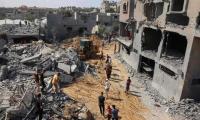
Amid Israel’s ongoing genocidal war on Gaza with the possibility of an immediate ceasefire becoming even more distant, the High-Level International Conference for the Peaceful Settlement of the Question of Palestine and the Implementation of the Two-State Solution was organised from July 28 to July 30, 2025 under the authority of the United Nations General Assembly resolutions.
Co-chaired by France and Saudi Arabia at the foreign ministers’ level, the conference attracted massive participation, with 160 out of 193 member countries of the UN attending; out of these, 125 countries extended their full support to the idea of the two-state solution to find lasting peace in the Middle East. About 40 to 50 participating countries were represented by their ministers, including Deputy Prime Minister/Foreign Minister Senator Ishaq Dar.
Originally scheduled to be held in June, the conference was postponed after the Israeli attack on Iran, which many analysts interpreted as Netanyahu’s attempt to derail the international gathering.
The conference comprised eight thematic working groups on a sovereign and unified Palestinian state living side by side in peace and security with Israel; security for Israelis and Palestinians; narrative for peace; economic viability of the Palestinian State; humanitarian action and reconstruction; preserving the two-state solution; promoting respect for international law to implement the two-state solution and Peace Day effort.
These working groups held preparatory meetings to develop and finalise proposals that fed into the thematic roundtables and informed the discussions during the plenary sessions.
The three-day conference concluded with the adoption of the New York Declaration that outlines a structured and phased pathway to the establishment of an independent, governable Palestinian state. The co-chairs have presented the declaration to the member countries, which have until early September to endorse it.
The declaration seeks to address some of the critical questions surrounding the governance and security framework of the Palestinian state, institutional support and capacity building, and the protection of Jerusalem’s holy places. It describes the recognition of Palestine as an essential step towards the revival of the two-state solution and urges the remainder of the UN member states to do so. Besides putting the Palestinian Authority (PAT) at the helm of governance over the whole of the Palestinian territory, it proposes the establishment of a temporary UN-stabilisation mission with a mandate to protect civilians, support the PA in the transition process and monitor the ceasefire agreement.
The declaration, among other things, also highlights the centrality of Gaza to the establishment of an independent state of Palestine, terming the Strip as an inseparable and integral part of the future state. Opposing the continued blockade, occupation and forced displacement of Palestinians, it calls for an immediate ceasefire in Gaza, followed by the establishment of a PA-led transitional administrative committee.
The New York Declaration also provides for a special committee, comprising nineteen countries, the co-chairs as well as the chairs of the eight working groups, to follow up on the implementation of the commitments.
In what is clearly a significant and unprecedented development, the declaration demands of Hamas, with the full backing of the 22-member Arab League, to disarm itself and hand over the authority in Gaza to the PA.
What added to the momentum and importance of the conference were consecutive announcements by France, the UK and Canada to recognise Palestine in September, conditions spelt out by the UK and Canada notwithstanding.
These announcements reflect a visible shift in the position of key G7 countries towards Israel, indicating the extent of Tel Aviv’s isolation propelled by the grave human rights violations including that of the international law, Fourth Geneva Convention and international humanitarian law as well as the use of starvation as a weapon of war.
The recent approval by the Israeli cabinet of a plan to take over full control of Gaza has fueled global anger and condemnation of the Netanyahu government, leading to reinforced calls for a meaningful exploration of the two-state solution as a means to end the perpetual crisis in the Middle East.
Israel’s growing isolation is also evidenced by a series of actions undertaken by the EU countries. So far, Germany, Italy, Spain, Norway, Ireland and the Netherlands have either halted or placed restrictions on military exports to Israel. Pushed by Spain and Ireland and backed by other states, the European Commission has initiated a formal review of the EU-Israel trade agreement.
The Netherlands invoked the ongoing human rights violations in Gaza to designate Israel as a national security risk. It also placed targeted sanctions and travel bans on Itamar Ben-Gvir as well as Bezalel Smotrich, two key ministers in the Netanyahu government, with Slovenia also declaring them as personae non gratae. With France and Portugal set to recognise Palestine, Spain, Slovenia, Norway and Ireland have already done so recently.
The UN conferences, often criticised for being ineffectual and focused more on optics than substance, are nevertheless significant as they provide a platform to member countries to voice their opinions and forge consensus on issues vital to international peace and security.
The conference on the two-state solution went a step ahead. It led to the following game-changing outcomes that will shape the dynamics in the Middle East and beyond, especially concerning the Palestinian Question.
First and foremost, it represented a collective endeavour of the international community to breathe new life into the two-state solution at a time when certain voices from within Israel and elsewhere are questioning the efficacy of this formula. It was also a show of confidence in the potential of the two-state solution framework to bring the protracted Israel-Palestine conflict to an end.
Second, the New York Declaration represents a win for multilateral diplomacy, as all endorsers will become participants in the decision-making process. At a time when the whole edifice of multilateralism is being challenged by the forces of popular nationalism, unilateralism, and apartheid states like Israel, a pathway to the implementation of the two-state solution offers a glimmer of hope if followed through concerted global follow-up and robust oversight.
Third, the conference provided much-needed moral clarity. The overwhelming support for the two-state solution shown by the member countries demonstrates which side they are on. By standing up for the Palestinians’ right to have an independent state, as mandated by the UN Charter and UNSC resolutions, a broader membership of the UN has upheld the foundational principle of self-determination. Support for the two-state solution, in this context, becomes an expression of justice, humanity and political morality.
Fourth, members from the G7 and the European Union are openly expressing their intention to recognise the Palestinian State and advocating the two-state solution. These countries are traditional allies of Israel but have been repelled by the level of brutality and impunity displayed by the extreme right-wing Israeli government in Gaza. The development will suck the political oxygen out of Israel and force it to see the writing on the wall.
Fifth, increased support from G-7 countries will influence the dynamics within the UN Security Council as well as the General Assembly, including the voting pattern and strengthen the voices of the Arab world and Global South calling for accountability of Israel for its war crimes. There are also reasons to believe that the voices calling for action against Netanyahu, Israeli occupation and apartheid and war crimes will become stronger at the legal forums such as the International Court of Justice.
In the same way, the calls for greater travel bans, targeted sanctions and trade and arms restrictions will impose a freeze on Israel’s expansion plans and hold its leaders accountable.
Sixth, the fact that France and Saudi Arabia got together to actively push through the two-state solution represents renewed consensus between Global South/Arab/OIC and EU/G7 groupings. It is also a powerful message to the Palestinian people that they are not alone in their just and legitimate struggle for the right to self-determination. Notwithstanding the realities of the predatory global power dynamics, much of the world supports their legitimate aspirations.
The overall message from the Two-State Solution Conference is that the world doesn’t believe in Israeli lies and propaganda anymore. The brutal Israeli actions and genocidal policies have led to erosion of support for it in the Western democracies.
The two-state solution is not just a figment of imagination but a relevant political framework that is capable of delivering a solution to a decades-old dispute. It is an acid test for the multilateral system to reassert its primacy by ensuring that the era of impunity is coming to an end.
The writer is an alumnus of the University of Sussex and has a degree in international journalism. He tweets/posts @Amanat222